372 posters, 1 audios, 13 topics, 29 sessions, 1,035 authors, 449 institutions
ePostersLive by SciGen Technologies S.A. All rights reserved.
51st Annual Regional Anesthesiology and Acute Pain Medicine Meeting
April 16 - 18, 2026 | Phoenix, Arizona

2316875
Total Hip Arthroplasty Patients Requiring Acute Pain Service Consultations: A Registry Study
Poster Presenter
Authors
Maya Tailor, Junying Wang, William Chan, Mary Kelly, Jennifer Terry, Dae Kim, Spencer Liu, Stavros Memtsoudis, Jiabin Liu, Jashvant Poeran, Seth Waldman, Daniel Maalouf, Yuhua Bao, Faye Rim, Alexandra Sideris
Affiliations
Hospital for Special Surgery, Pain Prevention Research Center, Department of Anesthesiology, Critical Care, and Pain Management, Hospital for Special Surgery, Center for Analytics, Modeling, and Performance (CAMP), Hospital for Special Surgery, Department of Population Health Sciences, Weill Cornell Medical College
Part of Topic
Scientific Abstracts > Acute Pain
#2316875 Total Hip Arthroplasty Patients Requiring Acute Pain Service Consultations: A Registry Study
Maya Tailor, BA1,2, Junying Wang, PhD1,2, William Chan, M. Eng1,2, Mary Kelly, DNP1,2, Jennifer Terry, BBA3, Dae Kim, MD1,2,4, Spencer Liu, MD1,2,4, Stavros Memtsoudis, MD, PhD, MBA1,2,4, Jiabin Liu, MD, PhD, FASA1,2,4, Jashvant Poeran, MD, PhD1,2, Seth Waldman, MD1,2,4, Daniel Maalouf, MD, MPH1,2,4, Yuhua Bao, PhD5, Faye Rim, MD, FAAPMR1,2,4, Alexandra Sideris, PhD1,2,4
1Department of Anesthesiology, Critical Care, and Pain Management, Hospital for Special Surgery, New York, NY, USA; 2Pain Prevention Research Center, Department of Anesthesiology, Critical Care, and Pain Management, Hospital for Special Surgery, New York, NY, USA; 3Center for Analytics, Modeling, and Performance (CAMP), Hospital for Special Surgery, New York, New York, USA; 4Department of Anesthesiology, Weill Cornell Medicine, New York, NY, USA; 5Department of Population Health Sciences, Weill Cornell Medical College, New York, New York, USA
Introduction
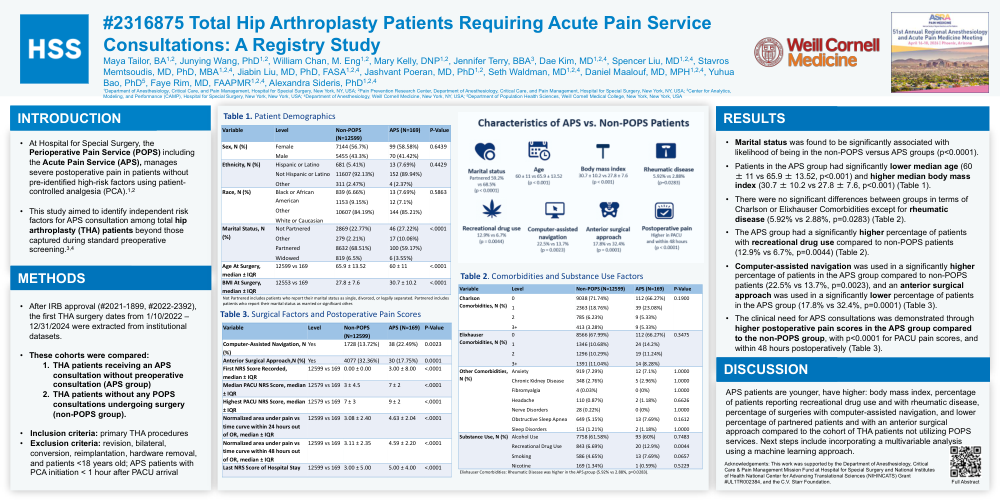
At the Hospital for Special Surgery, the Perioperative Pain Service (POPS) includes the Acute Pain Service (APS), which manages severe, emergent post-surgical pain by placing and managing patient-controlled analgesia (PCA) pumps in patients without known risk factors for uncontrolled post-surgical pain.1,2 The aim of this study was to identify risk factors among total hip arthroplasty (THA) patients requiring an APS consultation that are independent of the risk factors that are flagged for preoperative consultations.3,4
Methods
After IRB approval (#2021-1899, #2022-2392), the first surgery date from THA patients between 1/10/2022 – 12/31/2024 were extracted from institutional datasets. Inclusion criteria were patients undergoing THA, and exclusion criteria were surgeries that included revision, bilateral, conversion, reimplantation, hardware removal, and patients <18 years old. This study compared two groups: 1) THA patients receiving an APS consultation without preoperative consultation (APS group) and 2) THA patients without any POPS consultations undergoing surgery (non-POPS group). For the APS group, patients with PCA start times less than 1 hour after post-anesthesia care unit (PACU) entry were excluded. Categorical and continuous variables were analyzed using Chi-squared tests and Wilcoxon rank sum tests, respectively. All analyses were conducted at a significance level of 0.05 using SAS 9.4.
Results
There were 169 patients in the APS group and 12,599 in the non-POPS group. For patient demographics, marital status was found to be significantly associated with likelihood of being in the non-POPS versus APS groups (p<0.0001). Patients in the APS group had significantly lower median age (60 ± 11 vs 65.9 ± 13.52, p<0.001) and higher median body mass index (30.7 ± 10.2 vs 27.8 ± 7.6, p<0.001) (Table 1). There were no significant differences between groups in terms of Charlson or Elixhauser Comorbidities except for Rheumatic disease (5.92% vs 2.88%, p=0.0283) (Table 2). The APS group had a significantly higher percentage of patients with recreational drug use compared to non-POPS patients (12.9% vs 6.7%, p=0.0044) (Table 2). Computer-assisted navigation was used in a significantly higher percentage of patients in the APS group compared to non-POPS patients (22.5% vs 13.7%, p=0.0023), and an anterior surgical approach was used in a significantly lower percentage of patients in the APS group (17.8% vs 32.4%, p=0.0001) (Table 3). The clinical need for APS consultations was demonstrated through higher postoperative pain scores in the APS group compared to the non-POPS group, with p<0.0001 for PACU pain scores, and within 48 hours postoperatively (Table 3).
Discussion
These data highlight risk factors in THA patients requiring postoperative APS consultations at our institution. APS patients are younger, have higher: body mass index, percentage of patients reporting recreational drug use and with rheumatic disease, percentage of surgeries with computer-assisted navigation, and lower percentage of partnered patients and with an anterior surgical approach compared to the cohort of THA patients not utilizing POPS services. Next steps include incorporating a multivariable analysis using a machine learning approach.