372 posters, 1 audios, 13 topics, 29 sessions, 1,035 authors, 449 institutions
ePostersLive by SciGen Technologies S.A. All rights reserved.
51st Annual Regional Anesthesiology and Acute Pain Medicine Meeting
April 16 - 18, 2026 | Phoenix, Arizona

2316606
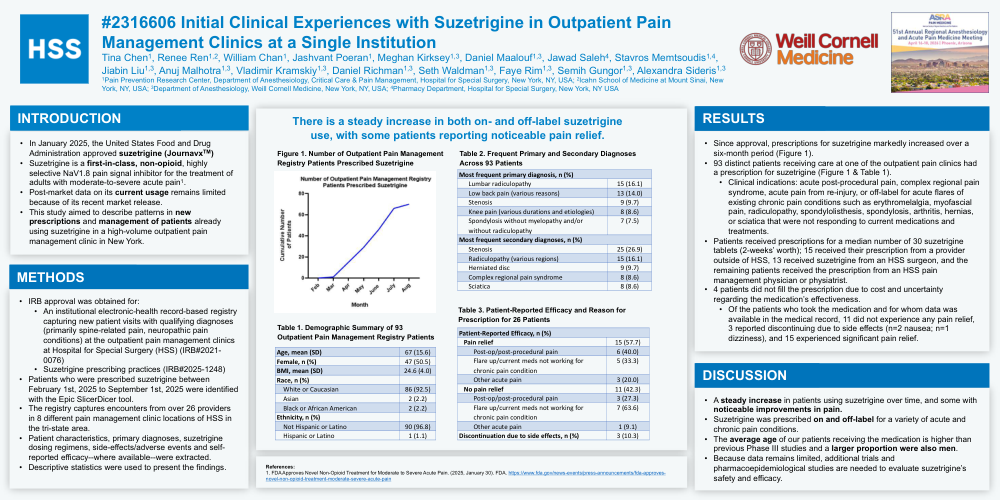
Initial Clinical Experiences with Suzetrigine In Outpatient Pain Management Clinics at a Single Institution
Poster Presenter
Authors
Tina Chen, Renee Ren, William Chan, Jashvant Poeran, Meghan Kirksey, Daniel Maalouf, Jawad Saleh, Stavros Memtsoudis, Jiabin Liu, Anuj Malhotra, Vladimir Kramskiy, Daniel Richman, Seth Waldman, Faye Rim, Semih Gungor, Alexandra Sideris
Affiliations
Hospital for Special Surgery, Department of Anesthesiology, Critical Care & Pain Management, Hospital for Special Surgery, New York, NY, USA, Pharmacy Department, Hospital for Special Surgery, New York, NY USA
Part of Topic
Scientific Abstracts > Chronic Pain
Title: Initial Clinical Experiences with Suzetrigine In Outpatient Pain Management Clinics at a Single Institution
Authors: Chen T1, Ren R1,2, Chan W1, Poeran J1, Kirksey M1,4, Maalouf D1,4, Saleh J3, Memtsoudis S1,4, Liu J1,4, Malhotra A1,4, Kramskiy V1,4, Richman D1,4, Waldman S1,4, Rim F1,4, Gungor S1,4, Sideris A1,4
1Pain Prevention Research Center Department of Anesthesiology, Critical Care & Pain Management, Hospital for Special Surgery, New York, NY, USA
2 Icahn School of Medicine at Mount Sinai, New York, NY, USA
3 Pharmacy Department, Hospital for Special Surgery, New York, NY USA
4 Department of Anesthesiology, Weill Cornell Medicine, New York, NY, USA
Introduction
The United States Food and Drug Administration approved Suzetrigine (JournavxTM) in January 2025, representing a first-in-class, non-opioid, highly selective NaV1.8 pain signal inhibitor for the treatment of adults with moderate-to-severe acute pain1. Because of its recent market release, data on its current usage remains limited. Therefore, this study aimed to describe patterns in new prescriptions and management of patients already using Suzetrigine in a high-volume outpatient pain management clinic in New York.
Materials & Methods
After IRB approval for an institutional electronic-health record-based registry capturing new patient visits with qualifying diagnoses (primarily spine-related pain, neuropathic pain conditions) at the outpatient pain management clinics at Hospital for Special Surgery (HSS) and Suzetrigine prescribing practices (IRB#2021-0076 & IRB#2025-1248), patients who were prescribed Suzetrigine between February 1st, 2025 to September 1st, 2025 were identified with the Epic SlicerDicer tool. The registry captures encounters from over 26 providers in 8 different pain management clinic locations of HSS in the tri-state area. Patient characteristics, primary diagnoses, Suzetrigine dosing regimens, side-effects/adverse events and self-reported efficacy--where available--were extracted. Descriptive statistics were used to present the findings.
Results
Since approval, prescriptions for Suzetrigine markedly increased over a six-month period (Figure 1). A total of 93 distinct patients receiving care at one of the outpatient pain clinics had a prescription for Suzetrigine (Figure 1 & Table 1). Clinical indications included acute post-procedural pain, complex regional pain syndrome, acute pain from re-injury, or off-label for acute flares of existing chronic pain conditions such as erythromelalgia, myofascial pain, radiculopathy, spondylolisthesis, spondylosis, arthritis, hernias, or sciatica that were not responding to current medications and treatments. Patients received prescriptions for a median number of thirty Suzetrigine tablets (2-weeks’ worth); fifteen received their prescription from a provider outside of HSS, thirteen received Suzetrigine from an HSS surgeon, and the remaining patients received the prescription from an HSS pain management physician or physiatrist. Four patients did not fill the prescription due to cost and uncertainty regarding the medication’s effectiveness. Of the patients who took the medication and for whom data was available in the medical record, eleven did not experience any pain relief, three reported discontinuing due to side effects (n=2 nausea; n=1 dizziness), and fifteen experienced significant pain relief.
Discussion
Our findings showed a steady increase in patients using Suzetrigine over time, and some with noticeable improvements in pain. Suzetrigine was prescribed on and off-label for a variety of acute and chronic pain conditions. The average age of our patients receiving the medication is higher than previous Phase III studies and a larger proportion were also men. Because data remains limited, additional trials and pharmacoepidemiological studies are needed to evaluate Suzetrigine’s safety and efficacy.
References
- 1. FDA Approves Novel Non-Opioid Treatment for Moderate to Severe Acute Pain. (2025, January 30). FDA. https://www.fda.gov/news-events/press-announcements/fda-approves-novel-non-opioid-treatment-moderate-severe-acute-pain
Figure 1. Number of Outpatient Pain Management Registry Patients Prescribed Suzetrigine
Table 1. Demographic Summary of 93 Outpatient Pain Management Registry Patients
|
Age, mean (SD) |
67 (15.6) |
|
Female, n (%) |
47 (50.5) |
|
BMI, mean (SD) |
24.6 (4.0) |
|
Race, n (%) |
|
|
White or Caucasian |
86 (92.5) |
|
Asian |
2 (2.2) |
|
Black or African American |
2 (2.2) |
|
Ethnicity, n (%) |
|
|
Not Hispanic or Latino |
90 (96.8) |
|
Hispanic or Latino |
1 (1.1) |
Table 2. Frequent Primary and Secondary Diagnoses Across 93 Patients
|
Most frequent primary diagnosis, n (%) |
|
|
Lumbar radiculopathy |
15 (16.1) |
|
Low back pain (various reasons) |
13 (14.0) |
|
Stenosis |
9 (9.7) |
|
Knee pain (various durations and etiologies) |
8 (8.6) |
|
Spondylosis without myelopathy and/or without radiculopathy |
7 (7.5) |
|
Most frequent secondary diagnoses, n (%) |
|
|
Stenosis |
25 (26.9) |
|
Radiculopathy (various regions) |
15 (16.1) |
|
Herniated disc |
9 (9.7) |
|
Complex regional pain syndrome |
8 (8.6) |
|
Sciatica |
8 (8.6) |
Table 3. Patient-Reported Efficacy and Reason for Prescription for 26 Patients
|
Patient-Reported Efficacy, n (%) |
|
|
Pain relief |
15 (57.7) |
|
Post-op/post-procedural pain |
6 (40.0) |
|
Flare up/current meds not working for chronic pain condition |
5 (33.3) |
|
Other acute pain |
3 (20.0) |
|
No pain relief |
11 (42.3) |
|
Post-op/post-procedural pain |
3 (27.3) |
|
Flare up/current meds not working for chronic pain condition |
7 (63.6) |
|
Other acute pain |
1 (9.1) |
|
Discontinuation due to side effects, n (%) |
3 (10.3) |