372 posters, 1 audios, 13 topics, 29 sessions, 1,035 authors, 449 institutions
ePostersLive by SciGen Technologies S.A. All rights reserved.
51st Annual Regional Anesthesiology and Acute Pain Medicine Meeting
April 16 - 18, 2026 | Phoenix, Arizona

2316324
Different local anesthetics with/without adjuvants for single-shot adductor canal block in TKA: network meta-analysis
Poster Presenter
Part of Topic
Scientific Abstracts > Regional Anesthesia
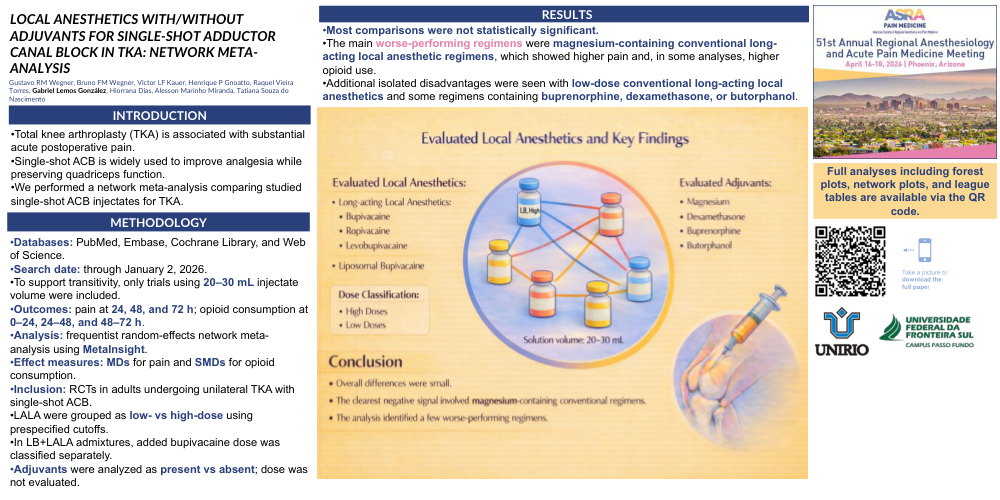
INTRODUCTION: Total knee arthroplasty (TKA) often produces severe acute postoperative pain. Single-shot adductor canal block (ACB) is widely used within multimodal analgesia to reduce pain while preserving knee extension strength. Randomized trials have tested diverse injectate regimens, including long-acting local anesthetics (LALA), liposomal bupivacaine (LB) alone or admixed with bupivacaine (Bupi), and multiple adjuvants across varying dosing strategies. We conducted a network meta-analysis to compare analgesic effectiveness among currently studied single-shot ACB solutions for TKA.
MATERIAL AND METHODS: We searched PubMed, Embase, Cochrane Library, and Web of Science to January 2, 2026 for RCTs in adults (≥18 years) undergoing unilateral TKA comparing single-shot ACB injectates. To support transitivity by keeping dosing conditions comparable across comparisons, we restricted inclusion to trials using a total injectate volume of 20–30 mL. Outcomes were pain at 24, 48, and 72 h and opioid consumption at 0–24, 24–48, and 48–72 h. A frequentist random-effects network meta-analysis was conducted using the MetaInsight web application, reporting mean differences for pain and standardized mean differences for opioid use. LALA were pooled and classified as low versus high dose using cutoffs of 65 mg for bupivacaine/levobupivacaine, 75 mg for ropivacaine, and 133 mg for LB. In LB+LALA admixtures, added bupivacaine dose was classified separately to maintain node homogeneity. Adjuvants were treated as present or absent, and their doses were not evaluated.
RESULTS: Twenty-one RCTs (n=1,934) were synthesized with LB_High as the reference. For pain at rest, differences emerged mainly after the first postoperative day. At 24 h (14 interventions; 16 RCTs; n=1,405), LALA_Low and magnesium-containing LALA regimens were associated with higher pain versus LB_High, while other regimens did not differ. At 48 h (10 interventions; 11 RCTs; n=900), higher pain was observed for LALA_High, LALA_Low, LALA_Low+butorphanol, LALA_High+buprenorphine, and LALA_High+magnesium; by 72 h (6 interventions; 6 RCTs; n=507), no regimen differed from LB_High. For opioid consumption, no regimen differed from LB_High at 0–24 h (7 interventions; 8 RCTs; n=788). At 24–48 h (8 interventions; 7 RCTs; n=559), both LALA_Low and LALA_High alone were similar to LB_High, whereas LALA_High combined with buprenorphine, dexamethasone, or magnesium required more opioids. At 48–72 h (6 interventions; 5 RCTs; n=341), LALA_Low was associated with higher opioid use, while remaining regimens did not differ. Overall, when significant, differences generally appeared after 24 h and favored LB_High; LB+bupivacaine admixtures were similar to LB_High, and patterns at 48 h suggested that LALA regimens with adjuvants tended to perform worse for both pain and opioid outcomes.
DISCUSSION: Differences among single-shot ACB injectates within 20–30 mL appear modest and time-dependent. Where separation emerged, liposomal bupivacaine–based regimens tended to outperform conventional LALA strategies, while adjuvants showed no consistent incremental benefit. Because many comparisons were informed by limited direct evidence and indirect estimates, estimates should be interpreted cautiously and prioritized for hypothesis generation. Future well-powered, protocol-standardized trials should evaluate patient-important outcomes, adverse events, and cost-effectiveness to determine whether these comparative signals warrant practice change.