372 posters, 1 audios, 13 topics, 29 sessions, 1,035 authors, 449 institutions
ePostersLive by SciGen Technologies S.A. All rights reserved.
51st Annual Regional Anesthesiology and Acute Pain Medicine Meeting
April 16 - 18, 2026 | Phoenix, Arizona

2316263
Postoperative Pain and Opioid Consumption in Robot-Assisted vs Conventional Open Kidney Transplantation
Part of Topic
Scientific Abstracts > Acute Pain
Objectives:
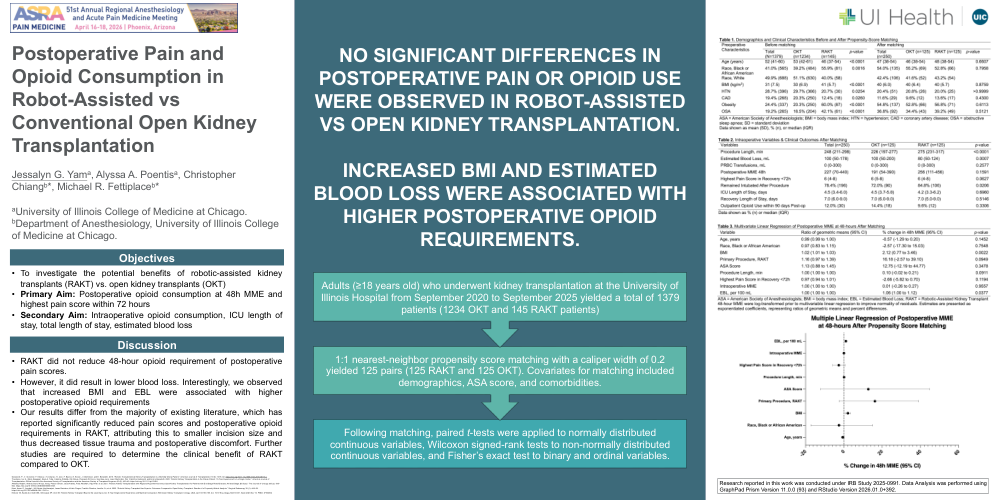
•To investigate the potential benefits of robotic-assisted kidney transplants (RAKT) vs. open kidney transplants (OKT)
•Primary Aim: Postoperative opioid consumption at 48h MME and highest pain score within 72 hours
•Secondary Aim: Intraoperative opioid consumption, ICU length of stay, total length of stay, estimated blood loss
Conclusion:
•NO SIGNIFICANT DIFFERENCES IN POSTOPERATIVE PAIN OR OPIOID USE WERE OBSERVED IN ROBOT-ASSISTED VS OPEN KIDNEY TRANSPLANTATION.
•NO SIGNIFICANT DIFFERENCES IN POSTOPERATIVE PAIN OR OPIOID USE WERE OBSERVED IN ROBOT-ASSISTED VS OPEN KIDNEY TRANSPLANTATION.
•INCREASED BMI AND ESTIMATED BLOOD LOSS WERE ASSOCIATED WITH HIGHER POSTOPERATIVE OPIOID REQUIREMENTS.
Methods:
•Adults (≥18 years old) who underwent kidney transplantation at the University of Illinois Hospital from September 2020 to September 2025 yielded a total of 1379 patients (1234 OKT and 145 RAKT patients)
•1:1 nearest-neighbor propensity score matching with a caliper width of 0.2 yielded 125 pairs (125 RAKT and 125 OKT). Covariates for matching included demographics, ASA score, and comorbidities.
•Following matching, paired t-tests were applied to normally distributed continuous variables, Wilcoxon signed-rank tests to non-normally distributed continuous variables, and Fisher’s exact test to binary and ordinal variables.
Discussion:
•RAKT did not reduce 48-hour opioid requirement of postoperative pain scores.
•However, it did result in lower blood loss. Interestingly, we observed that increased BMI and EBL were associated with higher postoperative opioid requirements
•Our results differ from the majority of existing literature, which has reported significantly reduced pain scores and postoperative opioid requirements in RAKT, attributing this to smaller incision size and thus decreased tissue trauma and postoperative discomfort. Further studies are required to determine the clinical benefit of RAKT compared to OKT.