372 posters, 1 audios, 13 topics, 29 sessions, 1,035 authors, 449 institutions
ePostersLive by SciGen Technologies S.A. All rights reserved.
51st Annual Regional Anesthesiology and Acute Pain Medicine Meeting
April 16 - 18, 2026 | Phoenix, Arizona

2316237
Trends in Adult and Adolescent Upper Extremity Block Utilization at a High-Volume Orthopedic Surgical Center
Poster Presenter
Authors
Maaz Khan, Junying Wang, Justine Jorgensen, Renee Ren, Jashvant Poeran, Kathryn DelPizzo, Michelle Carley, Alexandra Sideris, Stavros Memtsoudis, Nicholas Davis, Jordan Ruby
Affiliations
Hospital for Special Surgery, Rutgers Robert Wood Johnson Medical School, New Brunswick, NJ, USA, Pain Prevention Research Center Department of Anesthesiology, Critical Care & Pain Management, Hospital for Special Surgery, New York, NY, USA, Icahn School of Medicine at Mount Sinai, New York, NY, USA, Department of Anesthesiology, Weill Cornell Medicine, New York, NY, USA
Part of Topic
Scientific Abstracts > Regional Anesthesia
Trends in Adult and Adolescent Upper Extremity Block Utilization at a High-Volume Orthopedic Surgical Center
Maaz Shah Khan MBBS, MD1 , Junying Wang PhD1 , Justine Jorgensen1,2 , Renee Ren MD1,3,4 , Jashvant Poeran MD PhD1,3 , Kathryn DelPizzo, MD1,4 , Michelle Carley MD1,4 , Alexandra Sideris PhD1,4, Stavros Memtsoudis, MD, PhD1,4, Nicholas Davis MD1,4 , Jordan Ruby MD1,4
1Pain Prevention Research Center Department of Anesthesiology, Critical Care & Pain Management, Hospital for Special Surgery, New York, NY, USA
2Rutgers Robert Wood Johnson Medical School, New Brunswick, NJ, USA
3Icahn School of Medicine at Mount Sinai, New York, NY, USA
4Department of Anesthesiology, Weill Cornell Medicine, New York, NY, USA
Introduction
Post-shoulder surgery pain historically has been managed with interscalene block (ISB) or supraclavicular block (SCB), both with high risk of hemidiaphragmatic paralysis from phrenic nerve involvement1,2. The superior trunk block (STB) offers similar analgesia with better diaphragmatic sparing and lower paralysis rates. Our study aims to evaluate trends in adult and adolescent STB, ISB and SCB utilization in a high-volume orthopedic hospital and to evaluate differences in block uptake between the different age groups.
Materials and Methods
After IRB approval (IRB#2024-1639 and IRB#2016-436), we retrospectively queried Epicanesthesia records between 01/01/2016 – 12/31/2024, facilitated by the SlicerDicer tool, (for patients < 18 years and patients 18-80 years receiving an STB, ISB or SCB. Data extracted included block type, procedure, demographics, and ASA status. This study was in accordance with STrengthening the Reporting of OBservational studies in Epidemiology (STROBE) guidelines3.
Results/Case Report
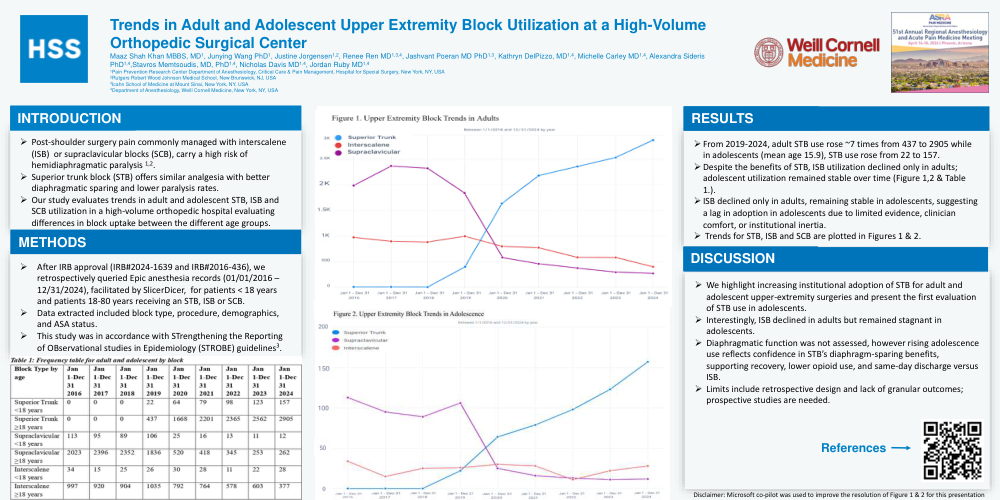
Between 2019 and 2024, a total of 19921 adult patients and 871 adolescent patients received an upper extremity block. In adults, STB use rose ~7 times from 437 to 2905 while in adolescents, STB use rose from 22 to 157 cases. In adolescents, upper extremity blocks were primarily for shoulder and proximal humerus procedures (89.5%), followed by clavicle/AC joint (5.5%), elbow/distal humerus (1.8%), and other upper-extremity cases (3.1%). While shoulder procedures remained the primary indication, use in non-shoulder surgeries expanded.
Mean age was 15.85 years, most patients were male (79.62%), nearly all ASA I/II (99.8%) and seen in ambulatory settings (99.4%). Patients were predominantly White/Caucasian (75.7%), followed by Other/Mixed (11.8%) and Black/African American (4%). Majority (85.1%) identified as non-Hispanic with 10.7% Hispanic/Latino.
Despite the benefits of STB, ISB utilization declined only in adults; adolescent utilization remained stable over time (Figure 1,2 & Table 1.). Although STB use increased in both groups, this pattern suggests a lag and may reflect differences in clinical comfort, limited adolescent-specific evidence or institutional inertia, highlighting the need for further investigation.
Trends for STB, ISB and SCB are plotted in Figures 1 & 2.
Discussion
We highlight growing institutional adoption of STB for adult and adolescent upper-extremity surgeries. Prior studies are adult-focused; to our knowledge this is the first adolescent STB evaluation. Interestingly, ISB declined in adults but remained stagnant in adolescents. Diaphragmatic function was not assessed, however rising adolescence use reflects confidence in STB’s diaphragm-sparing benefits, supporting recovery, lower opioid use, and same-day discharge versus ISB. Limits include retrospective design and lack of granular outcomes; prospective studies are needed.
References
1. Kaye AD, Allampalli V, Fisher P, et al. Supraclavicular vs. Infraclavicular Brachial Plexus Nerve Blocks: Clinical, Pharmacological, and Anatomical Considerations. Anesth Pain Med. Oct 2021;11(5):e120658. doi:10.5812/aapm.120658
2. Robles C, Berardone N, Orebaugh S. Effect of superior trunk block on diaphragm function and respiratory parameters after shoulder surgery. Regional Anesthesia & Pain Medicine. 2022;47(3):167–170.
3. Von Elm E, Altman DG, Egger M, et al. The Strengthening the Reporting of Observational Studies in Epidemiology (STROBE) Statement: guidelines for reporting observational studies. International journal of surgery. 2014;12(12):1495–1499.