372 posters, 1 audios, 13 topics, 29 sessions, 1,035 authors, 449 institutions
ePostersLive by SciGen Technologies S.A. All rights reserved.
51st Annual Regional Anesthesiology and Acute Pain Medicine Meeting
April 16 - 18, 2026 | Phoenix, Arizona

2316219
Continuous Erector Spinae Plane Block VS Continuous Thoracic Epidural for thoracic analgesia: A meta-analysis & narrative review.
Poster Presenter
Part of Topic
Scientific Abstracts > Acute Pain
INTRODUCTION:
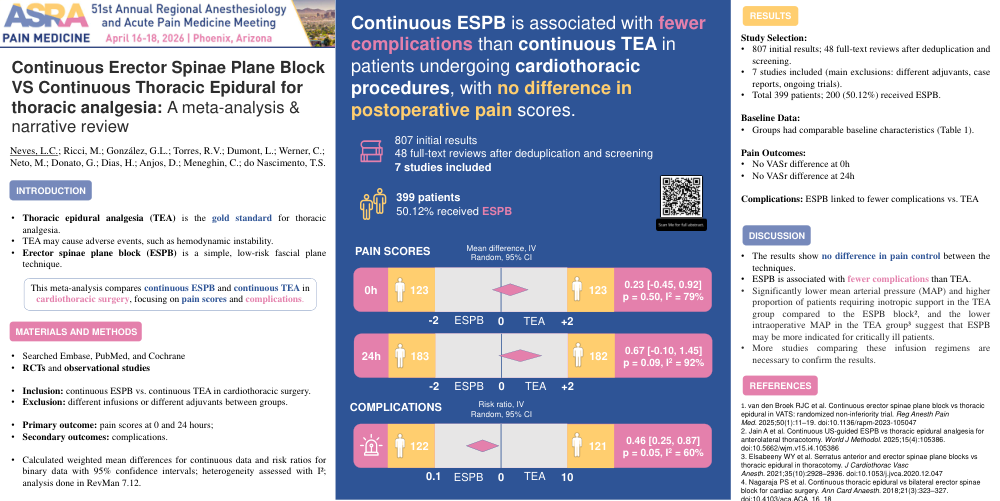
Thoracic Epidural Analgesia (TEA) remains the gold standard for thoracic analgesia¹, despite its associated adverse events, such as hemodynamic instability. Among recent fascial plane alternatives, the Erector Spinae Plane Block (ESPB) is considered a technically simple and low-risk procedure. This meta-analysis compares continuous ESPB and continuous TEA in patients undergoing cardiothoracic procedures regarding pain scores and associated complications.
MATERIALS AND METHODS:
Embase, PubMed, and the Cochrane Library were searched for randomized controlled trials (RCTs) or observational studies comparing the use of continuous ESPB with continuous TEA in cardiothoracic procedures. Studies with differing adjuvants between groups were excluded. The primary outcome was pain score at 0 and 24 hours, and secondary outcomes were complications, opioid consumption, and frequency of rescue opioids. We computed weighted mean differences (WMDs) for continuous outcomes and risk ratios (RRs) for binary endpoints, using 95% confidence intervals (CIs). Heterogeneity was assessed using I² statistics. Statistical analyses were performed using Review Manager (RevMan), version 7.12.0.
RESULTS:
The research yielded 807 results. After removing duplicates and ineligible studies by title or abstract, 48 studies were fully reviewed. Of these, 7 studies were included in this meta-analysis. The main reasons for exclusion were studies with different adjuvants between groups, case reports, or ongoing trials. A total of 399 patients were included, of whom 200 (50.12%) were selected for the ESPB block. The baseline characteristics were most commonly comparable between groups, as shown in Table 1.
No difference was found between groups related to VASr at 0 hour (MD: 0.23; 95% CI -0.45 to 0.92; p = 0.50; I² = 79%; Figure 2) and at VASr at 24 hours postoperative (MD: 0.67; 95% CI -0.10 to 1.45; p = 0.09; I² = 92%, Figure 3). However, ESPB was associated with fewer complications compared to TEA (MD: 0.46; 95% CI 0.25 to 0.87; p=0.02; I² = 60%; Figure 4).
DISCUSSION:
The results show no difference in pain control between the techniques. But the fewer complications associated with ESPB, the significantly lower mean arterial pressure (MAP) and higher proportion of patients requiring inotropic support in the TEA group compared to the ESPB block², and the lower intraoperative MAP in the TEA group³ suggest that ESPB may be more indicated for critically ill patients. More studies comparing these infusion regimens are necessary to confirm the results.