372 posters, 1 audios, 13 topics, 29 sessions, 1,035 authors, 449 institutions
ePostersLive by SciGen Technologies S.A. All rights reserved.
51st Annual Regional Anesthesiology and Acute Pain Medicine Meeting
April 16 - 18, 2026 | Phoenix, Arizona

2316183
Impact of Preoperative Opioid Exposure on Postoperative Outcomes Following Shoulder Arthroplasty
Part of Topic
Scientific Abstracts > Chronic Pain
Impact of Preoperative Opioid Exposure on Postoperative Outcomes Following Shoulder Arthroplasty
Aria Soltankhah, B.S.¹, Bryan Yavari, B.S.1, Stanna Calderon, B.S.1, Evan Lederman, M.D.1,2, Anup Shah, M.D.1,2
1University of Arizona College of Medicine - Phoenix
²Banner Health
-
Total shoulder arthroplasty (TSA) for the management of advanced shoulder pathology offers substantial improvements in pain and function. However, postoperative complications remain clinically meaningful and may be influenced by preoperative factors.
-
Opioid exposure prior to surgery has been linked to opioid overdose, pneumonia, infection, and respiratory failure, yet limited literature exists evaluating its impact on post-TSA outcomes (Wilson et al., 2021). This study investigates associations between opioid use before TSA and postoperative complications within 180 days after surgery.
-
A retrospective cohort study was conducted using the Banner Health TriNetX federated electronic health record network that includes all Banner hospitals.
-
Adult patients (≥18 years) undergoing primary total shoulder arthroplasty were identified using ICD-10-PCS and CPT procedure codes.
-
Patients were stratified into two cohorts: those with documented opioid prescriptions (ATC code N02A) within one year prior to surgery and those without opioid exposure during that period.
-
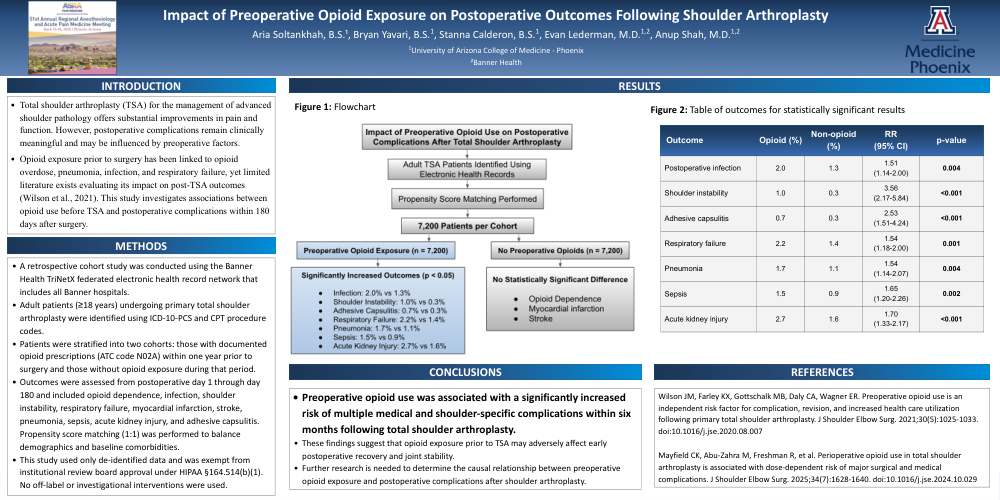
Outcomes were assessed from postoperative day 1 through day 180 and included opioid dependence, infection, shoulder instability, respiratory failure, myocardial infarction, stroke, pneumonia, sepsis, acute kidney injury, and adhesive capsulitis. Propensity score matching (1:1) was performed to balance demographics and baseline comorbidities.
-
This study used only de-identified data and was exempt from institutional review board approval under HIPAA §164.514(b)(1). No off-label or investigational interventions were used.
RESULTS
Figure 1: Flowchart
Figure 2: Table of outcomes for statistically significant results
|
Outcome |
Opioid (%) |
Non-opioid (%) |
RR (95% CI) |
p-value |
|
Postoperative infection |
2.0 |
1.3 |
1.51 (1.14-2.00) |
0.004 |
|
Shoulder instability |
1.0 |
0.3 |
3.56 (2.17-5.84) |
<0.001 |
|
Adhesive capsulitis |
0.7 |
0.3 |
2.53 (1.51-4.24) |
<0.001 |
|
Respiratory failure |
2.2 |
1.4 |
1.54 (1.18-2.00) |
0.001 |
|
Pneumonia |
1.7 |
1.1 |
1.54 (1.14-2.07) |
0.004 |
|
Sepsis |
1.5 |
0.9 |
1.65 (1.20-2.26) |
0.002 |
|
Acute kidney injury |
2.7 |
1.6 |
1.70 (1.33-2.17) |
<0.001 |
CONCLUSIONS
-
Preoperative opioid use was associated with a significantly increased risk of multiple medical and shoulder-specific complications within six months following total shoulder arthroplasty.
-
These findings suggest that opioid exposure prior to TSA may adversely affect early postoperative recovery and joint stability.
-
Further research is needed to determine the causal relationship between preoperative opioid exposure and postoperative complications after shoulder arthroplasty.
Wilson JM, Farley KX, Gottschalk MB, Daly CA, Wagner ER. Preoperative opioid use is an independent risk factor for complication, revision, and increased health care utilization following primary total shoulder arthroplasty. J Shoulder Elbow Surg. 2021;30(5):1025-1033. doi:10.1016/j.jse.2020.08.007
Mayfield CK, Abu-Zahra M, Freshman R, et al. Perioperative opioid use in total shoulder arthroplasty is associated with dose-dependent risk of major surgical and medical complications. J Shoulder Elbow Surg. 2025;34(7):1628-1640. doi:10.1016/j.jse.2024.10.029