372 posters, 1 audios, 13 topics, 29 sessions, 1,035 authors, 449 institutions
ePostersLive by SciGen Technologies S.A. All rights reserved.
51st Annual Regional Anesthesiology and Acute Pain Medicine Meeting
April 16 - 18, 2026 | Phoenix, Arizona

2316179
Epidural anesthesia vs Paravertebral block for thoracic surgery in adults: A systematic review and meta-analysis
Poster Presenter
Authors
Gabriel Binda Carvalho, Vinicius Fernandes Sarmento, Julio S. Curi, Joao Paulo Machado, Ana Flavia Vieira Leite, Juliano Nunes Quineper, Gustavo Nascimento de Medeiros, Gustavo Roberto Minetto Wegner, Rafael Arsky Lombardi
Affiliations
Hospital Meridional de Cariacica, Hospital do Servidor Publico Estadual de Sao paulo, Brazil, Hospital Meridional de Cariacica, Brazil, Department of Medicine, Universidade do Vale do Taquari, Rio Grande do Sul, Brazil, Londrina State University, Brazil, Hospital Mater Dei, Brazil, Hospital Mae de Deus, Brazil, Autonomous University of San Sebastian, Paraguay, Universidade federal da Fronteira Sul, Brazil, Department of Anesthesiology, University of Nebraska Medical Center, USA
Part of Topic
Scientific Abstracts > Regional Anesthesia
Abstract
Topic
Introduction
Epidural anesthesia is considered the gold standard for analgesia in thoracic surgery, and has been reported as superior to other regional anesthesia techniques1-4. Paravertebral block is a well-established alternative to epidural anesthesia and can also be performed for thoracic procedures such as thoracotomy, video-assisted thoracoscopic surgery (VATS), and robotic-assisted thoracic surgery (RATS). In this present study, we aimed to compare efficacy and safety of both techniques.
Materials and Methods
We systematically searched PubMed, Embase, and the Cochrane Library for relevant randomized controlled trials (RCTs) of thoracic surgeries in patients over 18 years old, comparing thoracic paravertebral blocks with thoracic epidural blocks. The primary outcome was the hospital length of stay. Secondary outcomes were postoperative pain scores, use of supplemental analgesics, and postoperative complications. We performed statistical analyses with RStudio version 4.5.1, risk of bias was evaluated with the Cochrane RoB 2 tool and trial sequential analysis (TSA) was performed using TSA software.
Results/Case Report
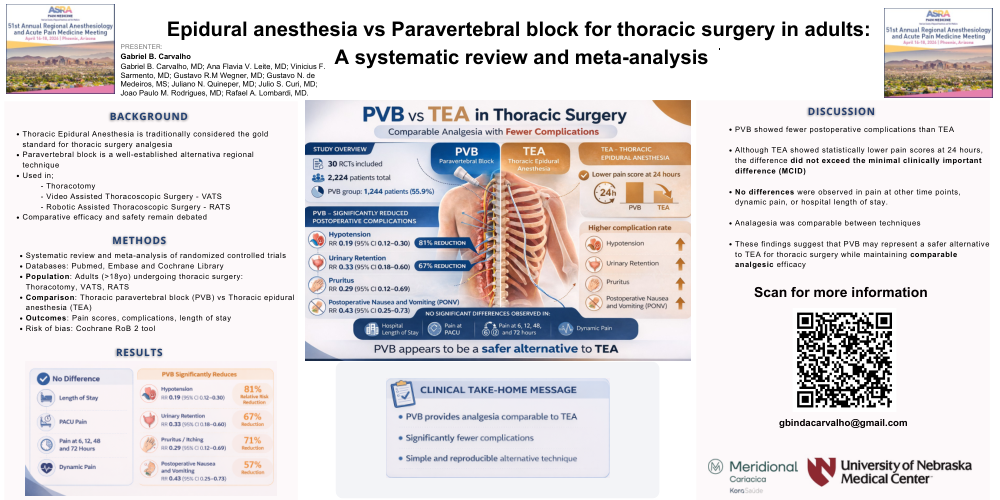
Thirty RCTs with 2,224 patients were included, with 1,244 patients (55.9%) in the paravertebral block (PVB) group. Compared with thoracic epidural anesthesia (TEA), PVB significantly reduced postoperative complications, including hypotension (RR 0.19; 95% CI 0.12-0.30), urinary retention (RR 0.33; 95% CI 0.18–0.60), pruritus (RR 0.29; 95% CI 0.12–0.69), and postoperative nausea and vomiting (RR 0.43; 95% CI 0.25–0.73). At 24 hours, TEA was associated with lower pain scores, and in TSA the Z curve crossed the sequential monitoring boundary. No significant differences were observed for hospital length of stay, pain at PACU, 6, 12, 48 and 72 hours, as well as dynamic pain. PVB block significantly provided less postoperative complications compared with thoracic epidural anesthesia, with no clinically relevant differences in pain outcomes or hospital length of stay. Our findings support PVB as a safer and equally effective alternative to TEA in thoracic surgeries.
Discussion
Across 30 randomized trials, PVB showed a safer postoperative profile than TEA, with lower rates of hypotension, urinary retention, pruritus, and postoperative nausea and vomiting. TEA provided statistically lower pain scores at 24 hours. However, the effect did not exceed the minimal clinically important difference and no differences were observed at other time points, dynamic pain, or hospital length of stay. Trial sequential analysis confirmed robust safety advantages favoring PVB.
References
1.Hamilton C, Alfille P, Mountjoy J, Bao X. Regional anesthesia and acute perioperative pain management in thoracic surgery: a narrative review. J Thorac Dis. June 2022;14(6):2276–2296.
2. Zhao X, Xiao W, Zhang T, Xi M, Sun X. The effects of different analgesic methods on chronic pain in patients undergoing video-assisted thoracoscopic surgery. Wideochirurgia Inne Tech Maloinwazyjne. 2023;18(1):157‐165.
3. Tamura T, Mori S, Mori A, Ando M, Yokota S, Shibata Y, et al. A randomized controlled trial comparing paravertebral block via the surgical field with thoracic epidural block using ropivacaine for post-thoracotomy pain relief. J Anesth. 2017;31(2):263‐270.
4. Loop T. Fast track in thoracic surgery and anaesthesia: update of concepts. Curr Opin Anesthesiol. February 2016;29(1):20.