Loading...

372 posters, 1 audios, 13 topics, 29 sessions, 1,035 authors, 449 institutions

ePostersLive by SciGen Technologies S.A. All rights reserved.

2316141

A Retrospective Comparison of Liposomal Bupivacaine with Continuous Popliteal Sciatic Nerve Catheter in Foot and Ankle Osteotomy
Part of Topic

Scientific Abstracts > Regional Anesthesia

Background

•Regional anesthesia is an integral component of multimodal analgesia for the perioperative management of orthopedic surgeries associated with significant postoperative pain [1, 2].
•Currently, both single-shot liposomal bupivacaine (LB) and continuous peripheral nerve blocks (CPNB) are widely used to manage pain following ankle arthroplasties and complex foot osteotomies [2-5].
 

The Clinical Gap & Objectives

The problem: Despite the proven independent efficacy of both techniques, there is a paucity of data directly comparing single-shot LB nerve blocks to CPNB.

Study purpose: This study aims to address this gap by providing additional comparative data and conclusions to assist clinical decision-making.


Material & Methods

Study type: Single-center retrospective chart review

IRB approval: University of Iowa IRB as an Umbrella Project on December 19, 2025 (IRB ID: 201911151), with a waiver of informed consent

Inclusion interval: Medical records from January 2021 to November 2025 

Inclusion criteria:

1.Patients ≥18 years old
2.Ankle arthroplasty and (or) complex foot osteotomy surgeries
3.Single-shot popliteal sciatic and adductor nerve blocks with LB vs single-shot adductor nerve blocks with a continuous popliteal sciatic nerve catheter (CPSNB)

Primary outcome: 24-hour MME

Secondary outcomes: NRS scores (PACU, 8 h, 12h, 24h), analgesic duration, procedural duration, ambulation outcomes, and adverse events. 

Statistical analysis:  Comparison using central tendency and dispersion measures 


Results

Matched cohorts: 

•31 patients per group 
•No statistically meaningful differences in age, BMI, sex, race, or ASA classification.
•Neither group experienced arrhythmia within the first 24 hours, nor were there any cases of infection, hematoma, delirium, or local anesthetic systemic toxicity.

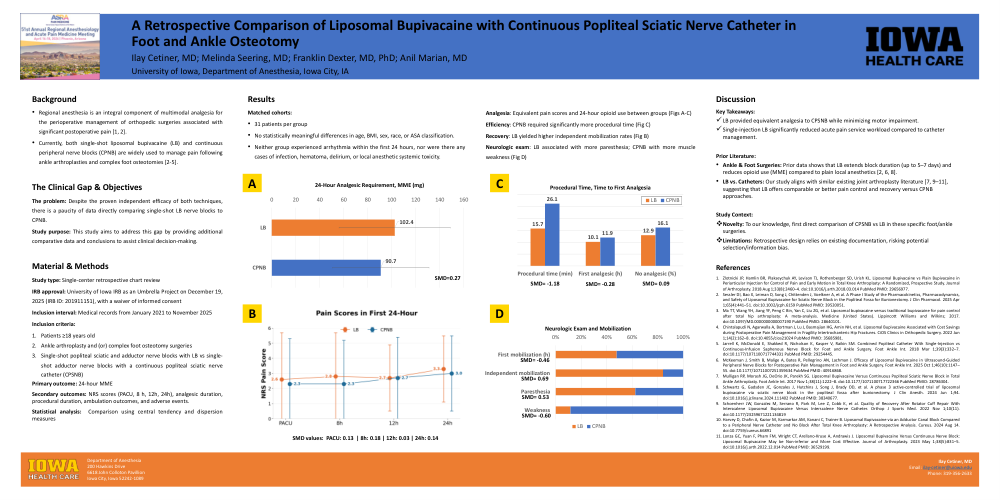
Analgesia: Equivalent pain scores and 24-hour opioid use between groups (Figs A-C)

Efficiency: CPNB required significantly more procedural time (Fig C)

Recovery: LB yielded higher independent mobilization rates (Fig B)

Neurologic exam: LB associated with more paresthesia; CPNB with more muscle weakness (Fig D)


Discussion

Key Takeaways:

üLB provided equivalent analgesia to CPSNB while minimizing motor impairment.
üSingle-injection LB significantly reduced acute pain service workload compared to catheter management.


Prior Literature:

•Ankle & Foot Surgeries: Prior data shows that LB extends block duration (up to 5–7 days) and reduces opioid use (MME) compared to plain local anesthetics [2, 6, 8].
•LB vs. Catheters: Our study aligns with similar existing joint arthroplasty literature [7, 9–11], suggesting that LB offers comparable or better pain control and recovery versus CPNB approaches.


Study Context:

vNovelty: To our knowledge, first direct comparison of CPSNB vs LB in these specific foot/ankle surgeries.
vLimitations: Retrospective design relies on existing documentation, risking potential selection/information bias.


asraspring2026 banner
Copyright © 2015-2026, ePostersLive® SciGen is a registered trademark of SciGen Technologies S.A. Patent pending.

This website and third-party tools we use rely on cookies for the best user experience. By selecting "I agree", you agree to cookie usage as described in our Privacy Policy.
