372 posters, 1 audios, 13 topics, 29 sessions, 1,035 authors, 449 institutions
ePostersLive by SciGen Technologies S.A. All rights reserved.
51st Annual Regional Anesthesiology and Acute Pain Medicine Meeting
April 16 - 18, 2026 | Phoenix, Arizona

2316139
Trends in Peripheral Nerve Block use for Knee Procedures in Adult & Pediatric Patients at a High-Volume Orthopedic Surgical Center
Poster Presenter
Authors
Justine Jorgensen, Junying Wang, Maaz Khan, Renee Ren, Jashvant Poeran, Alexandra Sideris, Daniel Maalouf, Jiabin Liu, Stavros Memstoudis, Jordan Ruby, Kathryn DelPizzo, Nicholas Davis, Michelle Carley
Affiliations
Hospital for Special Surgery, Rutgers Robert Wood Johnson Medical School, New Brunswick, NJ, USA, Pain Prevention Research Center Department of Anesthesiology, Critical Care & Pain Management, Hospital for Special Surgery, New York, NY, USA, Icahn School of Medicine at Mount Sinai, New York, NY, USA, Department of Anesthesiology, Critical Care & Pain Management, Hospital for Special Surgery, New York, NY, USA
Part of Topic
Scientific Abstracts > Regional Anesthesia
Trends in Peripheral Nerve Block use for Knee Procedures in Adult & Pediatric Patients at a High-Volume Orthopedic Surgical Center
Justine Jorgensen1,2, Junying Wang PhD1, Maaz Shah Khan MBBS1, Renee Ren MD1,3,4, Jashvant Poeran MD PhD1,4, Alexandra Sideris PhD1,4, Daniel Maalouf MD MPH1,4, Jiabin Liu MD,PhD,FASA1,4, Stavros Memtsoudis MD,PhD1,4, Jordan Ruby MD1,4, Kathryn DelPizzo, MD1,4, Nicholas Davis MD1,4, Michelle Carley MD1,4
1Pain Prevention Research Center Department of Anesthesiology, Critical Care & Pain Management, Hospital for Special Surgery, New York, NY, USA
2Rutgers Robert Wood Johnson Medical School, New Brunswick, NJ, USA
3Icahn School of Medicine at Mount Sinai, New York, NY, USA
4Department of Anesthesiology, Weill Cornell Medicine, New York, NY, US
Introduction
Post-knee surgery pain is commonly managed with adductor canal blocks (ACB) leaving anterior/lateral gaps. Genicular nerve blocks (GNB) and Anterior Femoral Cutaneous Nerve blocks (ACFNB) complement ACB, targeting additional anterior branches1,2, while iPACK blocks address posterior pain3. Though GNB and iPACK have been studied in adults, AFCNB remains understudied; pediatric data for all techniques are scarce. This study examines adult and pediatric nerve block utilization trends for knee surgery in a high-volume orthopedic hospital.
Materials and Methods
After IRB approval (IRB#2024-1639 & IRB#2016-436), we retrospectively queried Epic anesthesia records between 01/01/16 – 12/31/24, facilitated by Epic SlicerDicer, for patients less than 18 years old, and between 18-80 years old receiving ACB, GNB, iPACK blocks, and/or AFCNB. Data extracted included individual block types, procedures, demographics, ASA status, and anesthesia provider-level data. This study was in accordance with Strengthening the Reporting of Observational studies in Epidemiology (STROBE) guidelines4.
Results/Case Report
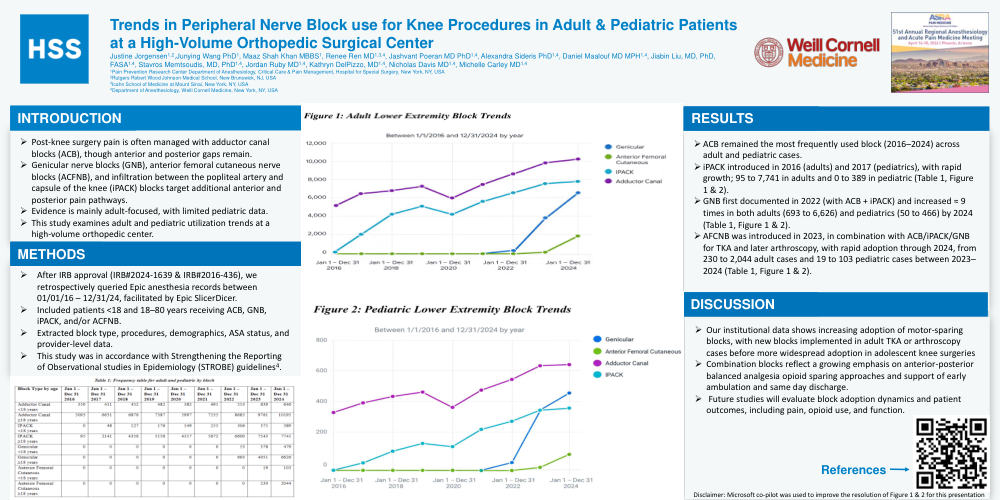
Between 2016-2024, ACB remained most frequently utilized block across both age groups (Figure 1,2). iPACK was first introduced; February 2016 for an adult TKA by a single provider. Pediatric adoption followed (April 2017), when two providers began using iPACK with ACB for arthroscopies. By 2024 adult cases increased from 95 to 7,741 pediatric cases from 0 to 389 per year (Figure 1, 2 & Table 1).
GNB use was first documented in July 2022 (with ACB + IPACK) by nine anesthesia providers for fourteen adult cases including TKA (n=5), uni-compartmental knee replacement (n=1), arthroscopy (n=8), and one adolescent ACL reconstruction. Between 2022 to 2024, GNB use increased ninefold from 693 to 6,626 adult and 50 to 466 in pediatrics cases per year (Figure 1, 2 & Table 1).
AFCNB was first documented in August 2023, combined with ACB, iPACK, and GNB, for four adult TKA cases performed by two anesthesia providers. Expanding in September 2023, including arthroscopies, encompassing eight adult and three pediatric cases across four providers. Usage increased from 230 in 2023 to 2,044 adult cases in 2024, pediatric cases grew nearly fivefold, from 19 in 2023 to 103 in 2024 (Figure 1, 2 & Table 1).
Discussion
Our institutional data highlights the increasing use of motor-sparing blocks, with new blocks implemented in adult TKA or arthroscopy cases before more widespread adoption in adolescent knee surgeries. Combination blocks reflect a growing emphasis on anterior-posterior balanced analgesia opioid sparing approaches and support of early ambulation and same day discharge. Limits include retrospective design and potential documentation issues. Future studies will evaluate block adoption dynamics and patient outcomes, including pain, opioid use, and function.
References
1. Bjørn S, Nielsen TD, Moriggl B, Hoermann R, Bendtsen TF. Anesthesia of the anterior femoral cutaneous nerves for total knee arthroplasty incision: randomized volunteer trial. Regional Anesthesia & Pain Medicine. 2020;45(2):107–116.
2. Chang Y-S, Lee S-A, Wang H-L, Liao W-C. Genicular nerve block in people with total knee arthroplasty: A systematic review and meta-analysis. Medicine. 2025;104(37):e44362.
3. Patterson ME, Vitter J, Bland K, Nossaman BD, Thomas LC, Chimento GF. The effect of the IPACK block on pain after primary TKA: a double-blinded, prospective, randomized trial. The Journal of Arthroplasty. 2020;35(6):S173–S177.
4. Ghaferi AA, Schwartz TA, Pawlik TM. STROBE reporting guidelines for observational studies. JAMA surgery. 2021;156(6):577–578.