372 posters, 1 audios, 13 topics, 29 sessions, 1,035 authors, 449 institutions
ePostersLive by SciGen Technologies S.A. All rights reserved.
51st Annual Regional Anesthesiology and Acute Pain Medicine Meeting
April 16 - 18, 2026 | Phoenix, Arizona

2316111
Utilizing Machine Learning to Identify Pain Trajectories in Patients with Complex Pain Undergoing Total Knee Arthroplasty
Poster Presenter
Authors
Sharon Toor, Junying Wang, Renee Ren, William Chan, Jashvant Poeran, Seth Waldman, Dae Kim, Mary Kelly, Stavros Memtsoudis, Daniel Maalouf, Jiabin Liu, Faye Rim, Alexandra Sideris
Affiliations
Hospital for Special Surgery, Pain Prevention Research Center, Department of Anesthesiology, Critical Care & Pain Management, Hospital for Special Surgery, New York, NY, USA, University of Central Florida College of Medicine, Orlando, FL, USA
Part of Topic
Scientific Abstracts > Acute Pain
Title: Utilizing Machine Learning to Identify Pain Trajectories in Patients with Complex Pain Undergoing Total Knee Arthroplasty
Authors: Sharon Toor1,2, Junying Wang2, Renee Ren2,4, William Chan2, Jashvant Poeran2, Seth Waldman2,3, Dae Kim2,3, Mary Kelly2, Stavros Memtsoudis2,3, Daniel Maalouf2,3, Jiabin Liu2,3, Faye Rim2,3, Alexandra Sideris2,3
Affiliations:
1 University of Central Florida College of Medicine, Orlando, FL, USA
2 Pain Prevention Research Center, Department of Anesthesiology, Critical Care & Pain Management, Hospital for Special Surgery, New York, NY, USA
3 Department of Anesthesiology, Weill Cornell Medicine, New York, NY, USA
4 Icahn School of Medicine at Mount Sinai, New York, NY, USA
Introduction
Chronic pain affects nearly 25% of U.S. adults and complicates recovery after total knee arthroplasty (TKA), putting patients at increased risk for persistent post-surgical pain1-3. At Hospital for Special Surgery, the Perioperative Pain Service (POPS) provides structured preoperative evaluations for complex/chronic pain, including screening for opioid tolerance, substance use, and psychosocial risk factors, guiding tailored perioperative care. Identifying distinct postoperative pain patterns and predictors in this high-risk group may enable earlier intervention and improved recovery.
Methods
This retrospective single-institutional study was IRB-approved (IRB#2021-1899 and IRB#2022-2392). Patients who underwent primary unilateral TKA managed by POPS’s Complex Pain Service between January 14, 2022 and March 4, 2025 were identified. An unsupervised machine learning approach was employed to identify distinct postoperative pain trajectories. NRS pain scores and opioid use during the post-anesthesia recovery unit (PACU) and postoperative days (POD) 1–5 were clustered using K-means. Two postoperative pain trajectories were identified and compared across demographic, psychosocial, and clinical variables. Predictive modeling with XGBoost incorporated 37 preoperative, intraoperative, and PACU factors. Group differences were assessed using Wilcoxon rank-sum tests to compare unadjusted marginal differences for continuous variables between the two clusters and Chi-squared tests were used to examine the marginal association between categorical variables and the two clusters. Model performance was evaluated using accuracy, precision, recall, ROC-AUC, and PR-AUC, with feature importance assessed via SHAP values.
Results
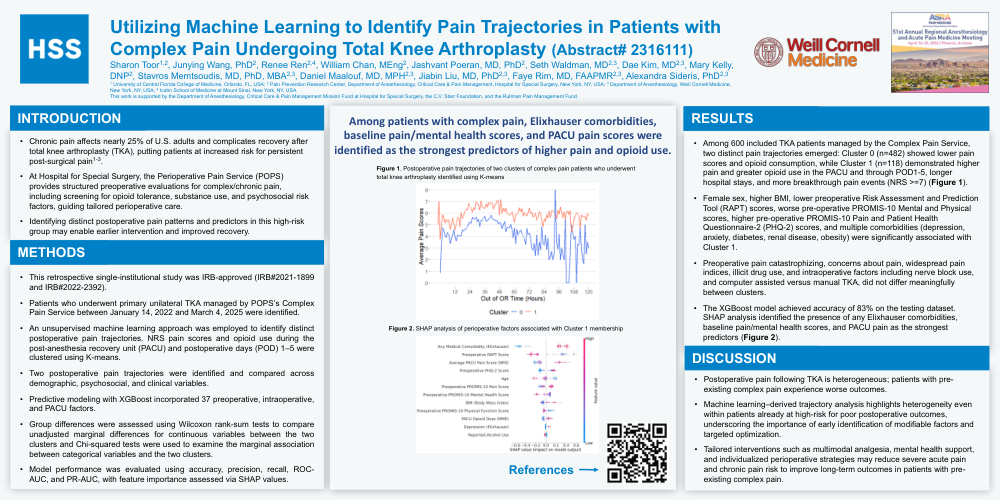
Among 600 included TKA patients managed by the Complex Pain Service, two distinct pain trajectories emerged: Cluster 0 (n=482) showed lower pain scores and opioid consumption, while Cluster 1 (n=118) demonstrated higher pain and greater opioid use in the PACU and through POD1-5, longer hospital stays, and more breakthrough pain events (NRS >=7) (Figure 1). Female sex, higher BMI, lower preoperative Risk Assessment and Prediction Tool (RAPT) scores, worse pre-operative PROMIS-10 Mental and Physical scores, higher pre-operative PROMIS-10 Pain and Patient Health Questionnaire-2 (PHQ-2) scores, and multiple comorbidities (depression, anxiety, diabetes, renal disease, obesity) were significantly associated with Cluster 1. Preoperative pain catastrophizing, concerns about pain, widespread pain indices, illicit drug use, and intraoperative factors including nerve block use, and computer assisted versus manual TKA, did not differ meaningfully between clusters. The XGBoost model achieved accuracy of 83% on the testing dataset. SHAP analysis identified the presence of any Elixhauser comorbidities, baseline pain/mental health scores, and PACU pain as the strongest predictors (Figure 2).
Discussion
Postoperative pain following TKA is heterogeneous; patients with pre-existing complex pain experience worse outcomes. Machine learning–derived trajectory analysis highlights heterogeneity even within patients already at high-risk for poor postoperative outcomes, underscoring the importance of early identification of modifiable factors and targeted optimization. Tailored interventions such as multimodal analgesia, mental health support, and individualized perioperative strategies may reduce severe acute pain and chronic pain risk to improve long-term outcomes in patients with pre-existing complex pain.
References
[1] Stretanski MF, Kopitnik NL, Matha A, Conermann T. Chronic Pain. 2025.
[2] Yong RJ, Mullins PM, Bhattacharyya N. Prevalence of chronic pain among adults in the United States. Pain 2022; 163: e328–32
[3] Cohen SP, Vase L, Hooten WM. Chronic pain: an update on burden, best practices, and new advances. Lancet 2021; 397: 2082–97