372 posters, 1 audios, 13 topics, 29 sessions, 1,035 authors, 449 institutions
ePostersLive by SciGen Technologies S.A. All rights reserved.
51st Annual Regional Anesthesiology and Acute Pain Medicine Meeting
April 16 - 18, 2026 | Phoenix, Arizona

2315935
Prescribing Patterns of Prescription Cannabidiol from 2018 to 2022: A Database Study
Poster Presenter
Part of Topic
Scientific Abstracts > Emerging Technology
Title: Prescribing Patterns of Prescription Cannabidiol from 2018 to 2022: A Database Study
Authors: William Chan1, Alex Illescas1, Jashvant Poeran1, Stavros Memtsoudis1,2, Alexandra Sideris1,2
Affiliations:
1 Pain Prevention Research Center, Department of Anesthesiology, Critical Care & Pain Management, Hospital for Special Surgery, New York, NY, USA
2 Department of Anesthesiology, Weill Cornell Medicine, New York, NY, USA
Introduction
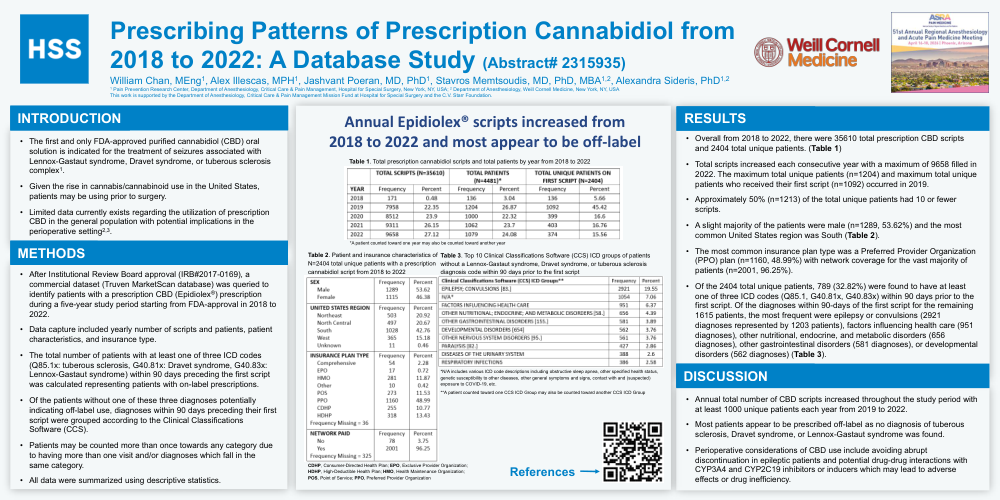
The first and only FDA-approved purified cannabidiol (CBD) oral solution is indicated for the treatment of seizures associated with Lennox-Gastaut syndrome, Dravet syndrome, or tuberous sclerosis complex1. Given the rise in cannabis/cannabinoid use in the United States, patients may be using prior to surgery. Limited data currently exists regarding the utilization of prescription CBD in the general population with potential implications in the perioperative setting2,3.
Methods
After Institutional Review Board approval (IRB#2017-0169), a commercial dataset (Truven MarketScan database) was queried to identify patients with a prescription CBD (Epidiolex®) prescription during a five-year study period starting from FDA-approval in 2018 to 2022. Data capture included yearly number of scripts and patients, patient characteristics, and insurance type. The total number of patients with at least one of three ICD codes (Q85.1x: tuberous sclerosis, G40.81x: Dravet syndrome, G40.83x: Lennox-Gastaut syndrome) within 90 days preceding the first script was calculated representing patients with on-label prescriptions. Of the patients without one of these three diagnoses potentially indicating off-label use, diagnoses within 90 days preceding their first script were grouped according to the Clinical Classifications Software (CCS). Patients may be counted more than once towards any category due to having more than one visit and/or diagnoses which fall in the same category. All data were summarized using descriptive statistics.
Results
Overall from 2018 to 2022, there were 35610 total prescription CBD scripts and 2404 total unique patients. (Table 1) Total scripts increased each consecutive year with a maximum of 9658 filled in 2022. The maximum total unique patients (n=1204) and maximum total unique patients who received their first script (n=1092) occurred in 2019. Approximately 50% (n=1213) of the total unique patients had 10 or fewer scripts. A slight majority of the patients were male (n=1289, 53.62%) and the most common United States region was South (Table 2). The most common insurance plan type was a Preferred Provider Organization (PPO) plan (n=1160, 48.99%) with network coverage for the vast majority of patients (n=2001, 96.25%). Of the 2404 total unique patients, 789 (32.82%) were found to have at least one of three ICD codes (Q85.1, G40.81x, G40.83x) within 90 days prior to the first script. Of the diagnoses within 90-days of the first script for the remaining 1615 patients, the most frequent were epilepsy or convulsions (2921 diagnoses represented by 1203 patients), factors influencing health care (951 diagnoses), other nutritional, endocrine, and metabolic disorders (656 diagnoses), other gastrointestinal disorders (581 diagnoses), or developmental disorders (562 diagnoses) (Table 3).
Discussion
Annual total number of CBD scripts increased throughout the study period with at least 1000 unique patients each year from 2019 to 2022. Most patients appear to be prescribed off-label as no diagnosis of tuberous sclerosis, Dravet syndrome, or Lennox-Gastaut syndrome was found. Perioperative considerations of CBD use include avoiding abrupt discontinuation in epileptic patients and potential drug-drug interactions with CYP3A4 and CYP2C19 inhibitors or inducers which may lead to adverse effects or drug inefficiency.
References
[1] Epidiolex [Prescribing information]. 2025. (accessed December 29th, 2025)
[2] Laudanski K, Wain J. Considerations for Cannabinoids in Perioperative Care by Anesthesiologists. J Clin Med. 2022 Jan 22;11(3):558. PMID: 35160010.
[3] Lee BH, Sideris A, Ladha KS, Johnson RL, Wu CL. Cannabis and Cannabinoids in the Perioperative Period. Anesth Analg. 2024 Jan 1;138(1):16-30. PMID: 35551150