372 posters, 1 audios, 13 topics, 29 sessions, 1,035 authors, 449 institutions
ePostersLive by SciGen Technologies S.A. All rights reserved.
51st Annual Regional Anesthesiology and Acute Pain Medicine Meeting
April 16 - 18, 2026 | Phoenix, Arizona

2315866
Preoperative cannabis and cannabinoid use patterns in hip and knee arthroplasty patients with complex pain
Poster Presenter
Authors
William Chan, Maya Tailor, Dae Kim, Mary Kelly, Spencer Liu, Seth Waldman, Jiabin Liu, Stavros Memtsoudis, Jashvant Poeran, Daniel Maalouf, Faye Rim, Alexandra Sideris
Affiliations
Hospital for Special Surgery, Pain Prevention Research Center, Department of Anesthesiology, Critical Care, and Pain Management, Hospital for Special Surgery, New York, NY, USA
Part of Topic
Scientific Abstracts > Acute Pain
Title: Preoperative cannabis and cannabinoid use patterns in hip and knee arthroplasty patients with complex pain
Authors: William Chan1, Maya Tailor1, Dae Kim1,2, Mary Kelly1, Spencer Liu1,2, Seth Waldman1,2, Jiabin Liu1,2, Stavros Memtsoudis1,2, Jashvant Poeran1, Daniel Maalouf1,2, Faye Rim1,2, Alexandra Sideris1,2
Affiliations:
1 Pain Prevention Research Center, Department of Anesthesiology, Critical Care, and Pain Management, Hospital for Special Surgery, New York, NY, USA
2 Department of Anesthesiology, Weill Cornell Medicine, New York, NY, USA
Introduction
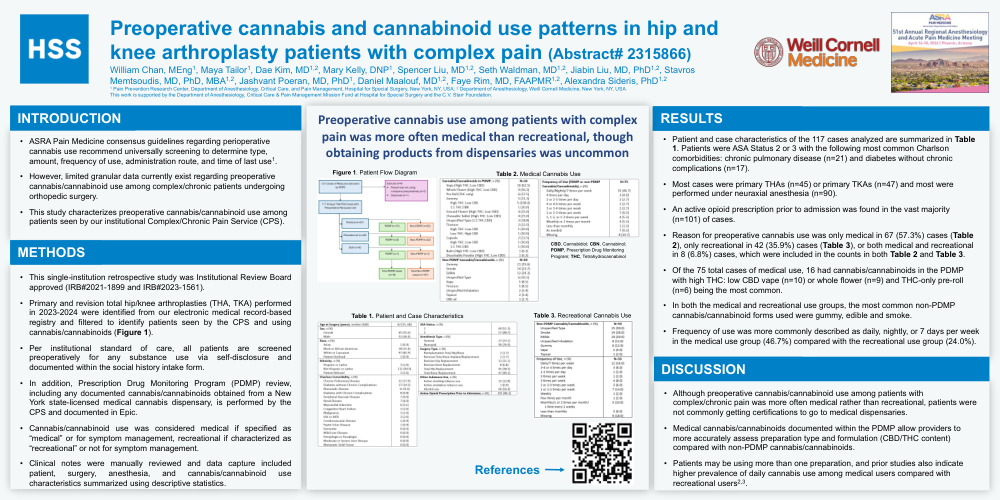
ASRA Pain Medicine consensus guidelines regarding perioperative cannabis use recommend universally screening to determine type, amount, frequency of use, administration route, and time of last use1. However, limited granular data currently exist regarding preoperative cannabis/cannabinoid use among complex/chronic patients undergoing orthopedic surgery. This study characterizes preoperative cannabis/cannabinoid use among patients seen by our institutional Complex/Chronic Pain Service (CPS).
Methods
This single-institution retrospective study was Institutional Review Board approved (IRB#2021-1899 and IRB#2023-1561). Primary and revision total hip/knee arthroplasties (THA, TKA) performed in 2023-2024 were identified from our electronic medical record-based registry and filtered to identify patients seen by the CPS and using cannabis/cannabinoids (Figure 1). Per institutional standard of care, all patients are screened preoperatively for any substance use via self-disclosure and documented within the social history intake form. In addition, Prescription Drug Monitoring Program (PDMP) review, including any documented cannabis/cannabinoids obtained from a New York state-licensed medical cannabis dispensary, is performed by the CPS and documented in Epic. Cannabis/cannabinoid use was considered medical if specified as “medical” or for symptom management, recreational if characterized as “recreational” or not for symptom management. Clinical notes were manually reviewed and data capture included patient, surgery, anesthesia, and cannabis/cannabinoid use characteristics summarized using descriptive statistics.
Results
Patient and case characteristics of the 117 cases analyzed are summarized in Table 1. Patients were ASA Status 2 or 3 with the following most common Charlson comorbidities: chronic pulmonary disease (n=21) and diabetes without chronic complications (n=17). Most cases were primary THAs (n=45) or primary TKAs (n=47) and most were performed under neuraxial anesthesia (n=90). An active opioid prescription prior to admission was found in the vast majority (n=101) of cases.
Reason for preoperative cannabis use was only medical in 67 (57.3%) cases (Table 2), only recreational in 42 (35.9%) cases (Table 3), or both medical and recreational in 8 (6.8%) cases, which were included in the counts in both Table 2 and Table 3. Of the 75 total cases of medical use, 16 had cannabis/cannabinoids in the PDMP with high THC: low CBD vape (n=10) or whole flower (n=9) and THC-only pre-roll (n=6) being the most common. In both the medical and recreational use groups, the most common non-PDMP cannabis/cannabinoid forms used were gummy, edible and smoke. Frequency of use was more commonly described as daily, nightly, or 7 days per week in the medical use group (46.7%) compared with the recreational use group (24.0%).
Discussion
Although preoperative cannabis/cannabinoid use among patients with complex/chronic pain was more often medical rather than recreational, patients were not commonly getting certifications to go to medical dispensaries. Medical cannabis/cannabinoids documented within the PDMP allow providers to more accurately assess preparation type and formulation (CBD/THC content) compared with non-PDMP cannabis/cannabinoids. Patients may be using more than one preparation, and prior studies also indicate higher prevalence of daily cannabis use among medical users compared with recreational users2,3.
References
[1] Shah S, Schwenk ES, Sondekoppam RV, Clarke H, Zakowski M, Rzasa-Lynn RS, Yeung B, Nicholson K, Schwartz G, Hooten WM, Wallace M, Viscusi ER, Narouze S. ASRA Pain Medicine consensus guidelines on the management of the perioperative patient on cannabis and cannabinoids. Reg Anesth Pain Med. 2023 Mar;48(3):97-117. PMID: 36596580.
[2] Turna J, Balodis I, Munn C, Ameringen MV, Busse J, MacKillop J. Overlapping patterns of recreational and medical cannabis use in a large community sample of cannabis users. Compr Psychiatry. 2020 Oct:102:152188. PMID: 3265359.
[3] Lin LA, Ilgen MA, Jannausch M, Bohnert KM. Comparing adults who use cannabis medically with those who use recreationally: Results from a national sample. Addict Behav. 2016 May 17;61:99–103. PMID: 27262964