372 posters, 1 audios, 13 topics, 29 sessions, 1,035 authors, 449 institutions
ePostersLive by SciGen Technologies S.A. All rights reserved.
51st Annual Regional Anesthesiology and Acute Pain Medicine Meeting
April 16 - 18, 2026 | Phoenix, Arizona

2315434
The Use of Continuous Stellate Ganglion Blockade to Treat Sustained Ventricular Arrhythmias After Cardiac Surgery
Poster Presenter
Authors
Affiliations
Part of Topic
Medically Challenging Cases > Acute Pain
Introduction
Postoperative arrhythmias after cardiac surgery are common and the sympathetic nervous system plays a key role in the induction of ventricular arrhythmias (1). The stellate ganglion block (SGB) has been shown to decrease cardiac sympathetic drive in refractory arrhythmias and is now emerging as an adjunct to pharmacologic therapies (2). We report a patient who developed sustained ventricular fibrillation (VF) after cardiac surgery and was treated with a continuous left SGB.
Case Report
A male in his mid 70s with history of atrial flutter, aortic valve replacement (AVR), mitral valve repair, ascending aortic aneurysm repair, colon and prostate cancer was admitted with infective endocarditis and severe aortic regurgitation. He underwent revision AVR and aortic root replacement, which was complicated by biventricular dysfunction requiring two-vessel coronary artery bypass graft, intra-aortic balloon pump (IABP) placement, and temporary chest closure. Amiodarone and lidocaine infusions were also started for frequent ventricular arrhythmias. He was then transferred to the Cardiac Surgery Intensive Care Unit intubated and sedated.
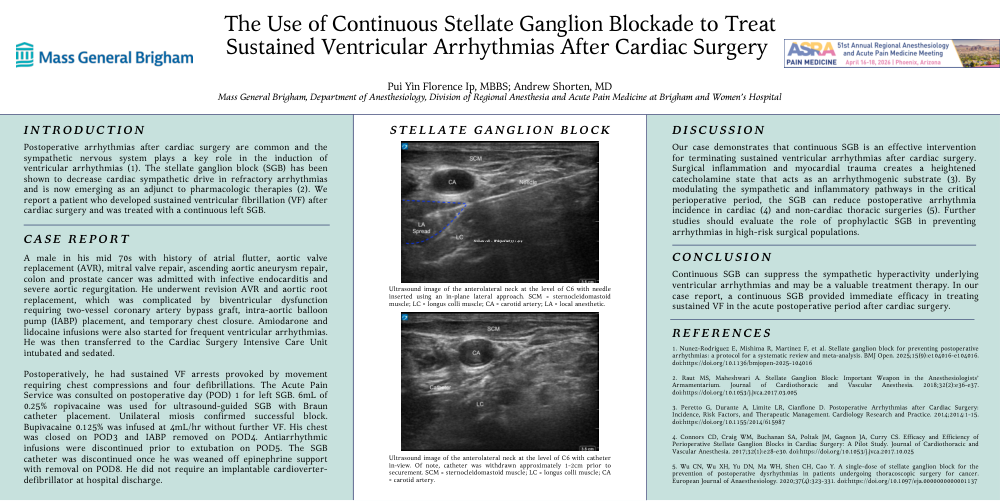
Postoperatively, he had sustained VF arrests provoked by movement requiring chest compressions and four defibrillations. The Acute Pain Service was consulted on postoperative day (POD) 1 for left SGB. 6mL of 0.25% ropivacaine was used for ultrasound-guided SGB with Braun catheter placement. Unilateral miosis confirmed successful block. Bupivacaine 0.125% was infused at 4mL/hr without further VF. His chest was closed on POD3 and IABP removed on POD4. Antiarrhythmic infusions were discontinued prior to extubation on POD5. The SGB catheter was discontinued once he was weaned off epinephrine support with removal on POD8. He did not require an implantable cardioverter- defibrillator at hospital discharge.
Discussion
Our case demonstrates that continuous SGB is an effective intervention for terminating sustained ventricular arrhythmias after cardiac surgery. Surgical inflammation and myocardial trauma creates a heightened catecholamine state that acts as an arrhythmogenic substrate (3). By modulating the sympathetic and inflammatory pathways in the critical perioperative period, the SGB can reduce postoperative arrhythmia incidence in cardiac (4) and non-cardiac thoracic surgeries (5). Further studies should evaluate the role of prophylactic SGB in preventing arrhythmias in high-risk surgical populations.
Conclusion
Continuous SGB can suppress the sympathetic hyperactivity underlying ventricular arrhythmias and may be a valuable treatment therapy. In our case report, a continuous SGB provided immediate efficacy in treating sustained VF in the acute postoperative period after cardiac surgery.
References
1. Nunez-Rodriguez E, Mishima R, Martinez F, et al. Stellate ganglion block for preventing postoperative arrhythmias: a protocol for a systematic review and meta-analysis. BMJ Open. 2025;15(9):e104016-e104016. doi:https://doi.org/10.1136/bmjopen-2025-104016
2. Raut MS, Maheshwari A. Stellate Ganglion Block: Important Weapon in the Anesthesiologists’ Armamentarium. Journal of Cardiothoracic and Vascular Anesthesia. 2018;32(2):e36-e37. doi:https://doi.org/10.1053/j.jvca.2017.03.005
3. Peretto G, Durante A, Limite LR, Cianflone D. Postoperative Arrhythmias after Cardiac Surgery: Incidence, Risk Factors, and Therapeutic Management. Cardiology Research and Practice. 2014;2014:1-15. doi:https://doi.org/10.1155/2014/615987
4. Connors CD, Craig WM, Buchanan SA, Poltak JM, Gagnon JA, Curry CS. Efficacy and Efficiency of Perioperative Stellate Ganglion Blocks in Cardiac Surgery: A Pilot Study. Journal of Cardiothoracic and Vascular Anesthesia. 2017;32(1):e28-e30. doi:https://doi.org/10.1053/j.jvca.2017.10.025
5. Wu CN, Wu XH, Yu DN, Ma WH, Shen CH, Cao Y. A single-dose of stellate ganglion block for the prevention of postoperative dysrhythmias in patients undergoing thoracoscopic surgery for cancer. European Journal of Anaesthesiology. 2020;37(4):323-331. doi:https://doi.org/10.1097/eja.0000000000001137