372 posters, 1 audios, 13 topics, 29 sessions, 1,035 authors, 449 institutions
ePostersLive by SciGen Technologies S.A. All rights reserved.
51st Annual Regional Anesthesiology and Acute Pain Medicine Meeting
April 16 - 18, 2026 | Phoenix, Arizona

2315320
Suzetrigine Utilization for Postoperative Pain Following Orthopedic surgery: A Retrospective Study
Poster Presenter
Authors
Maaz Khan, Junying Wang, William Chan, Tina Chen, Jashvant Poeran, Jawad Saleh, Daniel Maalouf, Jiabin Liu, Stavros Memtsoudis, Meghan Kirksey, Dae Kim, Mary Kelly, Faye Rim, Alexandra Sideris
Affiliations
Hospital for Special Surgery, Department of Anesthesiology, Critical Care & Pain Management, Hospital for Special Surgery, New York, NY, USA
Part of Topic
Scientific Abstracts > Acute Pain
Suzetrigine Utilization for Postoperative Pain Following Orthopedic surgery: A Retrospective Study
Maaz Shah Khan MBBS, MD1, Junying Wang PhD1, William Chan MEng1, Tina Chen BS1, Jashvant Poeran MD PhD1, Jawad N. Saleh PharmD2, Daniel Maalouf MD, MPH1, Jiabin Liu MD, PhD1,3, Stavros Memtsoudis MD, PhD1,3, Meghan Kirksey MD, PhD1,3, Dae Kim MD1,3, Mary Kelly DNP1, Faye Rim MD1,3, Alexandra Sideris PhD1,3
1 Pain Prevention Research Center Department of Anesthesiology, Critical Care & Pain Management, Hospital for Special Surgery, New York, NY, USA
2 Pharmacy Department, Clinical Services, The Hospital for Special Surgery, New York, NY, USA
3 Department of Anesthesiology, Weill Cornell Medicine, New York, NY, USA
Introduction
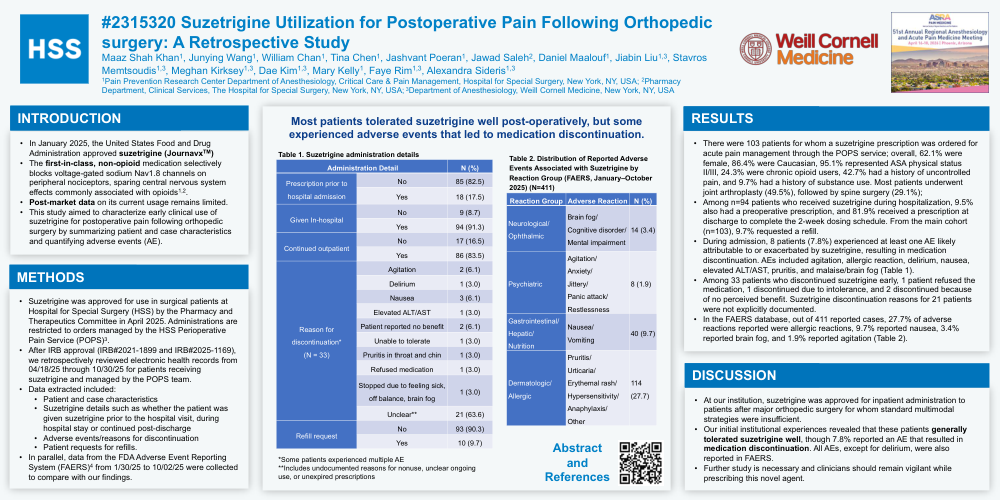
Suzetrigine, the first non-opioid analgesic introduced since celecoxib, is a first-in class medication that selectively blocks voltage-gated sodium Nav1.8 channels on peripheral nociceptors, sparing central nervous system effects commonly associated with opioids1,2. Despite U.S. Food and Drug Administration (FDA) approval in January 2025, post-market data remain limited. This study aimed to characterize early clinical use of Suzetrigine for postoperative pain following orthopedic surgery by summarizing patient and case characteristics and quantifying adverse events (AE).
Materials and Methods
Suzetrigine was approved for use in surgical patients at Hospital for Special Surgery (HSS) by the Pharmacy and Therapeutics Committee in April 2025. Administrations are restricted to orders managed by the HSS Perioperative Pain Service (POPS)3. After IRB approval (IRB#2021-1899 and IRB#2025-1169), we retrospectively reviewed electronic health records from 04/18/25 through 10/30/25 for patients receiving Suzetrigine and managed by the POPS team. Data extracted included patient and case characteristics, suzetrigine details such as whether the patient was given Suzetrigine prior to the hospital visit, during hospital stay or continued post-discharge, adverse events/reasons for discontinuation, and patient requests for refills. In parallel, data from the FDA Adverse Event Reporting System (FAERS)4 from 01/30/2025 to 10/02/2025 were collected to compare with our findings.
Results/Case Report
There were 103 patients for whom a Suzetrigine prescription was ordered for acute pain management through the POPS service; overall, 62.1% were female, 86.4% were Caucasian, 95.1% represented ASA physical status II/III, 24.3% were chronic opioid users, 42.7% had a history of uncontrolled pain, and 9.7% had a history of substance use. Most patients underwent joint arthroplasty (49.5%), followed by spine surgery (29.1%);
Among n=94 patients who received Suzetrigine during hospitalization, 9.5% also had a preoperative prescription, and 81.9% received a prescription at discharge to complete the 2-week dosing schedule. From the main cohort (n=103), 9.7% requested a refill. During admission, 8 patients (7.8%) experienced at least one AE likely attributable to or exacerbated by Suzetrigine, resulting in medication discontinuation. AEs included agitation, allergic reaction, delirium, nausea, elevated ALT/AST, pruritis, and malaise/brain fog (Table 1). Among 33 patients who discontinued Suzetrigine early, one patient refused the medication, one discontinued due to intolerance, and two discontinued because of no perceived benefit. Suzetrigine discontinuation reasons for 21 patients were not explicitly documented.
In the FAERS database, out of 411 reported cases, 27.7% of adverse reactions reported were allergic reactions, 9.7% reported nausea, 3.4% reported brain fog, and 1.9% reported agitation (Table 2).
Discussion
At our institution, Suzetrigine was approved for inpatient administration to patients after major orthopedic surgery for whom standard multimodal strategies were insufficient. Our initial institutional experiences revealed that these patients generally tolerated Suzetrigine well, though 7.8% reported an AE that resulted in medication discontinuation. All AEs, except for delirium, were also reported in FAERS. Further, study is necessary, and clinicians should remain vigilant while prescribing this novel agent.
Table 1. Suzetrigine administration details
|
|
|
N (%) |
|
Prescription prior to hospital admission |
No |
85 (82.5) |
|
Yes |
18 (17.5) |
|
|
Given In-hospital |
No |
9 (8.7) |
|
Yes |
94 (91.3) |
|
|
Continued outpatient |
No |
17 (16.5) |
|
Yes |
86 (83.5) |
|
|
Reason for discontinuation* (N = 33); |
Agitation |
2 (6.1) |
|
Delirium |
1 (3.0) |
|
|
Nausea |
3 (6.1) |
|
|
Elevated ALT/AST |
1 (3.0) |
|
|
Patient reported no benefit |
2 (6.1) |
|
|
Unable to tolerate |
1 (3.0) |
|
|
Pruritis in throat and chin |
1 (3.0) |
|
|
Refused medication |
1 (3.0) |
|
|
Stopped due to feeling sick, off balance, brain fog |
1 (3.0) |
|
|
Unclear** |
21 (63.6) |
|
|
Refill request |
No |
93 (90.3) |
|
Yes |
10 (9.7) |
* some patients experienced multiple AE
** Includes undocumented reasons for nonuse, unclear ongoing use, or unexpired prescriptions
Table 2. Distribution of Reported Adverse Events Associated with Suzetrigine by Reaction Group (FAERS, January–October 2025) (N=411)
|
Reaction group |
Adverse reaction |
N (%) |
|
Neurological/ophthalmic |
|
|
|
|
Brain fog/Cognitive disorder/Mental impairment |
14 (3.4) |
|
Psychiatric |
|
|
|
|
Agitation/Anxiety/Jittery/Panic attack/restlessness |
8 (1.9) |
|
Gastrointestinal/Hepatic/Nutrition |
|
|
|
|
Nausea/Vomiting |
40 (9.7) |
|
Dermatalogic/Allergic |
|
|
|
|
Pruritis/ Urticaria/Erythemal rash/Hypersensitivity/Anaphylaxis/Other |
114 (27.7) |
References:
1. Courtney D, Potru S, Mathew P. Suzetrigine: A novel selective sodium channel inhibitor for pain. American Journal of Health-System Pharmacy. 2025:zxaf219.
2. Sideris A, Richman D, Malhotra A, et al. EP132 Initial prescribing practices of suzetrigine for patients with chronic pain. BMJ Publishing Group Ltd; 2025.
3. Rim F, Liu SS, Kelly M, Kim D, Sideris A, Langford DJ. Preoperative pain screening and optimisation by a perioperative pain service to support complex surgical patients: no patient left behind. British Journal of Anaesthesia. 2024;132(2):437–439.
4. Liu P, Zhang Y, Xu X, Zhou M, Fei Y, Zhang L. Mining and analysis of adverse drug reactions associated with perampanel based on FAERS database. Epilepsy & Behavior. 2023;145:109283.