372 posters, 1 audios, 13 topics, 29 sessions, 1,035 authors, 449 institutions
ePostersLive by SciGen Technologies S.A. All rights reserved.
51st Annual Regional Anesthesiology and Acute Pain Medicine Meeting
April 16 - 18, 2026 | Phoenix, Arizona

2315091
Anatomy of the fascial planes of the back: analogies and disparities between ESB and RLB
Part of Topic
Scientific Abstracts > Regional Anesthesia
Introduction: ESB and RLB were invented as alternatives for the paravertebral block, involving local anesthetic injection into interfascial spaces targeting nerve blockade through anesthetic spread to nerves traveling within the plane and adjacent tissues. Given the milimetric distance between both injection sites, they are oftern confounded. However, they present distinct landmarks. Our goal is to clarify the analogy between both blocks through our findings from cadaveric dissections, highlighting their similarities and differences.
Methods: With four cadavers in prone position, we completed a midline incision over the spinous processes from occiput to sacrum, reflecting skin and fat. Following the branches of the dorsal rami, we detached the trapezius, latissimus dorsi, rhomboid, and serratus posterior superior from the spinous processes, revealing the thoracolumbar fascia and erector spinae. To expose the retrolaminar region, we reflected the spinalis and underlying transversospinalis muscles from T2 through T10 spinous processes. No distinct fascial layer was observed between the transversospinalis muscles and the periosteum of the vertebral lamina. To expose the posterior transverse processes, we reflected the spinalis and transversospinalis muscles laterally to reveal the connective tissue on the posterior surface of the thoracic transverse processes, and the muscles and ligaments attaching to the processes including the intertransverse ligaments, lateral costotransverse ligaments, and the levatores costarum and longissimus thoracis muscles.
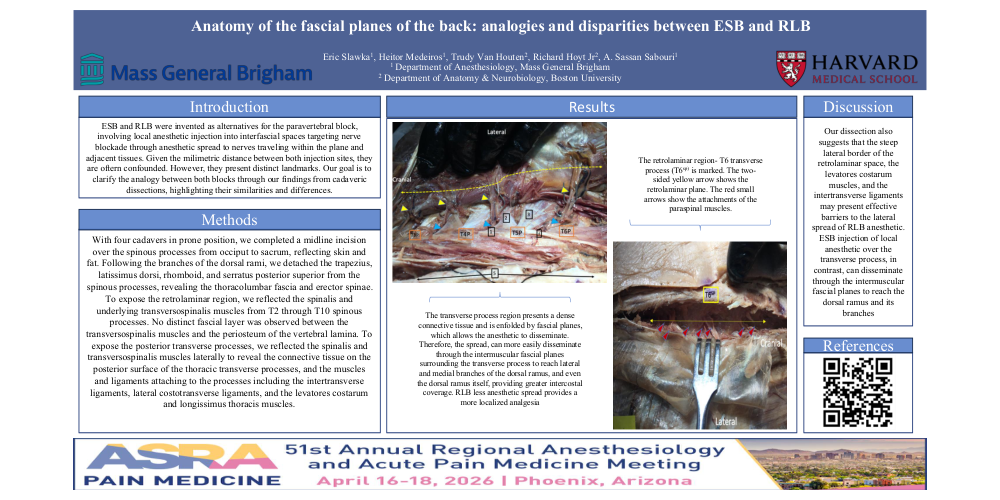
Results: The transverse process region presents a dense connective tissue and is enfolded by fascial planes, which allows the anesthetic to disseminate. Therefore, the spread, can more easily disseminate through the intermuscular fascial planes surrounding the transverse process to reach lateral and medial branches of the dorsal ramus, and even the dorsal ramus itself, providing greater intercostal coverage. RLB less anesthetic spread provides a more localized analgesia; The retrolaminar region- T6 transverse process (T6sp) is marked. The two- sided yellow arrow shows the retrolaminar plane. The red small arrows show the attachments of the paraspinal muscles.
Discussion: Our dissection also suggests that the steep lateral border of the retrolaminar space, the levatores costarum muscles, and the intertransverse ligaments may present effective barriers to the lateral spread of RLB anesthetic. ESB injection of local anesthetic over the transverse process, in contrast, can disseminate through the intermuscular fascial planes to reach the dorsal ramus and its branches