372 posters, 1 audios, 13 topics, 29 sessions, 1,035 authors, 449 institutions
ePostersLive by SciGen Technologies S.A. All rights reserved.
51st Annual Regional Anesthesiology and Acute Pain Medicine Meeting
April 16 - 18, 2026 | Phoenix, Arizona

2315056
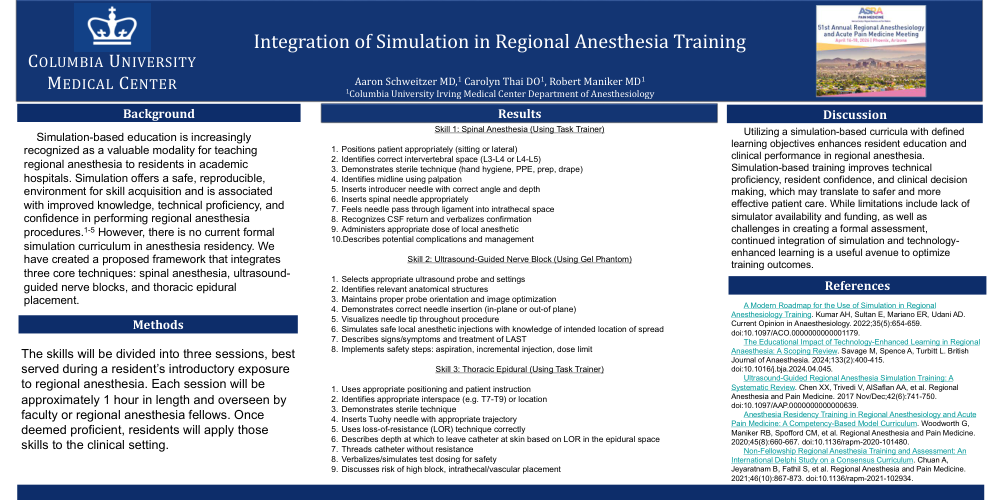
Integration of Simulation in Regional Anesthesia Training
Poster Presenter
Part of Topic
Scientific Abstracts > Education
Integration of Simulation in Regional Anesthesia Training
Introduction
Simulation-based education is increasingly recognized as a valuable modality for teaching regional anesthesia to residents in academic hospitals. Simulation offers a safe, reproducible, environment for skill acquisition and is associated with improved knowledge, technical proficiency, and confidence in performing regional anesthesia procedures.1-5 However, there is no current formal simulation curriculum in anesthesia residency. We have created a proposed framework that integrates three core techniques: spinal anesthesia, ultrasound-guided nerve blocks, and thoracic epidural placement.
Methods
The skills will be divided into three sessions, best served during a resident’s introductory exposure to regional anesthesia. Each session will be approximately 1 hour in length and overseen by faculty or regional anesthesia fellows. Once deemed proficient, residents will apply those skills to the clinical setting.
Results
Skill 1: Spinal Anesthesia (Using Task Trainer)
- Positions patient appropriately (sitting or lateral)
- Identifies correct intervertebral space (L3-L4 or L4-L5)
- Demonstrates sterile technique (hand hygiene, PPE, prep, drape)
- Identifies midline using palpation
- Inserts introducer needle with correct angle and depth
- Inserts spinal needle appropriately
- Feels needle pass through ligament into intrathecal space
- Recognizes CSF return and verbalizes confirmation
- Administers appropriate dose of local anesthetic
- Describes potential complications and management
Skill 2: Ultrasound-Guided Nerve Block (Using Gel Phantom)
- Selects appropriate ultrasound probe and settings
- Identifies relevant anatomical structures
- Maintains proper probe orientation and image optimization
- Demonstrates correct needle insertion (in-plane or out-of plane)
- Visualizes needle tip throughout procedure
- Simulates safe local anesthetic injections with knowledge of intended location of spread
- Describes signs/symptoms and treatment of LAST
- Implements safety steps: aspiration, incremental injection, dose limit
Skill 3: Thoracic Epidural (Using Task Trainer)
- Uses appropriate positioning and patient instruction
- Identifies appropriate interspace (e.g. T7-T9) or location
- Demonstrates sterile technique
- Inserts Tuohy needle with appropriate trajectory
- Uses loss-of-resistance (LOR) technique correctly
- Describes depth at which to leave catheter at skin based on LOR in the epidural space
- Threads catheter without resistance
- Verbalizes/simulates test dosing for safety
- Discusses risk of high block, intrathecal/vascular placement
Discussion
Utilizing a simulation-based curricula with defined learning objectives enhances resident education and clinical performance in regional anesthesia. Simulation-based training improves technical proficiency, resident confidence, and clinical decision making, which may translate to safer and more effective patient care. While limitations include lack of simulator availability and funding, as well as challenges in creating a formal assessment, continued integration of simulation and technology-enhanced learning is a useful avenue to optimize training outcomes.
References
- A Modern Roadmap for the Use of Simulation in Regional Anesthesiology Training. Kumar AH, Sultan E, Mariano ER, Udani AD. Current Opinion in Anaesthesiology. 2022;35(5):654-659. doi:10.1097/ACO.0000000000001179.
- The Educational Impact of Technology-Enhanced Learning in Regional Anaesthesia: A Scoping Review. Savage M, Spence A, Turbitt L. British Journal of Anaesthesia. 2024;133(2):400-415. doi:10.1016/j.bja.2024.04.045.
- Ultrasound-Guided Regional Anesthesia Simulation Training: A Systematic Review. Chen XX, Trivedi V, AlSaflan AA, et al. Regional Anesthesia and Pain Medicine. 2017 Nov/Dec;42(6):741-750. doi:10.1097/AAP.0000000000000639.
- Anesthesia Residency Training in Regional Anesthesiology and Acute Pain Medicine: A Competency-Based Model Curriculum. Woodworth G, Maniker RB, Spofford CM, et al. Regional Anesthesia and Pain Medicine. 2020;45(8):660-667. doi:10.1136/rapm-2020-101480.
- Non-Fellowship Regional Anesthesia Training and Assessment: An International Delphi Study on a Consensus Curriculum. Chuan A, Jeyaratnam B, Fathil S, et al. Regional Anesthesia and Pain Medicine. 2021;46(10):867-873. doi:10.1136/rapm-2021-102934.