383 posters, 2 videos, 1 audios, 8 topics, 28 sessions, 328 authors, 225 institutions
ePostersLive by SciGen Technologies S.A. All rights reserved.
50th Annual Regional Anesthesiology and Acute Pain Medicine Meeting
May 1 - 3, 2025 | Orlando, Florida

6879
PNEUMOTHORAX IN ARTHROSCOPIC SHOULDER SURGERY: A MULTIFACTORIAL RISK ANALYSIS AND CASE REPORT
Poster Presenter
Authors
Affiliations
Part of Topic
Safety/QA/QI Projects
Pneumothorax in Arthroscopic Shoulder Surgery:
A Multifactorial Risk Analysis and Case Report
Amanda Burns MD1 and Shubha Srinivasreddy MD1
Penn State Health Department of Anesthesiology and Perioperative Management
1
Introduction
• This casehighlights a pneumothorax during arthroscopic shoulder surgery requiring general anesthesia and an interscalene brachial plexus block and examines the contributing factors and management.
Case Discussion
• An 84-year-old female with a medical history of pulmonary sarcoidosis on steroids with no recent pulmonary function tests and chronic back pain presented for right reverse shoulder arthroplasty due to chronic glenohumeral arthritis.
• Patient received and tolerated well a preoperative interscalene single shot nerve block with ultrasound guidance.
• She was induced and intubated then placed in a beach chair position. Fifty minutes after induction, the patient’s oxygen saturation began to drop. Her tidal volumes remained consistent with no change in peak inspiratory pressures required to maintain her tidal volumes. The FiO2 was increased. Throughout the rest of the procedure, she remained hemodynamically stable.
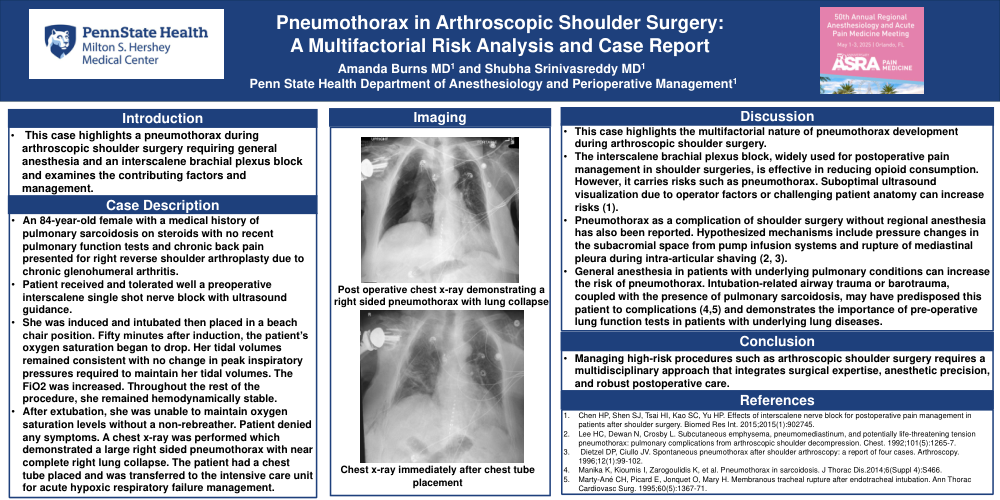
• After extubation, she was unable to maintain oxygen saturation levels without a non-rebreather. Patient denied any symptoms. A chest x-ray was performed which demonstrated a large right sided pneumothorax with near complete right lung collapse. The patient had a chest tube placed and was transferred to the intensive care unit for acute hypoxic respiratory failure management.
Discussion
• This case highlights the multifactorial nature of pneumothorax development during arthroscopic shoulder surgery.
• The interscalene brachial plexus block, widely used for postoperative pain management in shoulder surgeries, is effective in reducing opioid consumption. However, it carries risks such as pneumothorax. Suboptimal ultrasound visualization due to operator factors or challenging patient anatomy can increase
risks (1).
• Pneumothorax as a complication of shoulder surgery without regional anesthesia has also been reported. Hypothesized mechanisms include pressure changes in
the subacromial space from pump infusion systems and rupture of mediastinal
pleura during intra-articular shaving (2, 3).
• General anesthesia in patients with underlying pulmonary conditions can increase the risk of pneumothorax. Intubation-related airway trauma or barotrauma,
coupled with the presence of pulmonary sarcoidosis, may have predisposed this patient to complications (4,5) and demonstrates the importance of pre-operative lung function tests in patients with underlying lung diseases.
Conclusion
• Managing high-risk procedures such as arthroscopic shoulder surgery requires a multidisciplinary approach that integrates surgical expertise, anesthetic precision, and robust postoperative care.
References
1. Chen HP, Shen SJ, Tsai HI, Kao SC, Yu HP. Effects of interscalene nerve block for postoperative pain management in
patients after shoulder surgery. Biomed Res Int. 2015;2015(1):902745.
2. Lee HC, Dewan N, Crosby L. Subcutaneous emphysema, pneumomediastinum, and potentially life-threatening tension
pneumothorax: pulmonary complications from arthroscopic shoulder decompression. Chest. 1992;101(5):1265-7.
3. Dietzel DP, Ciullo JV. Spontaneous pneumothorax after shoulder arthroscopy: a report of four cases. Arthroscopy.
1996;12(1):99-102.
4. Manika K, Kioumis I, Zarogoulidis K, et al. Pneumothorax in sarcoidosis. J Thorac Dis.2014;6(Suppl 4):S466.
5. Marty-Ané CH, Picard E, Jonquet O, Mary H. Membranous tracheal rupture after endotracheal intubation. Ann Thorac
Cardiovasc Surg. 1995;60(5):1367-71.