383 posters, 2 videos, 1 audios, 8 topics, 28 sessions, 328 authors, 225 institutions
ePostersLive by SciGen Technologies S.A. All rights reserved.
50th Annual Regional Anesthesiology and Acute Pain Medicine Meeting
May 1 - 3, 2025 | Orlando, Florida

6460
LANGUAGE DISCORDANCE AND REGIONAL ANESTHESIA FOR ANKLE FRACTURE SURGERY
Poster Presenter
Authors
Affiliations
Part of Topic
Safety/QA/QI Projects
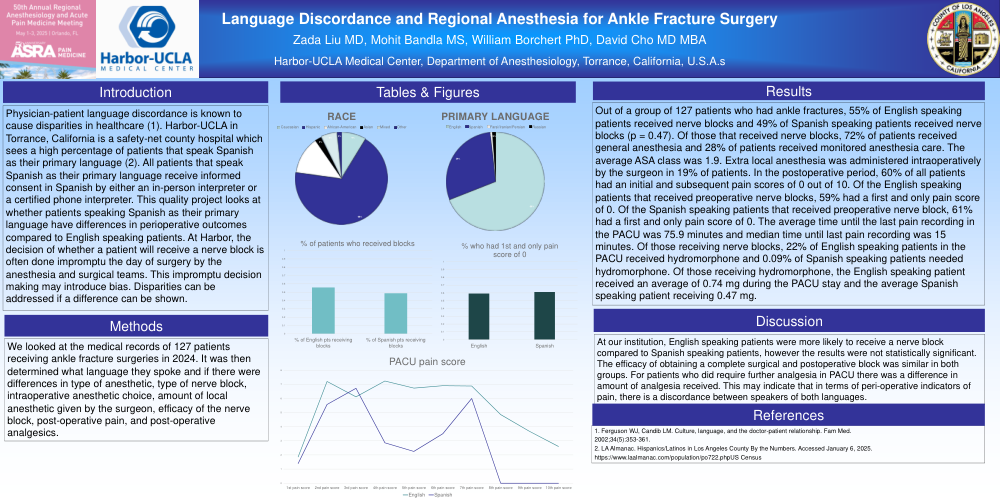
Physician-patient language discordance is known to cause disparities in healthcare (1). Harbor-UCLA in Torrance, California is a safety-net county hospital which sees a high percentage of patients that speak Spanish as their primary language (2). All patients that speak Spanish as their primary language receive informed consent in Spanish by either an in-person interpreter or a certified phone interpreter. This quality project looks at whether patients speaking Spanish as their primary language have differences in perioperative outcomes compared to English speaking patients. At Harbor, the decision of whether a patient will receive a nerve block is often done impromptu the day of surgery by the anesthesia and surgical teams. This impromptu decision making may introduce bias. Disparities can be addressed if a difference can be shown.
We looked at the medical records of 127 patients receiving ankle fracture surgeries in 2024. It was then determined what language they spoke and if there were differences in type of anesthetic, type of nerve block, intraoperative anesthetic choice, amount of local anesthetic given by the surgeon, efficacy of the nerve block, post-operative pain, and post-operative analgesics.
Out of a group of 127 patients who had ankle fractures, 55% of English speaking patients received nerve blocks and 49% of Spanish speaking patients received nerve blocks (p = 0.47). Of those that received nerve blocks, 72% of patients received general anesthesia and 28% of patients received monitored anesthesia care. The average ASA class was 1.9. Extra local anesthesia was administered intraoperatively by the surgeon in 19% of patients. In the postoperative period, 60% of all patients had an initial and subsequent pain scores of 0 out of 10. Of the English speaking patients that received preoperative nerve blocks, 59% had a first and only pain score of 0. Of the Spanish speaking patients that received preoperative nerve block, 61% had a first and only pain score of 0. The average time until the last pain recording in the PACU was 75.9 minutes and median time until last pain recording was 15 minutes. Of those receiving nerve blocks, 22% of English speaking patients in the PACU received hydromorphone and 0.09% of Spanish speaking patients needed hydromorphone. Of those receiving hydromorphone, the English speaking patient received an average of 0.74 mg during the PACU stay and the average Spanish speaking patient receiving 0.47 mg.
At our institution, English speaking patients were more likely to receive a nerve block compared to Spanish speaking patients, however the results were not statistically significant. The efficacy of obtaining a complete surgical and postoperative block was similar in both groups. For patients who did require further analgesia in PACU there was a difference in amount of analgesia received. This may indicate that in terms of peri-operative indicators of pain, there is a discordance between speakers of both languages.
1. Ferguson WJ, Candib LM. Culture, language, and the doctor-patient relationship. Fam Med.
2002;34(5):353-361.
2. LA Almanac. Hispanics/Latinos in Los Angeles County By the Numbers. Accessed January 6, 2025.
https://www.laalmanac.com/population/po722.phpUS Census