383 posters, 2 videos, 1 audios, 8 topics, 28 sessions, 328 authors, 225 institutions
ePostersLive by SciGen Technologies S.A. All rights reserved.
50th Annual Regional Anesthesiology and Acute Pain Medicine Meeting
May 1 - 3, 2025 | Orlando, Florida

6688
DETECTING ANTICOAGULANT USE PRIOR TO NEURAXIAL ANESTHESIA: ANALYSIS OF ELECTRONIC MEDICAL RECORD SEARCH VS SUMMARIZED REPORT
Poster Presenter
Authors
Affiliations
Part of Topic
Safety/QA/QI Projects
Detecting Anticoagulant Use Prior to Neuraxial Anesthesia: Analysis of Electronic Medical Record Search vs Summarized Report
Sam Bonge MD, Michael Kissen MD, Nicole Fierro MD, Jason Hager MD, Dave Frattinger, Rodney Litorja, Gabriel Pollock MD
Department of Anesthesiology
Cedars-Sinai Medical Center, Los Angeles
Introduction
• Spinal and perineural hematomas are serious complications associated
with neuraxial anesthesia and deep plexus peripheral nerve blocks.
• Risk is increased in patients taking anticoagulants and/or antiplatelets
• Study aims to determine if providing relevant anticoagulant information in
one EMR location improves accuracy in assessing the safety of neuraxial
anesthesia and reduces the time required to find this information.
Material and Methods
• An anticoagulation summary report was created in Epic composed of
medications containing specific pharmaceutical classes or subclasses.
• The report lists the following:
• Anticoagulants received during the last 14 days of hospital admission
• Anticoagulants taken 7 days prior to admission
• Dates and times of medication administration
• Pertinent lab values, PT, PTT, INR, PLT, and fibrinogen levels
• A testing environment was then created to simulate a standardized
patient scheduled to receive spinal anesthesia after receiving a one-time
dose of 600 mg clopidogrel 4 days before the planned procedure date
• Participants were randomized either to use the report or to use their
traditional method of identifying anticoagulants.
• Outcomes
• Primary: Determine if participants were able to identify the use of
clopidogrel prior to determining spinal eligibility.
• Secondary: Length of time required for chart review, confidence level
in finding anticoagulant use, and whether participants would continue
to use the report in their practice.
Results
• 40 anesthesiologists took part in the simulation
• 20 attendings and 20 trainees
• 10 participants from each group used the anticoagulation
summary report and the remaining 10 used their traditional
method.
• Overall accuracy in electing not to proceed with spinal anesthesia
due to recent clopidogrel use was 90%.
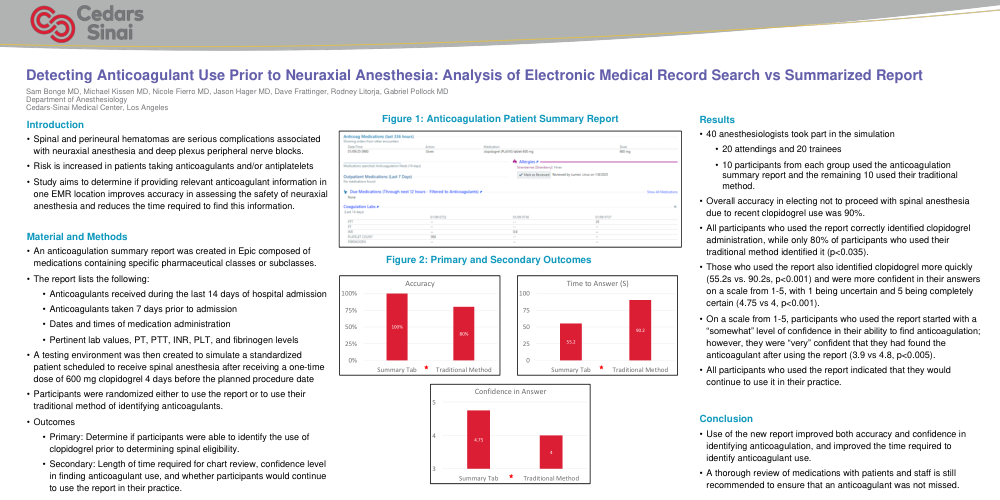
• All participants who used the report correctly identified clopidogrel
administration, while only 80% of participants who used their
traditional method identified it (p<0.035).
• Those who used the report also identified clopidogrel more quickly
(55.2s vs. 90.2s, p<0.001) and were more confident in their answers
on a scale from 1-5, with 1 being uncertain and 5 being completely
certain (4.75 vs 4, p<0.001).
• On a scale from 1-5, participants who used the report started with a
“somewhat” level of confidence in their ability to find anticoagulation;
however, they were “very” confident that they had found the
anticoagulant after using the report (3.9 vs 4.8, p<0.005).
• All participants who used the report indicated that they would
continue to use it in their practice.
Conclusion
• Use of the new report improved both accuracy and confidence in
identifying anticoagulation, and improved the time required to
identify anticoagulant use.
• A thorough review of medications with patients and staff is still
recommended to ensure that an anticoagulant was not missed.
© 2019 Cedar