383 posters, 2 videos, 1 audios, 8 topics, 28 sessions, 328 authors, 225 institutions
ePostersLive by SciGen Technologies S.A. All rights reserved.
50th Annual Regional Anesthesiology and Acute Pain Medicine Meeting
May 1 - 3, 2025 | Orlando, Florida

6787
PATIENT PERCEPTION OF PERIPHERAL NERVE BLOCK DURATION: A SCALABLE DATA ANALYSIS
Poster Presenter
Authors
Affiliations
Part of Topic
Safety/QA/QI Projects
Patient-Reported peripheral nerve block duration: a scalable data analysis
Meredith T. Peck, DO (1), Joshua J. Scofield(2)
1. Department of Anesthesiology at Dartmouth Hitchcock Medical Center Lebanon, NH, 2. Department of Data Analytics, IDEXX Westbrook, ME
Introduction
Peripheral nerve block duration is a commonly utilized adjunct in postoperative pain management. Understanding patients' perceptions of block duration offers insights that may not align with objective measures. Leveraging scalable data analysis in the era of electronic health records (EHRs) and advanced analytical tools can bridge this gap, enhancing patient care.
Materials & Methods
In this prospective observational study, 143 patients who received peripheral nerve blocks were contacted 3–5 days postoperatively to estimate block duration. Data on block type, surgery type, gender, age, and provider experience were collected. Statistical analyses included descriptive statistics, regression, and t-tests.
RESULTS
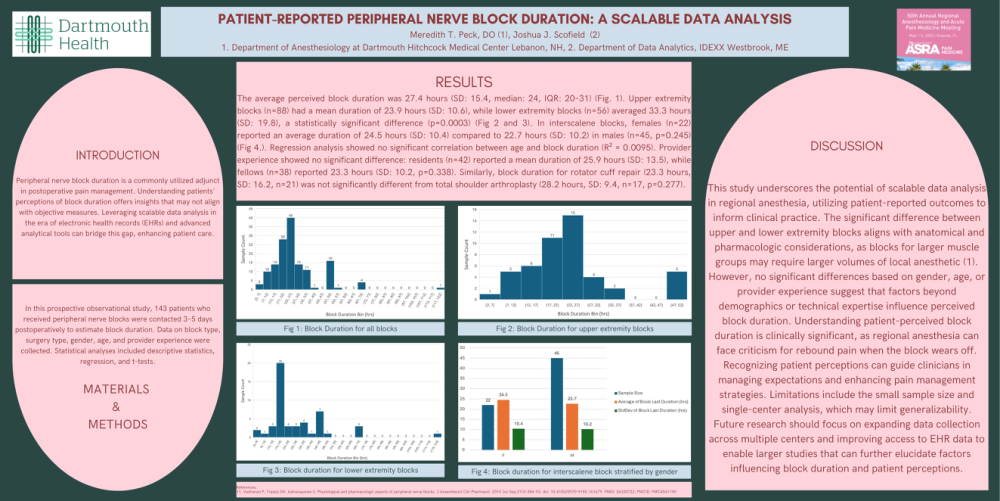
The average perceived block duration was 27.4 hours (SD: 15.4, median: 24, IQR: 20–31) (Fig. 1). Upper extremity blocks (n=88) had a mean duration of 23.9 hours (SD: 10.6), while lower extremity blocks (n=56) averaged 33.3 hours (SD: 19.8), a statistically significant difference (p=0.0003) (Fig 2 and 3). In interscalene blocks, females (n=22) reported an average duration of 24.5 hours (SD: 10.4) compared to 22.7 hours (SD: 10.2) in males (n=45, p=0.245) (Fig 4.). Regression analysis showed no significant correlation between age and block duration (R² = 0.0095). Provider experience showed no significant difference: residents (n=42) reported a mean duration of 25.9 hours (SD: 13.5), while fellows (n=38) reported 23.3 hours (SD: 10.2, p=0.338). Similarly, block duration for rotator cuff repair (23.3 hours, SD: 16.2, n=21) was not significantly different from total shoulder arthroplasty (28.2 hours, SD: 9.4, n=17, p=0.277).
DISCUSSION
This study underscores the potential of scalable data analysis in regional anesthesia, utilizing patient-reported outcomes to inform clinical practice. The significant difference between upper and lower extremity blocks aligns with anatomical and pharmacologic considerations, as blocks for larger muscle groups may require larger volumes of local anesthetic (1). However, no significant differences based on gender, age, or provider experience suggest that factors beyond demographics or technical expertise influence perceived block duration. Understanding patient-perceived block duration is clinically significant, as regional anesthesia can face criticism for rebound pain when the block wears off. Recognizing patient perceptions can guide clinicians in managing expectations and enhancing pain management strategies. Limitations include the small sample size and single-center analysis, which may limit generalizability. Future research should focus on expanding data collection across multiple centers and improving access to EHR data to enable larger studies that can further elucidate factors influencing block duration and patient perceptions.
References:
11. Vadhanan P, Tripaty DK, Adinarayanan S. Physiological and pharmacologic aspects of peripheral nerve blocks. J Anaesthesiol Clin Pharmacol. 2015 Jul-Sep;31(3):384-93. doi: 10.4103/0970-9185.161679. PMID: 26330722; PMCID: PMC4541190