383 posters, 2 videos, 1 audios, 8 topics, 28 sessions, 328 authors, 225 institutions
ePostersLive by SciGen Technologies S.A. All rights reserved.
50th Annual Regional Anesthesiology and Acute Pain Medicine Meeting
May 1 - 3, 2025 | Orlando, Florida

6632
ASSESSMENT OF POST DISCHARGE PAIN COMPLAINTS TO IMPROVE PATIENT EXPERIENCE: A QUALITY IMPROVEMENT PROJECT.
Poster Presenter
Authors
Affiliations
Part of Topic
Safety/QA/QI Projects
Introduction
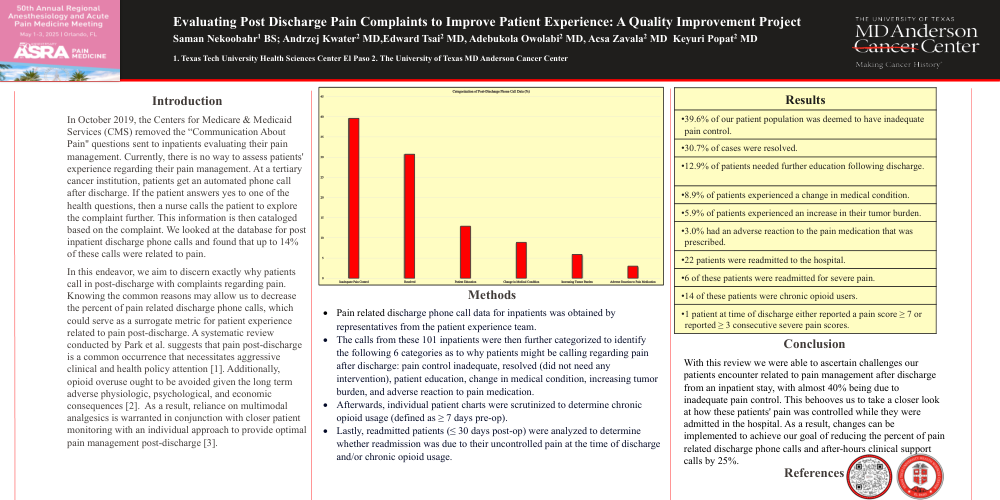
In October 2019, the Centers for Medicare & Medicaid Services (CMS) removed the “Communication About Pain'' questions sent to inpatients evaluating their pain management. Currently, there is no way to assess patients' experience regarding their pain management. At a tertiary cancer institution, patients get an automated phone call after discharge. If the patient answers yes to one of the health questions, then a nurse calls the patient to explore the complaint further. This information is then cataloged based on the complaint. We looked at the database for post inpatient discharge phone calls and found that up to 14% of these calls were related to pain.
In this endeavor, we aim to discern exactly why patients call in post-discharge with complaints regarding pain. Knowing the common reasons may allow us to decrease the percent of pain related discharge phone calls, which could serve as a surrogate metric for patient experience related to pain post-discharge. A systematic review conducted by Park et al. suggests that pain post-discharge is a common occurrence that necessitates aggressive clinical and health policy attention [1]. Additionally, opioid overuse ought to be avoided given the long term adverse physiologic, psychological, and economic consequences [2]. As a result, reliance on multimodal analgesics is warranted in conjunction with closer patient monitoring with an individual approach to provide optimal pain management post-discharge [3
Methods
Conclusion
With this review we were able to ascertain challenges our patients encounter related to pain management after discharge from an inpatient stay, with almost 40% being due to inadequate pain control. This behooves us to take a closer look at how these patients' pain was controlled while they were admitted in the hospital. As a result, changes can be implemented to achieve our goal of reducing the percent of pain related discharge phone calls and after-hours clinical support calls by 25%.