383 posters, 2 videos, 1 audios, 8 topics, 28 sessions, 328 authors, 225 institutions
ePostersLive by SciGen Technologies S.A. All rights reserved.
50th Annual Regional Anesthesiology and Acute Pain Medicine Meeting
May 1 - 3, 2025 | Orlando, Florida

6429
AN EARLY DETECTION AND MONITORING SYSTEM FOR SAFE OPIOID HOSPITAL DISCHARGES
Poster Presenter
Authors
Affiliations
Part of Topic
Safety/QA/QI Projects
Introduction
•The Joint Commission’s two-pronged approach sets standards for safe opioid prescribing:
-identifying patients with concurrent prescriptions of opioids and/or benzodiazepines
-discouraging providers from prescribing two or more opioids or a concomitant benzodiazepines prescription.1
•The Defense Health Agency's (DHA) Strategic Plan Fiscal Year 2023-2028 involves mitigating errors through continuous improvement to enhance safety.2
•The ORYX measurement requirements support Joint Commission-accredited organizations in their quality improvement efforts.
•Safe opioid prescribing within the Military Health System (MHS) upon inpatient hospitalization discharge is tightly regulated.
Objectives
The ORYX MHS report aims to highlight five key objectives on how regional anesthesiologists may contribute to the guidelines:
1.Increasing awareness amongst regional anesthesiologists on the Joint Commission’s requirement for safe discharge opioid prescribing
2.Developing an early surveillance system for safe opioid prescribing
3.Monitoring the trends in safe discharge opioid prescribing
4.Implementing a notification system to identify patient cases with unsafe opioid prescription(s)
5.Assessing appropriateness of when and how to prescribe opioids, as well as incorporating collaboration amongst anesthesia and surgery providers
Methods
•This is a prospective chart review of EHR and prescription fill data of inpatient military beneficiaries.
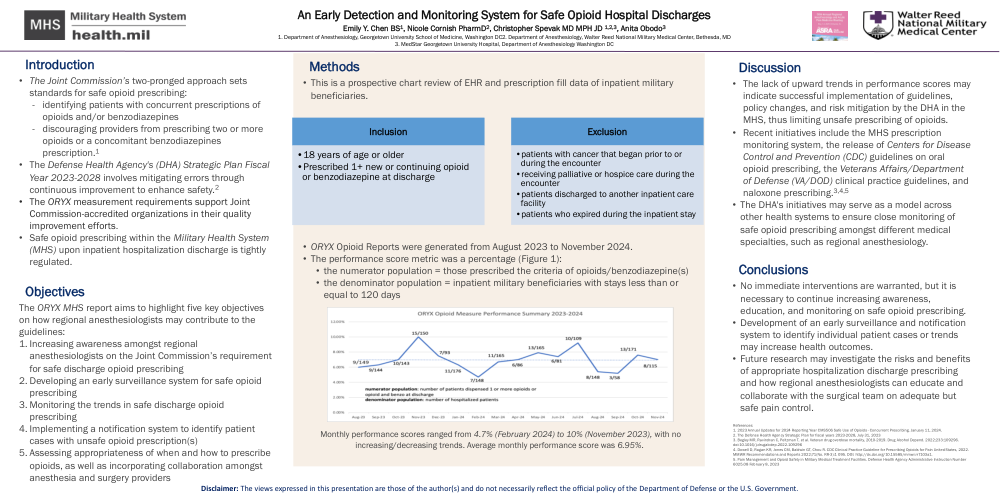
•ORYX Opioid Reports were generated from August 2023 to November 2024.
•The performance score metric was a percentage (Figure 1):
•the numerator population = those prescribed the criteria of opioids/benzodiazepine(s)
•the denominator population = inpatient military beneficiaries with stays less than or equal to 120 days
Discussion
•The lack of upward trends in performance scores may indicate successful implementation of guidelines, policy changes, and risk mitigation by the DHA in the MHS, thus limiting unsafe prescribing of opioids.
•Recent initiatives include the MHS prescription monitoring system, the release of Centers for Disease Control and Prevention (CDC) guidelines on oral opioid prescribing, the Veterans Affairs/Department of Defense (VA/DOD) clinical practice guidelines, and naloxone prescribing.3,4,5
•The DHA's initiatives may serve as a model across other health systems to ensure close monitoring of safe opioid prescribing amongst different medical specialties, such as regional anesthesiology.
Conclusions
•No immediate interventions are warranted, but it is necessary to continue increasing awareness, education, and monitoring on safe opioid prescribing.
•Development of an early surveillance and notification system to identify individual patient cases or trends may increase health outcomes.
•Future research may investigate the risks and benefits of appropriate hospitalization discharge prescribing and how regional anesthesiologists can educate and collaborate with the surgical team on adequate but safe pain control.