383 posters, 2 videos, 1 audios, 8 topics, 28 sessions, 328 authors, 225 institutions
ePostersLive by SciGen Technologies S.A. All rights reserved.
50th Annual Regional Anesthesiology and Acute Pain Medicine Meeting
May 1 - 3, 2025 | Orlando, Florida

6795
INVESTIGATING THE USE OF VIDEO-STREAMING AND NOISE-CANCELING TECHNOLOGY TO MINIMIZE INTRAOPERATIVE SEDATION IN TKA
Poster Presenter
Authors
Affiliations
Part of Topic
Safety/QA/QI Projects
Investigating the Use of Video-Streaming and Noise-Canceling Technology to Minimize Intraoperative Sedation in Total Knee Arthroplasty
Aamil U Patel MD, David A Olsen MD, Matthew P Abdel MD**, Karen E Nase CRNA DNP, Jason K Panchamia DO, Adam D Niesen MD, Hugh M Smith MD PhD, Laurence C Torsher MD, Christopher M Duncan MD, Adam W Amundson, MD
Mayo Clinic, Department of Anesthesiology and Perioperative Medicine; Mayo Clinic, Department of Orthopedic Surgery**
Introduction
In lower extremity orthopedic surgery, neuraxial anesthesia combined with moderate sedation is a commonly employed technique for joint arthroplasty procedures. While effective, moderate sedation carries inherent risks, including over-sedation, respiratory depression [1], post-operative delirium [2], and potential neurologic injury due to hypoxia or hypotension. Thus, managing patients under spinal anesthesia presents a delicate balance between achieving sufficient sedation and maintaining patient safety.
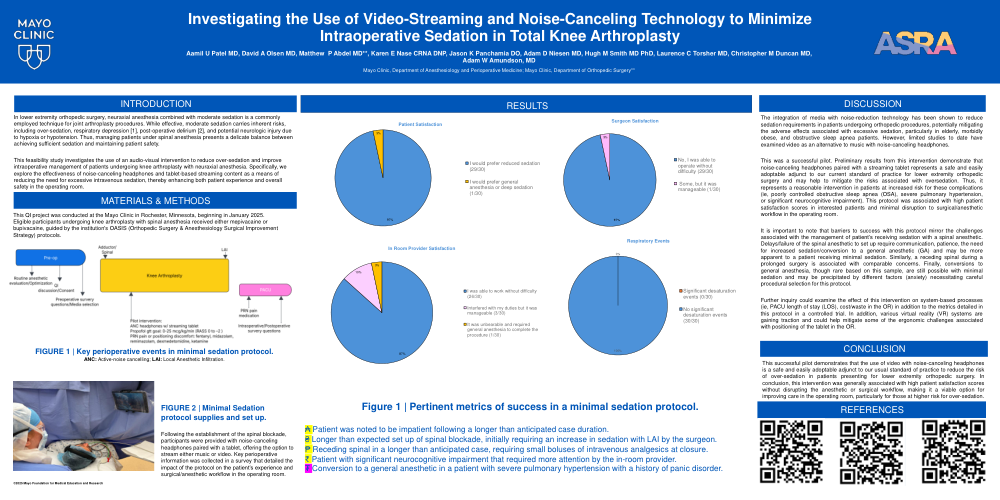
This feasibility study investigates the use of an audio-visual intervention to reduce over-sedation and improve intraoperative management of patients undergoing knee arthroplasty with neuraxial anesthesia. Specifically, we explore the effectiveness of noise-canceling headphones and tablet-based streaming content as a means of reducing the need for excessive intravenous sedation, thereby enhancing both patient experience and overall safety in the operating room.
Materials & Methods
This QI project was conducted at the Mayo Clinic in Rochester, Minnesota, beginning in January 2025. Eligible participants undergoing knee arthroplasty with spinal anesthesia received either mepivacaine or bupivacaine, guided by the institution's OASIS (Orthopedic Surgery & Anesthesiology Surgical Improvement Strategy) protocols.
Following the establishment of the spinal blockade, participants were provided with noise-canceling headphones paired with a tablet, offering the option to stream either music or video. Key perioperative information was collected in a survey that detailed the impact of the protocol on the patient’s experience and surgical/anesthetic workflow in the operating room.
DISCUSSION
The integration of media with noise-reduction technology has been shown to reduce sedation requirements in patients undergoing orthopedic procedures, potentially mitigating the adverse effects associated with excessive sedation, particularly in elderly, morbidly obese, and obstructive sleep apnea patients. However, limited studies to date have examined video as an alternative to music with noise-canceling headphones.
This was a successful pilot. Preliminary results from this intervention demonstrate that noise-canceling headphones paired with a streaming tablet represents a safe and easily adoptable adjunct to our current standard of practice for lower extremity orthopedic surgery and may help to mitigate the risks associated with oversedation. Thus, it represents a reasonable intervention in patients at increased risk for these complications (ie, poorly controlled obstructive sleep apnea (OSA), severe pulmonary hypertension, or significant neurocognitive impairment). This protocol was associated with high patient satisfaction scores in interested patients and minimal disruption to surgical/anesthetic workflow in the operating room.
It is important to note that barriers to success with this protocol mirror the challenges associated with the management of patient’s receiving sedation with a spinal anesthetic. Delays/failure of the spinal anesthetic to set up require communication, patience, the need for increased sedation/conversion to a general anesthetic (GA) and may be more apparent to a patient receiving minimal sedation. Similarly, a receding spinal during a prolonged surgery is associated with comparable concerns. Finally, conversions to general anesthesia, though rare based on this sample, are still possible with minimal sedation and may be precipitated by different factors (anxiety) necessitating careful procedural selection for this protocol.
Further inquiry could examine the effect of this intervention on system-based processes (ie, PACU length of stay (LOS), cost/waste in the OR) in addition to the metrics detailed in this protocol in a controlled trial. In addition, various virtual reality (VR) systems are gaining traction and could help mitigate some of the ergonomic challenges associated with positioning of the tablet in the OR.
CONCLUSION
This successful pilot demonstrates that the use of video with noise-canceling headphones is a safe and easily adoptable adjunct to our usual standard of practice to reduce the risk of over-sedation in patients presenting for lower extremity orthopedic surgery. In conclusion, this intervention was generally associated with high patient satisfaction scores without disrupting the anesthetic or surgical workflow, making it a viable option for improving care in the operating room, particularly for those at higher risk for over-sedation.