383 posters, 2 videos, 1 audios, 8 topics, 28 sessions, 328 authors, 225 institutions
ePostersLive by SciGen Technologies S.A. All rights reserved.
50th Annual Regional Anesthesiology and Acute Pain Medicine Meeting
May 1 - 3, 2025 | Orlando, Florida

6670
THE USE OF ANTERIOR FEMORAL NERVE BLOCKS IN TOTAL KNEE ARTHROPLASTY: A QUALITY IMPROVEMENT PROJECT
Poster Presenter
Authors
Affiliations
Part of Topic
Safety/QA/QI Projects
The Use of Anterior Femoral Cutaneous Nerve Blocks in Total Knee
Arthroplasty: A Quality Improvement Project
James Tautkus, MD; Andrew Kehrer, DO; William Perillo, DO; Haleh Saadat, MD, FAAP; Vlad Frenk, MD, FASA
Introduction Key Findings
Discussion
Discussion
Problem: Many patients experience anterior distal knee pain following
total knee arthroplasty (TKA), commonly associated with the anterior
femoral cutaneous nerve (AFCN) distribution.
Current Practice:
• IV diazepam is used as first-line treatment to relieve muscle spasms.
• Opioids and rescue blocks are used for additional pain management.
Objective:
• Incorporate AFCN block into the preoperative nerve block protocol.
Hypothesis:
• We hypothesize that incorporating AFCN block will reduce the need for
postoperative pain medications and interventions
Methods
Standard Analgesia Care:
• Femoral Triangle Block (FTB) and Injection between the Popliteal Artery
and the Capsule of the Knee (IPACK) are administered preoperatively.
Intervention:
• AFCN block was added to the standard analgesia protocol.
Data Collection:
• A retrospective review of medical records for 105 patients who
received the AFCN block as part of the protocol and 100 patients who
did not receive the block
Exclusion Criteria:
• None of the patients were chronic opioid users.
Primary Outcome:
• Postanesthesia care unit (PACU) diazepam use.
US images
Key Findings:
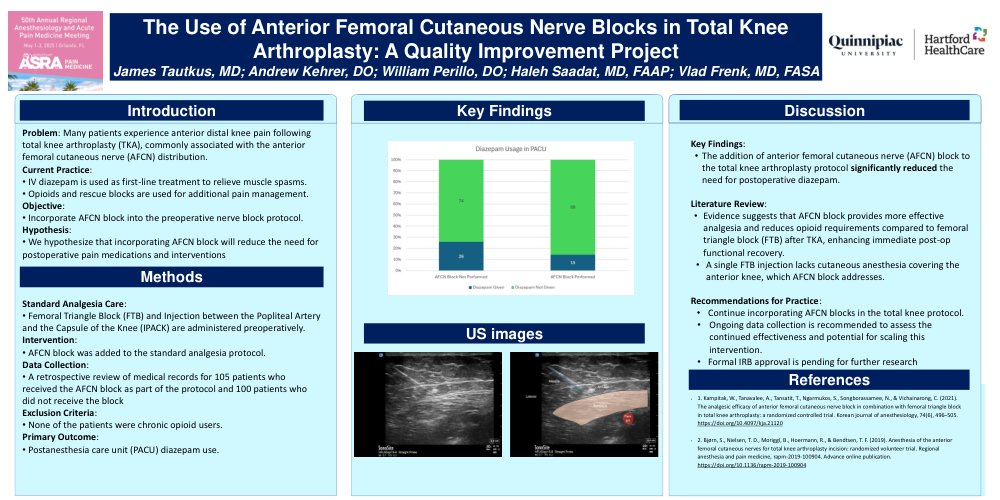
• The addition of anterior femoral cutaneous nerve (AFCN) block to
the total knee arthroplasty protocol significantly reduced the
need for postoperative diazepam.
Literature Review:
• Evidence suggests that AFCN block provides more effective
analgesia and reduces opioid requirements compared to femoral
triangle block (FTB) after TKA, enhancing immediate post-op
functional recovery.
• A single FTB injection lacks cutaneous anesthesia covering the
anterior knee, which AFCN block addresses.
Recommendations for Practice:
• Continue incorporating AFCN blocks in the total knee protocol.
• Ongoing data collection is recommended to assess the
continued effectiveness and potential for scaling this
intervention.
• Formal IRB approval is pending for further research
References
⦁ 1. Kampitak, W., Tanavalee, A., Tansatit, T., Ngarmukos, S., Songborassamee, N., & Vichainarong, C. (2021).
The analgesic efficacy of anterior femoral cutaneous nerve block in combination with femoral triangle block
in total knee arthroplasty: a randomized controlled trial. Korean journal of anesthesiology, 74(6), 496–505.
https://doi.org/10.4097/kja.21120
⦁ 2. Bjørn, S., Nielsen, T. D., Moriggl, B., Hoermann, R., & Bendtsen, T. F. (2019). Anesthesia of the anterior
femoral cutaneous nerves for total knee arthroplasty incision: randomized volunteer trial. Regional
anesthesia and pain medicine, rapm-2019-100904. Advance online publication.
https://doi.org/10.1136/rapm-2019-100904