383 posters, 2 videos, 1 audios, 8 topics, 28 sessions, 328 authors, 225 institutions
ePostersLive by SciGen Technologies S.A. All rights reserved.
50th Annual Regional Anesthesiology and Acute Pain Medicine Meeting
May 1 - 3, 2025 | Orlando, Florida

6695
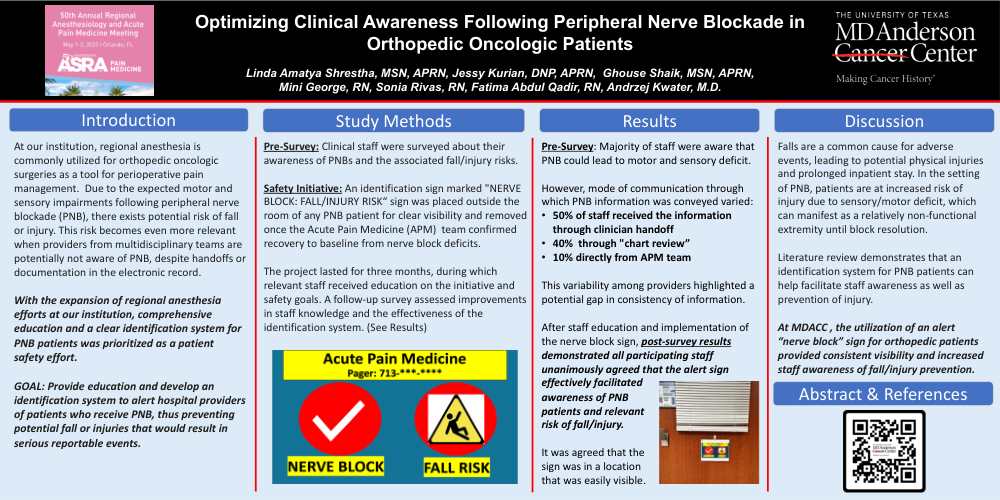
OPTIMIZING CLINICAL AWARENESS FOLLOWING PERIPHERAL NERVE BLOCKADE IN ORTHOPEDIC ONCOLOGIC PATIENTS
Poster Presenter
Authors
Affiliations
Part of Topic
Safety/QA/QI Projects
INTRODUCTION
At our institution, regional anesthesia is commonly utilized for orthopedic oncologic surgeries as a tool for perioperative pain management. Due to the expected motor and sensory impairments following peripheral nerve blockade (PNB), there exists potential risk of fall or injury. This risk becomes even more relevant when providers from multidisciplinary teams are potentially not aware of PNB, despite handoffs or documentation in the electronic record.
With the expansion of regional anesthesia efforts at our institution, comprehensive education and a clear identification system for PNB patients was prioritized as a patient safety effort.
GOAL: Provide education and develop an identification system to alert hospital providers of patients who receive PNB, thus preventing potential fall or injuries that would result in serious reportable events.
STUDY METHODS
Pre-Survey: Clinical staff were surveyed about their awareness of PNBs and the associated fall/injury risks.
Safety Initiative: An identification sign marked "NERVE BLOCK: FALL/INJURY RISK“ sign was placed outside the room of any PNB patient for clear visibility and removed once the Acute Pain Medicine (APM) team confirmed recovery to baseline from nerve block deficits.
The project lasted for three months, during which relevant staff received education on the initiative and safety goals. A follow-up survey assessed improvements in staff knowledge and the effectiveness of the identification system. (See Results)
RESULTS
Pre-Survey: Majority of staff were aware that PNB could lead to motor and sensory deficit.
However, mode of communication through which PNB information was conveyed varied:
This variability among providers highlighted a potential gap in consistency of information.
Following staff education and implementation of the nerve block sign, post-survey results demonstrated all participating staff unanimously agreed that the alert sign effectively facilitated awareness of PNB patients and the relevant risk of fall/injury.
It was also agreed that the sign was placed in a location that was easily visible.
DISCUSSION
Falls are a common cause for adverse events, leading to potential physical injuries and prolonged inpatient stay. In the setting of PNB, patients are at increased risk of injury due to sensory/motor deficit, which can manifest as a relatively non-functional extremity until block resolution.
Literature review demonstrates that an identification system for PNB patients can help facilitate staff awareness as well as prevention of injury.
At MDACC , the utilization of an alert “nerve block” sign for orthopedic patients provided consistent visibility and increased staff awareness offall/injury prevention.