343 posters, 5 videos, 2 audios, 18 topics, 33 sessions, 263 authors, 202 institutions
ePostersLive by SciGen Technologies S.A. All rights reserved.
24th Annual Pain Medicine Meeting 2025
November 13-15, 2025| JW Marriott Austin, Austin, Texas

2228709
Technology Review: Smart Connected Infusion Pump for Opioid-Sparing Regional Analgesia in Orthopedic Surgery
Poster Presenter
Authors
Affiliations
Part of Topic
Scientific Abstracts - Late Breaking > Emerging Technology
Technology Review: Smart Connected Infusion Pump for Opioid-Sparing Regional Analgesia in Orthopedic Surgery
David Nelson M.D., Jeffrey Brand M.D., Virginia Rubio R.N., Georgetown Surgery Center and Anna Lester, BSc (Hons), MSc, MRCPod, Eitan Medical
Introduction: Opioid-sparing analgesia (OSA) reduces postoperative opioid use, which persists in up to 26% of orthopedic patients (1). Continuous peripheral nerve blocks (cPNBs) enhance analgesia, shorten hospitalization, and decrease opioid reliance (1), yet outpatient adoption remains limited by outdated infusion technology (2).
Traditional elastomeric pumps lack flow accuracy, and older electronic systems are increasingly unreliable (3). This review explores a next-generation connected smart pump (Avoset® Infusion Pump, Eitan Medical) designed to improve safety, precision, and usability in OSA applications.
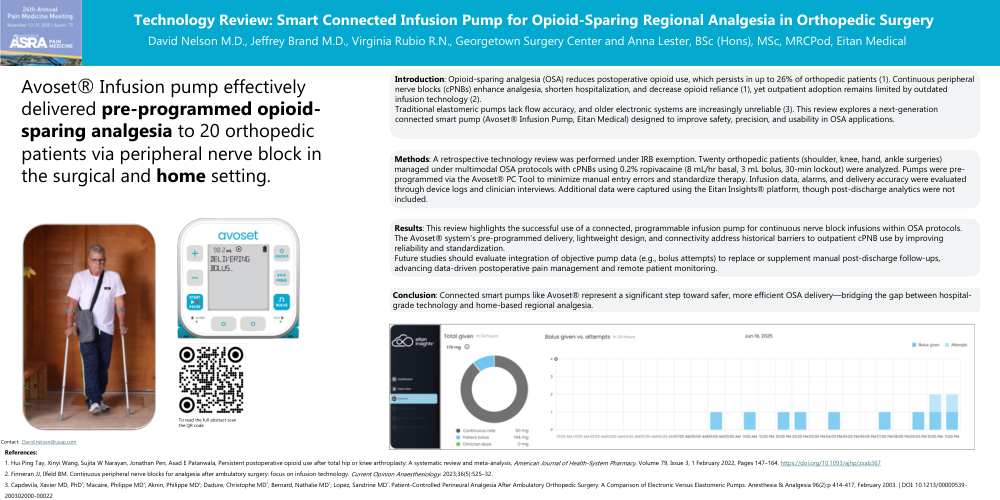
Methods: A retrospective technology review was performed under IRB exemption. Twenty orthopedic patients (shoulder, knee, hand, ankle surgeries) managed under multimodal OSA protocols with cPNBs using 0.2% ropivacaine (8 mL/hr basal, 3 mL bolus, 30-min lockout) were analyzed. Pumps were pre-programmed via the Avoset® PC Tool to minimize manual entry errors and standardize therapy. Infusion data, alarms, and delivery accuracy were evaluated through device logs and clinician interviews. Additional data were captured using the Eitan Insights® platform, though post-discharge analytics were not included.
Results: This review highlights the successful use of a connected, programmable infusion pump for continuous nerve block infusions within OSA protocols. The Avoset® system’s pre-programmed delivery, lightweight design, and connectivity address historical barriers to outpatient cPNB use by improving reliability and standardization.
Future studies should evaluate integration of objective pump data (e.g., bolus attempts) to replace or supplement manual post-discharge follow-ups, advancing data-driven postoperative pain management and remote patient monitoring.
Conclusion: Connected smart pumps like Avoset® represent a significant step toward safer, more efficient OSA delivery—bridging the gap between hospital-grade technology and home-based regional analgesia.
Avoset® Infusion pump effectively delivered pre-programmed opioid-sparing analgesia to 20 orthopedic patients via peripheral nerve block in the surgical and home setting.