343 posters, 5 videos, 2 audios, 18 topics, 33 sessions, 263 authors, 202 institutions
ePostersLive by SciGen Technologies S.A. All rights reserved.
24th Annual Pain Medicine Meeting 2025
November 13-15, 2025| JW Marriott Austin, Austin, Texas

2224981
Stellate Ganglion Block Attenuates Cerebral Vasospasm after Aneurysmal Subarachnoid Hemorrhage in the Setting of Moyamoya Disease
Poster Presenter
Authors
Affiliations
Part of Topic
Scientific Abstracts - Late Breaking > Regional Anesthesia
Stellate Ganglion Block Attenuates Cerebral Vasospasm after Aneurysmal Subarachnoid Hemorrhage in the Setting of Moyamoya Disease
Daniel Van Florcke, DO; Randal A. Serafini, PhD/MHA; Daniel Kanzer, MD
Department of Anesthesia, Icahn School of Medicine at Mount Sinai, New York, NY
BACKGROUND: Cerebral angiographic vasospasm occurs in approximately 40% of patients with aneurysmal subarachnoid hemorrhage (1), often leading to delayed cerebral ischemia and poor clinical outcomes. While conventional management strategies include hemodynamic augmentation, calcium channel blockers, and endovascular interventions (2), the stellate ganglion block (SGB) has emerged as a safe, potential adjunct therapy due to rapid, potent modulation of sympathetic tone and reduced mean cerebral blood flow velocity (3,4). SGB can reduce the systemic drug burden and delay/avoid the need for surgical intervention in a minimally invasive manner.
METHODS: Clinical data were obtained through review of the electronic medical record and bedside observations during the patient’s hospitalization.
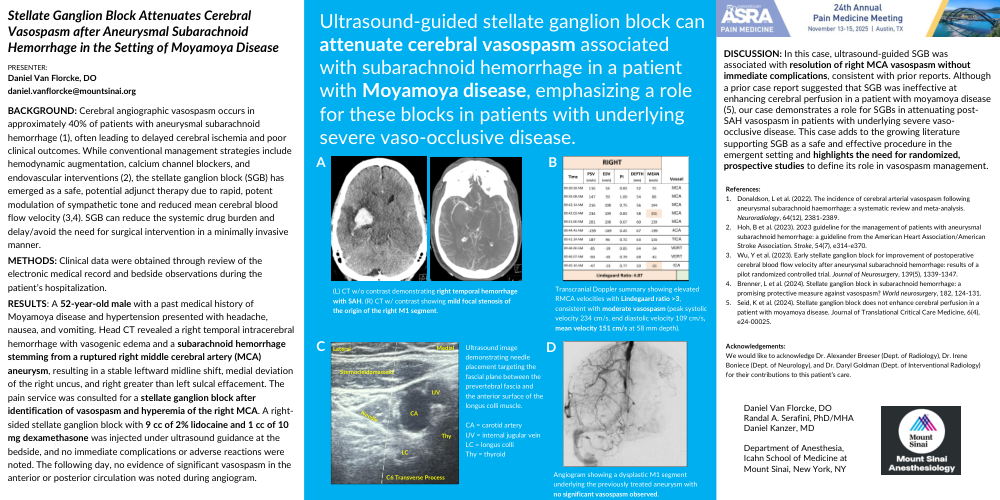
RESULTS: A 52-year-old male with a past medical history of Moyamoya disease and hypertension presented with headache, nausea, and vomiting. Head CT revealed a right temporal intracerebral hemorrhage with vasogenic edema and a subarachnoid hemorrhage stemming from a ruptured right middle cerebral artery (MCA) aneurysm, resulting in a stable leftward midline shift, medial deviation of the right uncus, and right greater than left sulcal effacement. The pain service was consulted for a stellate ganglion block after identification of vasospasm and hyperemia of the right MCA. A right-sided stellate ganglion block with 9 cc of 2% lidocaine and 1 cc of 10 mg dexamethasone was injected under ultrasound guidance at the bedside, and no immediate complications or adverse reactions were noted. The following day, no evidence of significant vasospasm in the anterior or posterior circulation was noted during angiogram.
DISCUSSION: In this case, ultrasound-guided SGB was associated with resolution of right MCA vasospasm without immediate complications, consistent with prior reports. Although a prior case report suggested that SGB was ineffective at enhancing cerebral perfusion in a patient with moyamoya disease (5), our case demonstrates a role for SGBs in attenuating post-SAH vasospasm in patients with underlying severe vaso-occlusive disease. This case adds to the growing literature supporting SGB as a safe and effective procedure in the emergent setting and highlights the need for randomized, prospective studies to define its role in vasospasm management.
References:
Acknowledgements:
We would like to acknowledge Dr. Alexander Breeser (Dept. of Radiology), Dr. Irene Boniece (Dept. of Neurology), and Dr. Daryl Goldman (Dept. of Interventional Radiology) for their contributions to this patient’s care.