343 posters, 5 videos, 2 audios, 18 topics, 33 sessions, 263 authors, 202 institutions
ePostersLive by SciGen Technologies S.A. All rights reserved.
24th Annual Pain Medicine Meeting 2025
November 13-15, 2025| JW Marriott Austin, Austin, Texas

2225708
Multi-Dimensional Predictors of Long-Term SCS Success: Moving Beyond the Numerical Pain Score
Poster Presenter
Authors
Affiliations
Part of Topic
Scientific Abstracts - Late Breaking > Chronic Pain
MULTI-DIMENSIONAL PREDICTORS OF LONG-TERM SCS SUCCESS:MOVING BEYOND THE NUMERICAL PAIN SCORE
Authors: Yanzhi Zeng, MBBS MMed (Anes), Rhyall Hughes, MD, Tarvit Worravitudomsuk, MD, Victoria Bains, CNS, Navroop Liddar, BSc, Danielle Alvares, PHD, Anuj Bhatia, MBBS MD PhD FRCPC
Presenting Author: Tarvit Worravitudomsuk, MD
Introduction
Spinal cord stimulation (SCS) trial success is commonly defined by a ≥50% reduction in pain scores; however, there is a paucity of literature validating this threshold as the minimal clinically important difference. The Patient's Global Impression of Change (PGIC) provides a more holistic assessment of a patient's status and may better identify responders to SCS therapy. In this study, we examined how well it correlates with NRS and other measures of pain or its impact on the patient’s function and wellbeing.
Materials and Methods
Following Institutional Research Ethics Board approval (#18-5864), we conducted a retrospective analysis of patients receiving a permanent SCS implant between August 2017 and September 2024. Data, including scores from the Numerical Rating Scale (NRS), Neuropathic Pain Symptom Inventory (NPSI), Pain Catastrophizing Scale (PCS), Patient Health Questionnaire-9 (PHQ-9), Generalized Anxiety Disorder-7 (GAD-7), Brief Pain Inventory (BPI), Pittsburgh Sleep Quality Inventory (PSQI), and EQ-5D VAS, were collected at baseline and 12 months post-implantation, along with a 12-month PGIC rating. Responders were defined using three thresholds: ≥50% NRS reduction (NRS50), ≥30% NRS reduction (NRS30), and a PGIC score of ≥6 (“Much” or “Very much improved”). We then compared baseline clinical scores and the magnitude of change at 12 months between responders and non-responders for each threshold to assess the relative contribution of each measure to a successful outcome.
Results
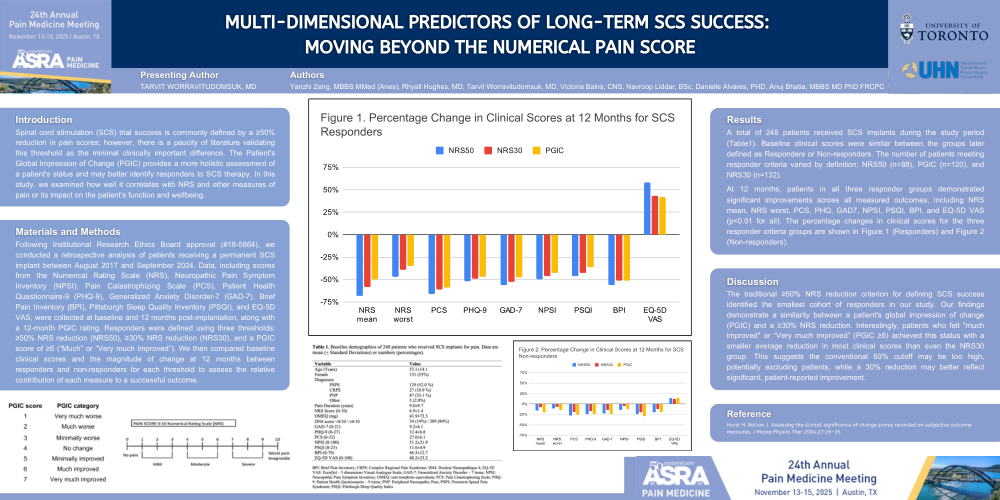
A total of 248 patients received SCS implants during the study period (Table1). Baseline clinical scores were similar between the groups later defined as Responders or Non-responders. The number of patients meeting responder criteria varied by definition: NRS50 (n=88), PGIC (n=120), and NRS30 (n=132). At 12 months, patients in all three responder groups demonstrated significant improvements across all measured outcomes, including NRS mean, NRS worst, PCS, PHQ, GAD7, NPSI, PSQI, BPI, and EQ-5D VAS (p<0.01 for all). The percentage changes in clinical scores for the three responder criteria groups are shown in Figure 1 (Responders) and Figure 2 (Non-responders).
Discussion
The traditional ≥50% NRS reduction criterion for defining SCS success identified the smallest cohort of responders in our study. Our findings demonstrate a similarity between a patient's global impression of change (PGIC) and a ≥30% NRS reduction. Interestingly, patients who felt "much improved" or “Very much improved” (PGIC ≥6) achieved this status with a smaller average reduction in most clinical scores than even the NRS30 group. This suggests the conventional 50% cutoff may be too high, potentially excluding patients, while a 30% reduction may better reflect significant, patient-reported improvement.
Reference
Hurst H, Bolton J. Assessing the clinical significance of change scores recorded on subjective outcome measures. J Manip Physiol Ther 2004;27:26-35.