343 posters, 5 videos, 2 audios, 18 topics, 33 sessions, 263 authors, 202 institutions
ePostersLive by SciGen Technologies S.A. All rights reserved.
24th Annual Pain Medicine Meeting 2025
November 13-15, 2025| JW Marriott Austin, Austin, Texas

2229405
Inequalities in Marginalized Populations' Access to Interventional Pain Procedures: Consequences for Migrant Workers.
Poster Presenter
Authors
Affiliations
Part of Topic
Safety/QA/QI Projects - Late Breaking
Audio
Title: Inequalities in Marginalized Populations’ Access to Interventional Pain Procedures: Consequences for Migrant Workers
Authors:
Kevin Peyra, MD, PT – International Medical Graduate, Philippines, De La Salle Medical & Health Sciences Institute
Addison Sayoc, MD, PT – International Medical Graduate, Philippines, University of Santo Tomas
Introduction
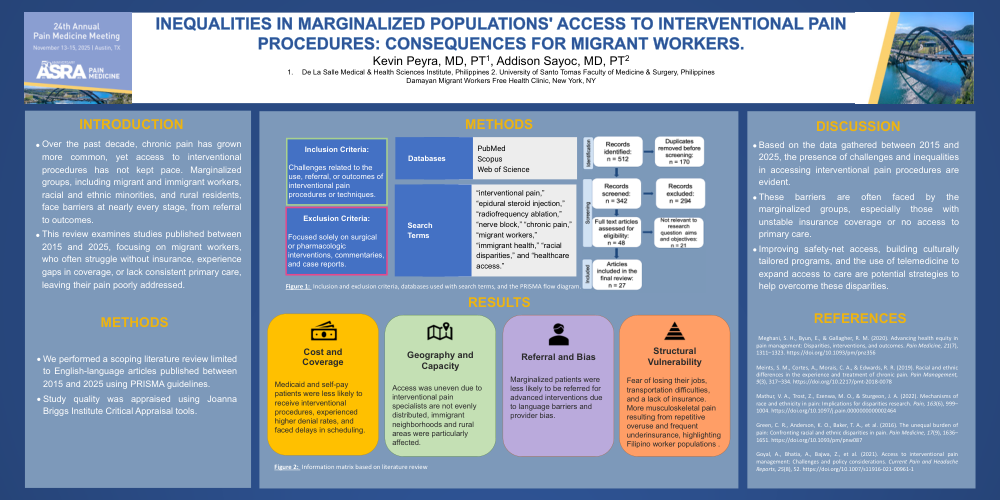
Over the past decade, the prevalence of chronic pain has increased substantially, yet access to interventional pain procedures has not kept pace.
Marginalized groups—including migrant and immigrant workers, racial and ethnic minorities, and rural residents—face persistent barriers from referral to treatment outcomes.
Migrant workers are particularly vulnerable. Many experience unstable employment, limited insurance coverage, language barriers, and inconsistent primary care access, leading to undertreated or chronic pain that limits their function and quality of life.
Objectives
This review aimed to synthesize evidence on disparities in access to interventional pain procedures among marginalized populations, with a specific focus on migrant workers.
Methods
-
Databases: PubMed, Scopus, Web of Science
-
Study period: 2015–2025
-
Inclusion criteria: English-language studies examining access, referral, or outcomes of interventional pain procedures (e.g., epidural steroid injections, nerve blocks, radiofrequency ablation).
-
Exclusion: Surgical, pharmacologic-only, or commentary papers.
Results of Search and Screening:
-
512 articles identified
-
342 abstracts screened
-
48 full texts reviewed
-
27 studies met inclusion criteria
Results
Four major themes emerged:
-
Cost and Coverage
-
Patients with Medicaid or self-pay were less likely to receive interventional procedures, faced higher denial rates, and experienced delays in scheduling compared to privately insured patients.
-
-
Geography and Capacity
-
Interventional pain specialists are unevenly distributed, leaving immigrant neighborhoods and rural areas particularly underserved.
-
-
Referral and Bias
-
Marginalized patients were less frequently referred for advanced interventions due to language barriers, provider bias, and limited advocacy.
-
-
Structural Vulnerability
-
Migrant workers face transportation barriers, fear of job loss, and lack of insurance.
-
High rates of musculoskeletal pain and repetitive strain injuries were documented, particularly among Filipino and Southeast Asian workers.
-
Discussion
This review highlights systemic inequalities in interventional pain care across marginalized populations.
Barriers are often intertwined—financial, geographic, and cultural—and they disproportionately affect those with unstable insurance or no primary care connection.
Potential strategies:
-
Expand safety-net programs for uninsured or underinsured patients
-
Implement culturally tailored pain management programs
-
Utilize telemedicine and community outreach to extend access to underserved populations
Conclusion
Equitable access to interventional pain care is essential to reduce suffering, improve function, and restore dignityamong marginalized workers.
Addressing these disparities aligns with the core mission of Physical Medicine and Rehabilitation—to promote recovery, participation, and quality of life for all.
Keywords:
Interventional Pain • Migrant Workers • Health Disparities • Access to Care • Pain Medicine