343 posters, 5 videos, 2 audios, 18 topics, 33 sessions, 263 authors, 202 institutions
ePostersLive by SciGen Technologies S.A. All rights reserved.
24th Annual Pain Medicine Meeting 2025
November 13-15, 2025| JW Marriott Austin, Austin, Texas

2229352
Cryoneurolysis for management of limb spasticity: A systematic review
Poster Presenter
Authors
Affiliations
Part of Topic
Scientific Abstracts - Late Breaking > Emerging Technology
Cryoneurolysis for management of limb spasticity: A systematic review
Jensen Clark1, Aarti Mehta1, Kunal Damaraju1, Brandon Goodwin DO2, Richard Lisi DO3, Dr. Alphonsa Thomas DO4
Rowan-Virtua School of Osteopathic Medicine, Stratford, New Jersey, USA1
Johns Hopkins Hospital, Baltimore, Maryland, USA2
Brown University, Providence, Rhode Island, USA3
Hackensack Meridian Johnson Rehabilitation Institute, Brick, New Jersey, USA4
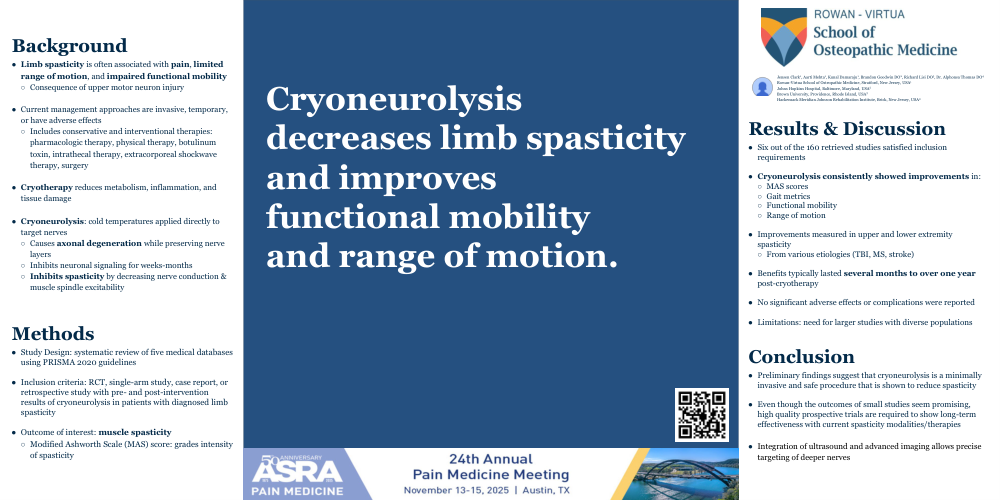
Cryoneurolysis decreases limb spasticity and improves functional mobility and range of motion.
Background:
-
Limb spasticity is often associated with pain, limited range of motion, and impaired functional mobility
-
Consequence of upper motor neuron injury
-
Current management approaches are invasive, temporary, or have adverse effects
-
Includes conservative and interventional therapies: pharmacologic therapy, physical therapy, botulinum toxin, intrathecal therapy, extracorporeal shockwave therapy, and surgery
-
Cryotherapy reduces metabolism, inflammation, and tissue damage
-
Cryoneurolysis: cold temperatures applied directly to target nerves
-
Causes axonal degeneration while preserving nerve layers
-
Inhibits neuronal signaling for weeks to months
-
Inhibits spasticity by decreasing nerve conduction & muscle spindle excitability
Methods
-
Study Design: systematic review of five medical databases using PRISMA 2020 guidelines
-
Inclusion criteria: RCT, single-arm study, case report, or retrospective study with pre- and post-intervention results of cryoneurolysis in patients with diagnosed limb spasticity
-
Outcome of interest: muscle spasticity
-
Modified Ashworth Scale (MAS) score: grades the intensity of spasticity
Results & Discussion
-
Six out of the 160 retrieved studies satisfied the inclusion requirements
-
Cryoneurolysis consistently showed improvements in:
-
MAS scores
-
Gait metrics
-
Functional mobility
-
Range of motion
-
Improvements measured in upper and lower extremity spasticity
-
From various etiologies (TBI, MS, stroke)
-
Benefits typically lasted several months to over one year post-cryotherapy
-
No significant adverse effects or complications were reported
-
Limitations: need for larger studies with diverse populations
Conclusion
-
Preliminary findings suggest that cryoneurolysis is a minimally invasive and safe procedure that is shown to reduce spasticity
-
Even though the outcomes of small studies seem promising, high-quality prospective trials are required to show long-term effectiveness with current spasticity modalities/therapies
-
Integration of ultrasound and advanced imaging allows precise targeting of deeper nerves