343 posters, 5 videos, 2 audios, 18 topics, 33 sessions, 263 authors, 202 institutions
ePostersLive by SciGen Technologies S.A. All rights reserved.
24th Annual Pain Medicine Meeting 2025
November 13-15, 2025| JW Marriott Austin, Austin, Texas

2229428
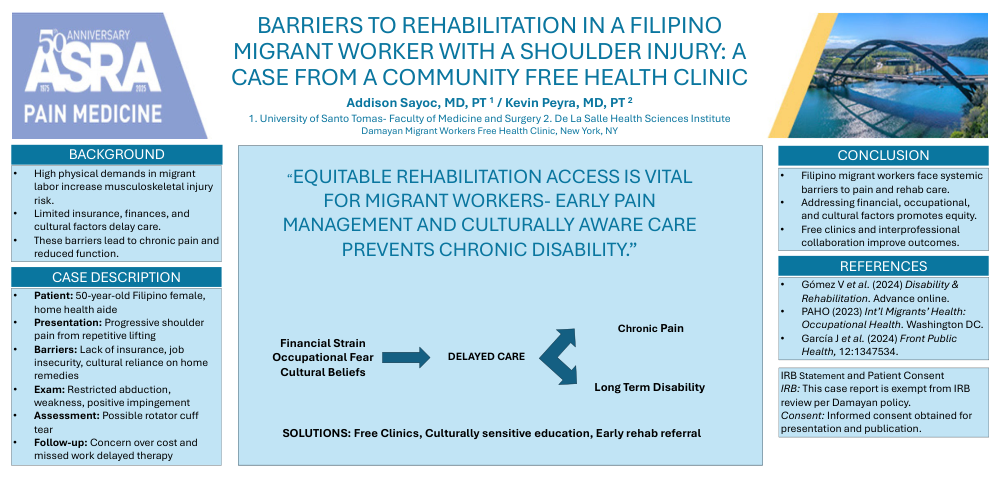
Barriers to Rehabilitation in a Filipino Migrant Worker with a Shoulder Injury: A Case From a Community Free Health Clinic
Poster Presenter
Authors
Affiliations
Part of Topic
Medically Challenging Cases - Late Breaking
Barriers to Rehabilitation in a Filipino Migrant Worker with a Shoulder Injury: A Case From a Community Free Health Clinic
Addison Sayoc, MD, PT
Univeristy of Santo Tomas- Faculty of Medicine and Surgery / Damayan Migrant Workers Free Health Clinic
Background
Migrant workers often perform physically demanding jobs, putting them at risk for musculoskeletal injuries. These injuries can lead to functional loss and chronic pain when left untreated. Limited insurance coverage, financial constraints, and cultural beliefs frequently delay access to rehabilitation, worsening long-term outcomes.
Case Description
A 50-year-old Filipino female home health aide presented to the Damayan Migrant Workers Free Health Clinic with progressive bilateral shoulder pain after months of repeated lifting and household chores. She reported difficulty with daily activities and work duties but delayed seeking care due to lack of insurance, fear of job loss, and reliance on home remedies such as massage and herbal oils.
On examination, she had restricted abduction, weakness in external rotation, and positive impingement signs, suggesting a possible rotator cuff tear. Despite counseling, she remained concerned about the cost of therapy and taking time off work.
Discussion
This case highlights barriers to rehabilitation faced by migrant workers, including financial strain, occupational insecurity, and reliance on alternative treatments. These challenges contribute to delayed care, which can lead to chronic pain, functional decline, and long-term disability.
For pain medicine specialists and physiatrists, such cases underscore the importance of early recognition of musculoskeletal injuries, timely pain management, and collaboration with rehabilitation services. Community free clinics play a critical role as accessible entry points for underserved populations, but lasting solutions require culturally sensitive education and equitable access to both pain and rehabilitation care.
Conclusion
Filipino migrant workers are at high risk for musculoskeletal injuries yet face significant barriers to both pain management and rehabilitation. Addressing financial, occupational, and cultural challenges is essential to promote equity in care, reduce the burden of chronic pain, and support functional recovery.
Equitable rehabilitation access is vital for migrant workers-early pain management and culturally aware care prevent chronic disability.
References
-
Gómez V, Feldman DE, Côté D, Kairy D, Laberge M, et al. (2024). Physiotherapy experiences of injured immigrant workers in Quebec: An intersectional perspective. Disability and Rehabilitation. Advance online publication. https://doi.org/10.1080/09638288.2024.xxxxx
-
Pan American Health Organization. (2023). International migrants’ health: Occupational health. Washington, DC: PAHO. https://www.paho.org/sites/default/files/2023-08/healthmigration-occupational-health-2023.pdf
-
García J, Alvarez A, Nguyen T. (2024). Perceptions of occupational injury, workplace safety, and workers’ rights among Spanish-speaking patients. Frontiers in Public Health, 12, 1347534. https://doi.org/10.3389/fpubh.2024.1347534