343 posters, 5 videos, 2 audios, 18 topics, 33 sessions, 263 authors, 202 institutions
ePostersLive by SciGen Technologies S.A. All rights reserved.
24th Annual Pain Medicine Meeting 2025
November 13-15, 2025| JW Marriott Austin, Austin, Texas

2228110
Analgesic and obstetric outcomes of spinal cord stimulation use in pregnancy
Poster Presenter
Authors
Affiliations
Part of Topic
Scientific Abstracts - Late Breaking > Chronic Pain
Abstract Title: Analgesic and obstetric outcomes of spinal cord stimulation use in pregnancy
Abstract Category
Chronic Pain
Director or Chair Contact
Anuj Bhatia MD PhD
Anuj.Bhatia@uhn.ca
Neuromodulation for Pain Program, Toronto Western Hospital, Department of Anaesthesia and Pain Medicine, University of Toronto, Toronto, Ontario, Canada
Submitting Author Details
Victoria Bains MN CNS
Victoria.Bains@uhn.ca
Neuromodulation for Pain Program, Toronto Western Hospital, Department of Anaesthesia and Pain Medicine, University of Toronto, Toronto, Ontario, Canada
Co-Author(s) Details
Emma Robertson RN (Co-author)
Anna Kalleitner RN (Co-author)
Danielle Alvares, PhD (Co-author)
Pranab Kumar MD FRCPC (Co-author)
Ehtesham Baig MD FRCPC (Co-author)
Anuj Bhatia MD PhD FRCPC (Co-author)
Abstract Body
Introduction
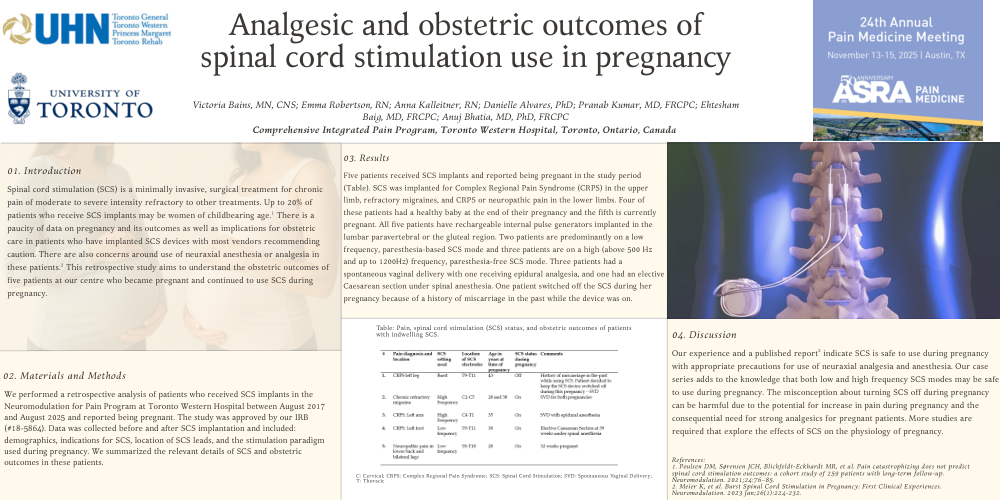
Spinal cord stimulation (SCS) is a minimally invasive, surgical treatment for chronic pain of moderate to severe intensity refractory to other treatments. Up to 20% of patients who receive SCS implants may be women of childbearing age.1 There is a paucity of data on pregnancy and its outcomes as well as implications for obstetric care in patients who have implanted SCS devices with most vendors recommending caution. There are also concerns around use of neuraxial anesthesia or analgesia in these patients.2 This retrospective study aims to understand the obstetric outcomes of five patients at our centre who became pregnant and continued to use SCS during pregnancy.
Material and Methods
We performed a retrospective analysis of patients who received SCS implants in the Neuromodulation for Pain Program at Toronto Western Hospital between August 2017 and August 2025 and reported being pregnant. The study was approved by our IRB (#18-5864). Data was collected before and after SCS implantation and included: demographics, indications for SCS, location of SCS leads, and the stimulation paradigm used during pregnancy. We summarized the relevant details of SCS and obstetric outcomes in these patients.
Results
Five patients received SCS implants and reported being pregnant in the study period (Table 1). SCS was implanted for Complex Regional Pain Syndrome (CRPS) in the upper limb, refractory migraines, and CRPS or neuropathic pain in the lower limbs. Four of these patients had a healthy baby at the end of their pregnancy and the fifth is currently pregnant. All five patients have rechargeable internal pulse generators implanted in the lumbar paravertebral or the gluteal region. Two patients are predominantly on a low frequency, paresthesia-based SCS mode and three patients are on a high (above 500 Hz and up to 1200Hz) frequency, paresthesia-free SCS mode. Three patients had a spontaneous vaginal delivery with one receiving epidural analgesia, and one had an elective Caesarean section under spinal anesthesia. One patient switched off the SCS during her pregnancy because of a history of miscarriage in the past while the device was on.
Discussion
Our experience and a published report2 indicate SCS is safe to use during pregnancy with appropriate precautions for use of neuraxial analgesia and anesthesia (Appendix 1). Our case series adds to the knowledge that both low and high frequency SCS modes may be safe to use during pregnancy. The misconception about turning SCS off during pregnancy can be harmful due to the potential for increase in pain during pregnancy and the consequential need for strong analgesics for pregnant patients. More studies are required that explore the effects of SCS on the physiology of pregnancy.
References
- Poulsen DM, Sørensen JCH, Blichfeldt-Eckhardt MR, et al. Pain catastrophizing does not predict spinal cord stimulation outcomes: a cohort study of 259 patients with long-term follow-up. Neuromodulation. 2021;24:76–85.
- Meier K, et al. Burst Spinal Cord Stimulation in Pregnancy: First Clinical Experiences. Neuromodulation. 2023 Jan;26(1):224-232.