343 posters, 5 videos, 2 audios, 18 topics, 33 sessions, 263 authors, 202 institutions
ePostersLive by SciGen Technologies S.A. All rights reserved.
24th Annual Pain Medicine Meeting 2025
November 13-15, 2025| JW Marriott Austin, Austin, Texas

2227844
"Gasserian Ganglion Block as a Novel Approach for Refractory Burning Mouth Syndrome in Complex Regional Pain Syndrome"
Poster Presenter
Authors
Affiliations
Part of Topic
Scientific Abstracts - Late Breaking > Chronic Pain
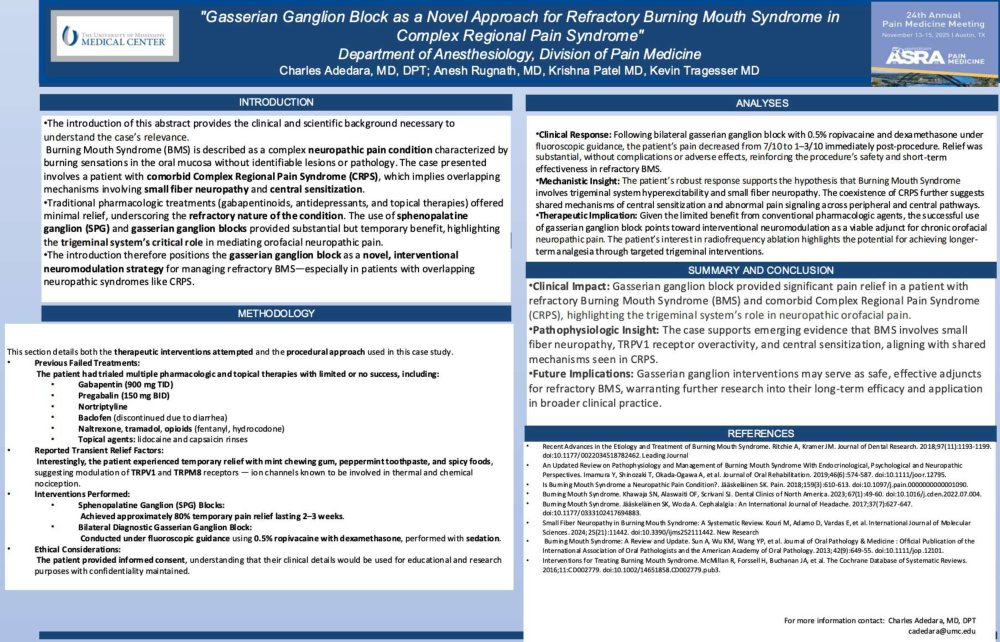
"Gasserian Ganglion Block as a Novel Approach for Refractory Burning Mouth Syndrome in Complex Regional Pain Syndrome" Author(s) 1. Charles A. Adedara, MD, DPT (he/him/his) (Role: Submitting Author) 2. Krishna Patel, MD (she/her/hers) (Role: Presenting Author) 3. Anesh Rugnath, MD (he/him/his) (Role: Co-Author) 4. Kevin Tragesser, MD (Role: Co-Author) Abstract Topic Chronic Pain Introduction This case highlights the neuropathic complexity of Burning Mouth Syndrome (BMS), particularly in a patient with comorbid complex regional pain syndrome, suggesting shared mechanisms of small fiber neuropathy and central sensitization. Conventional treatments provided minimal benefit, whereas sphenopalatine and gasserian ganglion blocks yielded significant but temporary relief, emphasizing the trigeminal system’s role in pain generation. These findings support interventional neuromodulation, including gasserian ganglion procedures, as adjunctive strategies for managing refractory BMS in carefully selected patients. Materials and Methods Failed treatments: Gabapentin 900 mg TID, pregabalin 150 mg BID, nortriptyline, baclofen (diarrhea), naltrexone, tramadol, opioids (fentanyl, hydrocodone), topical lidocaine, capsaicin rinses. Reported transient relief: Mint chewing gum, peppermint toothpaste, spicy foods—suggesting TRPV1/TRPM8 receptor modulation. Interventions: * SPG blocks: ~80% temporary relief for 2–3 weeks. * Bilateral diagnostic gasserian ganglion block: Performed under fluoroscopy using 0.5% ropivacaine + dexamethasone, with sedation. The patient was informed about the purpose and nature of this case study, including the use of their medical information for educational and research purposes. The patient understood that all personal identifiers would be kept confidential, and participation was entirely voluntary. The patient provided verbal/written consent to proceed. Results/Case Report Pain decreased from 7/10 to 1–3/10 immediately post-procedure. No complications. Patient is considering radiofrequency ablation for longer-term relief. Discussion This case illustrates refractory neuropathic Burning Mouth Syndrome (BMS) in a patient with comorbid CRPS, supporting shared mechanisms of small fiber neuropathy. BMS pathophysiology includes reduced intraepithelial nerve fiber density, overexpression of TRPV1/P2X3/Nav1.7 channels, dopaminergic hypofunction, impaired descending pain modulation, and postmenopausal estrogen decline. The patient’s improvement with sphenopalatine and gasserian ganglion blocks highlights the trigeminal pathway’s role and suggests gasserian ganglion interventions, traditionally used for trigeminal neuralgia, as promising options in refractory BMS.