343 posters, 5 videos, 2 audios, 18 topics, 33 sessions, 263 authors, 202 institutions
ePostersLive by SciGen Technologies S.A. All rights reserved.
24th Annual Pain Medicine Meeting 2025
November 13-15, 2025| JW Marriott Austin, Austin, Texas

2226892
L5-S1 Transforaminal Lumbar Interbody Fusion (TLIF) in a Patient with Arthrogryposis : We Have Your (New) Back
Poster Presenter
Authors
Affiliations
Part of Topic
Medically Challenging Cases - Late Breaking > Acute Pain
Introduction:
Arthrogryposis multiplex congenita is a group of disorders characterized by congenital contractures to more than one limb. Individuals with arthrogryposis are more at risk of developing degenerative spinal conditions such as scoliosis. Often times, conservative management is attempted first to help alleviate associated symptoms with degenerative spinal conditions. However, when conservative management fails, surgical intervention is resorted to. This patient developed complications, including difficulty ambulating and neuropathic pain post-surgery, and required acute rehabilitation services.
Materials and Methods:
As per Nassau University Medical Center policy, this case report is exempt from IRB review requirements as all patient information has been deidentified. Informed consent was obtained from the patient.
Case Report:
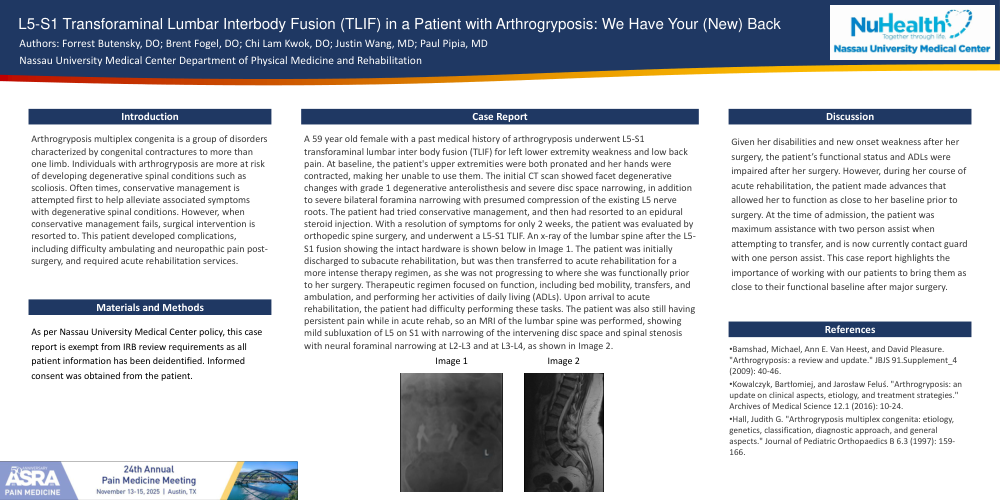
A 59 year old female with a past medical history of arthrogryposis underwent L5-S1 transforaminal lumbar inter body fusion (TLIF) for left lower extremity weakness and low back pain. At baseline, the patient's upper extremities were both pronated and her hands were contracted, making her unable to use them. The initial CT scan showed facet degenerative changes with grade 1 degenerative anterolisthesis and severe disc space narrowing, in addition to severe bilateral foramina narrowing with presumed compression of the existing L5 nerve roots. The patient had tried conservative management, and then had resorted to an epidural steroid injection. With a resolution of symptoms for only 2 weeks, the patient was evaluated by orthopedic spine surgery, and underwent a L5-S1 TLIF. An x-ray of the lumbar spine after the L5-S1 fusion showing the intact hardware is shown below in Image 1. The patient was initially discharged to subacute rehabilitation, but was then transferred to acute rehabilitation for a more intense therapy regimen, as she was not progressing to where she was functionally prior to her surgery. Therapeutic regimen focused on function, including bed mobility, transfers, and ambulation, and performing her activities of daily living (ADLs). Upon arrival to acute rehabilitation, the patient had difficulty performing these tasks. The patient was also still having persistent pain while in acute rehab, so an MRI of the lumbar spine was performed, showing mild subluxation of L5 on S1 with narrowing of the intervening disc space and spinal stenosis with neural foraminal narrowing at L2-L3 and at L3-L4, as shown in Image 2.
Discussion:
Given her disabilities and new onset weakness after her surgery, the patient’s functional status and ADLs were impaired after her surgery. However, during her course of acute rehabilitation, the patient made advances that allowed her to function as close to her baseline prior to surgery. At the time of admission, the patient was maximum assistance with two person assist when attempting to transfer, and is now currently contact guard with one person assist. This case report highlights the importance of working with our patients to bring them as close to their functional baseline after major surgery.
References: