343 posters, 5 videos, 2 audios, 18 topics, 33 sessions, 263 authors, 202 institutions
ePostersLive by SciGen Technologies S.A. All rights reserved.
24th Annual Pain Medicine Meeting 2025
November 13-15, 2025| JW Marriott Austin, Austin, Texas

2198363
Unique approach to sciatic nerve block for pain relief in trauma patient with severe burns
Poster Presenter
Authors
Affiliations
Part of Topic
Medically Challenging Cases
Introduction
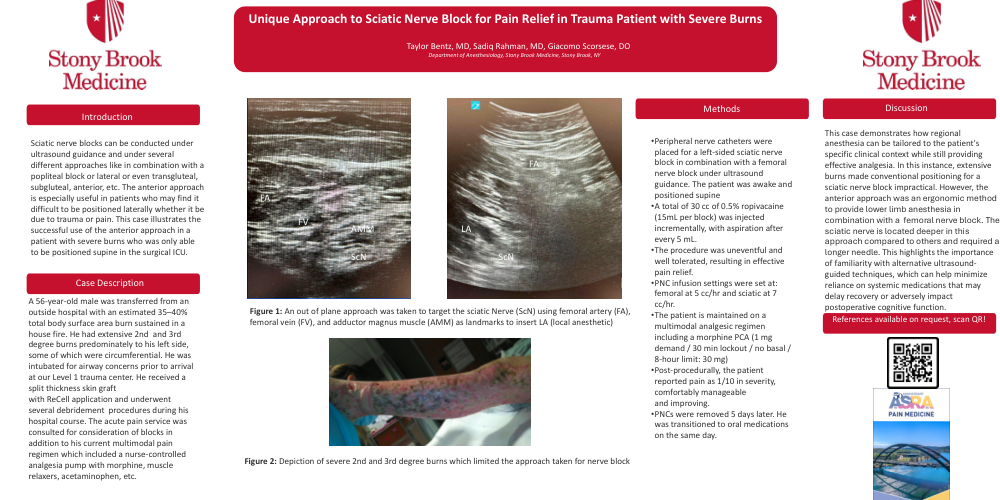
Sciatic nerve blocks can be conducted under ultrasound guidance and under several different approaches like in combination with a popliteal block or lateral or even transgluteal, subgluteal, anterior, etc. The anterior approach is especially useful in patients who may find it difficult to be positioned laterally whether it be due to trauma or pain. This case illustrates the successful use of the anterior approach in a patient with severe burns who was only able to be positioned supine in the surgical ICU.
Case Description
A 56-year-old male was transferred from an outside hospital with an estimated 35–40% total body surface area burn sustained in a house fire. He had extensive 2nd and 3rd degree burns predominately to his left side, some of which were circumferential. He was intubated for airway concerns prior to arrival at our Level 1 trauma center. He received a split thickness skin graft with ReCell application and underwent several debridement procedures during his hospital course. The acute pain service was consulted for consideration of blocks in addition to his current multimodal pain regimen which included a nurse-controlled analgesia pump with morphine, muscle relaxers, acetaminophen, etc.
Methods
•Peripheral nerve catheters were placed for a left-sided sciatic nerve block in combination with a femoral nerve block under ultrasound guidance. The patient was awake and positioned supine •A total of 30 cc of 0.5% ropivacaine (15mL per block) was injected incrementally, with aspiration after every 5 mL. •The procedure was uneventful and well tolerated, resulting in effective pain relief. •PNC infusion settings were set at: femoral at 5 cc/hr and sciatic at 7 cc/hr. •The patient is maintained on a multimodal analgesic regimen including a morphine PCA (1 mg demand / 30 min lockout / no basal / 8-hour limit: 30 mg) •Post-procedurally, the patient reported pain as 1/10 in severity, comfortably manageable and improving. •PNCs were removed 5 days later. He was transitioned to oral medications on the same day.
Discussion
This case demonstrates how regional anesthesia can be tailored to the patient's specific clinical context while still providing effective analgesia. In this instance, extensive burns made conventional positioning for a sciatic nerve block impractical. However, the anterior approach was an ergonomic method to provide lower limb anesthesia in combination with a femoral nerve block. The sciatic nerve is located deeper in this approach compared to others and required a longer needle. This highlights the importance of familiarity with alternative ultrasoundguided techniques, which can help minimize reliance on systemic medications that may delay recovery or adversely impact postoperative cognitive function.