343 posters, 5 videos, 2 audios, 18 topics, 33 sessions, 263 authors, 202 institutions
ePostersLive by SciGen Technologies S.A. All rights reserved.
24th Annual Pain Medicine Meeting 2025
November 13-15, 2025| JW Marriott Austin, Austin, Texas

2198323
Closed-loop Spinal Cord Stimulation for Refractory Angina: A Case Report
Poster Presenter
Authors
Affiliations
Part of Topic
Medically Challenging Cases
Introduction
Spinal cord stimulation (SCS) is an effective treatment for refractory angina pectoris (RAP).1, 2 Despite development of paresthesia-free stimulation, RAP is often managed with tonic paresthesia-based stimulation. One limitation of tonic, closed-loop SCS systems is intermittent unpleasant changes in stimulation intensity due to variation in distance between electrodes and the spinal cord. Closed-loop systems adjust stimulation automatically thereby maintaining intensity within a therapeutic window, and subsequently offering an advantage in conditions responsive to tonic stimulation.3,4,5
Materials and Methods
As the case report is devoid of patient identifiable information, it is exempt from IRB review requirements as per Mayo Clinic policy. Patient consent was obtained.
Results/Case Report
47-year-old woman was referred to our clinic from cardiology for refractory angina pectoris. Patient described episodic left chest pain with dyspnea which has significantly impacted her ability to work and function. The pain often required multiple nitroglycerin tablets per day and has led to frequent emergency room visits. She has been diagnosed with severe coronary endothelial dysfunction based upon coronary angiography with a coronary spasm provocation study. After failure of multiple first and second line treatments, she was referred for consideration of SCS.
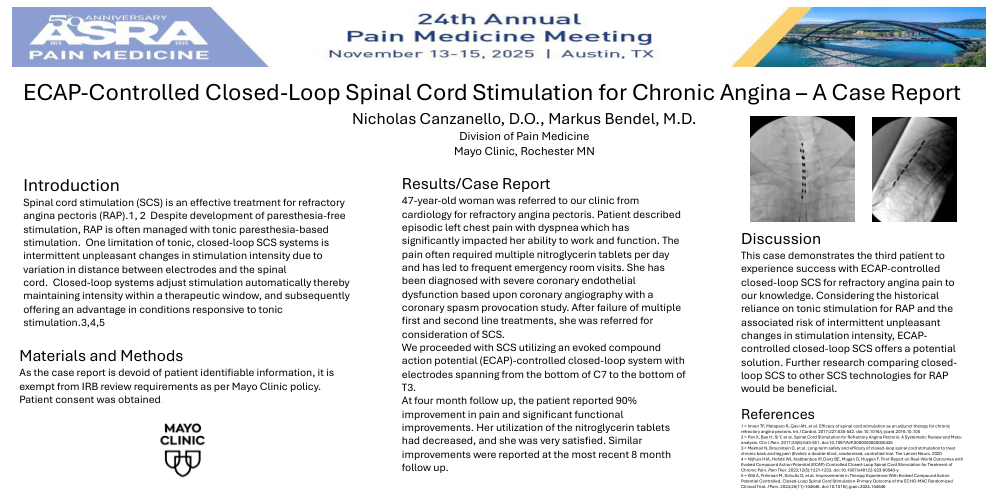
We proceeded with SCS utilizing an evoked compound action potential (ECAP)-controlled closed-loop system with electrodes spanning from the bottom of C7 to the bottom of T3.
At four month follow up, the patient reported 90% improvement in pain and significant functional improvements. Her utilization of the nitroglycerin tablets had decreased, and she was very satisfied. Similar improvements were reported at the most recent 8 month follow up.
Discussion
This case demonstrates the third patient to experience success with ECAP-controlled closed-loop SCS for refractory angina pain to our knowledge. Considering the historical reliance on tonic stimulation for RAP and the associated risk of intermittent unpleasant changes in stimulation intensity, ECAP-controlled closed-loop SCS offers a potential solution. Further research comparing closed-loop SCS to other SCS technologies for RAP would be beneficial.
References
1 = Imran TF, Malapero R, Qavi AH, et al. Efficacy of spinal cord stimulation as an adjunct therapy for chronic refractory angina pectoris. Int J Cardiol. 2017;227:535-542. doi:10.1016/j.ijcard.2016.10.105
2 = Pan X, Bao H, Si Y, et al. Spinal Cord Stimulation for Refractory Angina Pectoris: A Systematic Review and Meta-analysis. Clin J Pain. 2017;33(6):543-551. doi:10.1097/AJP.0000000000000435
3 = Mekhail N, Brounstein D, et al. Long-term safety and efficacy of closed-loop spinal cord stimulation to treat chronic back and leg pain (Evoke): a double-blind, randomised, controlled trial. The Lancet Neuro. 2020
4 = Nijhuis HJA, Hofsté WJ, Krabbenbos IP, Dietz BE, Mugan D, Huygen F. First Report on Real-World Outcomes with Evoked Compound Action Potential (ECAP)-Controlled Closed-Loop Spinal Cord Stimulation for Treatment of Chronic Pain. Pain Ther. 2023;12(5):1221-1233. doi:10.1007/s40122-023-00540-y
5 = Will A, Fishman M, Schultz D, et al. Improvements in Therapy Experience With Evoked Compound Action Potential Controlled, Closed-Loop Spinal Cord Stimulation-Primary Outcome of the ECHO-MAC Randomized Clinical Trial. J Pain. 2024;25(11):104646. doi:10.1016/j.jpain.2024.104646