343 posters, 5 videos, 2 audios, 18 topics, 33 sessions, 263 authors, 202 institutions
ePostersLive by SciGen Technologies S.A. All rights reserved.
24th Annual Pain Medicine Meeting 2025
November 13-15, 2025| JW Marriott Austin, Austin, Texas

2198124
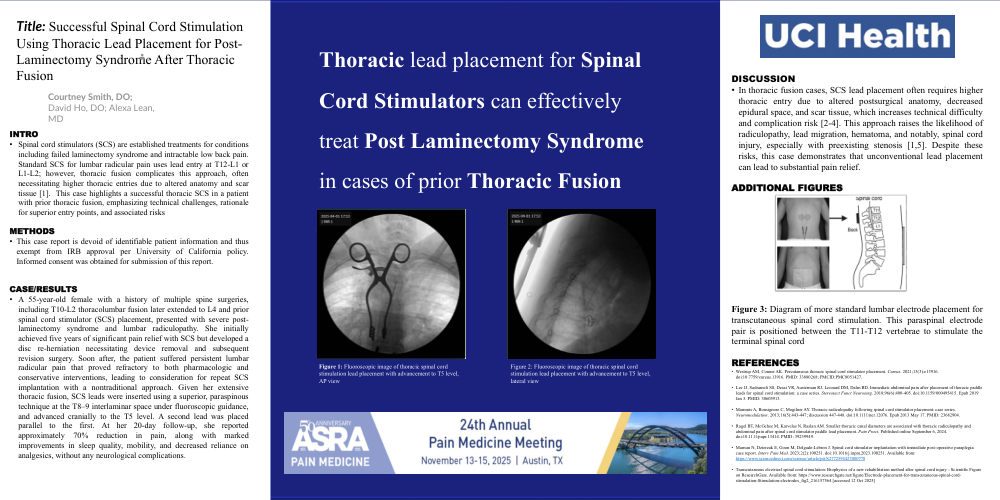
Successful Spinal Cord Stimulation Using Thoracic Lead Placement for Post-Laminectomy Syndrome After Thoracic Fusion
Poster Presenter
Authors
Affiliations
Part of Topic
Medically Challenging Cases
Introduction:
Spinal cord stimulators (SCS) are established treatments for conditions including failed laminectomy syndrome and intractable low back pain. Standard SCS for lumbar radicular pain uses lead entry at T12-L1 or L1-L2; however, thoracic fusion complicates this approach, often necessitating higher thoracic entries due to altered anatomy and scar tissue [1]. This case highlights a successful thoracic SCS in a patient with prior thoracic fusion, emphasizing technical challenges, rationale for superior entry points, and associated risks.
Materials and Methods:
This case report is devoid of identifiable patient information, and thus exempt from IRB approval per University of California policy. Informed consent was obtained for submission of this report.
Case/Results:
A 55-year-old female with a history of multiple spine surgeries, including T10-L2 thoracolumbar fusion later extended to L4 and prior spinal cord stimulator (SCS) placement, presented with severe post-laminectomy syndrome and lumbar radiculopathy. She initially achieved five years of significant pain relief with SCS, but developed a disc re-herniation necessitating device removal and subsequent revision surgery. Soon after, the patient suffered persistent lumbar radicular pain that proved refractory to both pharmacologic and conservative interventions, leading to consideration for repeat SCS implantation with a nontraditional approach. Given her extensive thoracic fusion, SCS leads were inserted using a superior, paraspinous technique at the T8–9 interlaminar space under fluoroscopic guidance, and advanced cranially to the T5 level. A second lead was placed parallel to the first. At her 20-day follow-up, she reported approximately 70% reduction in pain, along with marked improvements in sleep quality, mobility, and decreased reliance on analgesics, without any neurological complications.
Discussion:
In thoracic fusion cases, SCS lead placement often requires higher thoracic entry due to altered postsurgical anatomy, decreased epidural space, and scar tissue, which increases technical difficulty and complication risk [2-4]. This approach raises the likelihood of radiculopathy, lead migration, hematoma, and notably, spinal cord injury, especially with preexisting stenosis [1,5]. Despite these risks, this case demonstrates that unconventional lead placement can lead to substantial pain relief.