343 posters, 5 videos, 2 audios, 18 topics, 33 sessions, 263 authors, 202 institutions
ePostersLive by SciGen Technologies S.A. All rights reserved.
24th Annual Pain Medicine Meeting 2025
November 13-15, 2025| JW Marriott Austin, Austin, Texas

2197994
Transauricular Vagal Nerve Stimulation for Vaso-Occlusive Pain in Sickle Cell Disease: A Medically Complex Pediatric Case
Poster Presenter
Authors
Affiliations
Part of Topic
Medically Challenging Cases
Transcutaneous Auricular Vagal Nerve Stimulation For Vaso-Occlusive Pain In Sickle Cell Disease: A Medically Complex Pediatric Case
Abdulrehman Yousaf, BS1, Akshay Nair, BS1,Benoit Niclou, MD1, Vipin Bansal, MD1,2 , Vivien Sheehan, MD, PhD3 , Anna Woodbury, MD, MSc1 1Department of Anesthesiology, Emory University School of Medicine, Atlanta, GA, 2Department of Anesthesiology, Children's Healthcare of Atlanta, Atlanta, GA, 3Aflac Cancer and Blood Disorders Center, Children's Healthcare of Atlanta, Atlanta, GA
INTRODUCTON
-
Transcutaneousauricularvagalnervestimulation(taVNS)is a non-invasive, FDA-cleared therapy that stimulates the
auricular branch of the vagal nerve (ABVN)1.
-
Stimulating the ABVN isthought tom odulate descending pain pathways and stimulate anti-inflammatory mediators.
-
Children with sickle cell disease(SCD) suffer from extremely painful vaso-occlusive crises (VOC) which puts them at risk of escalating opioid use.
-
Our study is aimed at exploring the feasibility of using taVNS for its potential analgesic and anti-inflammatory benefits in children suffering from VOC. We report the first case of taVNS use for a VOC pain crisis.
METHODS
• Patient:18-year-old female patient with homozygous HbSSand recent acute chest syndrome was hospitalized with vaso-occlusive pain crisis refractory to hydromorphone and methadone.
-
Treatment:SparrowAscent (taVNSdevice) fromSpark Biomedical
-
Parameters:
-
Biphasicstimulation:15Hz(inner),100Hz(outer),250μs
pulse width
-
Intensity titrated to patient comfort(2-3.5mA)
-
Duration:5.2 to 16.7hours/dayfor7consecutivedays
-
-
Data Collection:
• Painscores(VASandFACES)
• Vitalsigns(HR,MAP,RR,SPO2) • Opioid usage (MME/day)
• Stimulation timing and tolerability -
Analysis:Comparisonofpainscoresandphysiologic changes during on vs off sessions
RESULTS
-
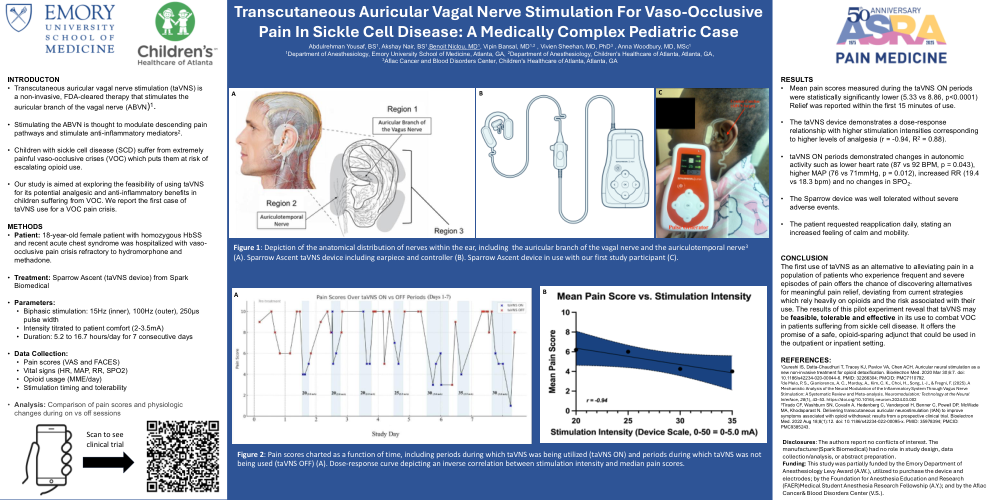
Mean pain scores measured during the taVNS ON periods were statistically significantly lower (5.33 vs 8.86, p<0.0001) Relief was reported within the first 15 minutes of use.
-
The taVNS device demonstrates a dose-response relationship with higher stimulation intensities corresponding to higher levels of analgesia (r = -0.94, R2 = 0.88).
-
taVNS ON periods demonstrated changes in autonomic activity such as lower heart rate (87 vs 92 BPM, p = 0.043), higher MAP (76 vs 71mmHg, p = 0.012), increased RR (19.4 vs 18.3 bpm) and no changes in SPO2.
-
The Sparrow device was well tolerated without severe adverse events.
-
The patient requested reapplication daily, stating an increased feeling of calm and mobility.
CONCLUSION
The first use of taVNS as an alternative to alleviating pain in a population of patients who experience frequent and severe episodes of pain offers the chance of discovering alternatives for meaningful pain relief, deviating from current strategies which rely heavily on opioids and the risk associated with their use. The results of this pilot experiment reveal that taVNS may be feasible, tolerable and effective in its use to combat VOC in patients suffering from sickle cell disease. It offers the promise of a safe, opioid-sparing adjunct that could be used in the outpatient or inpatient setting.
REFERENCES:
1Qureshi IS, Datta-Chaudhuri T, Tracey KJ, Pavlov VA, Chen ACH. Auricular neural stimulation as a new non-invasive treatment for opioid detoxification. Bioelectron Med. 2020 Mar 30;6:7. doi: 10.1186/s42234-020-00044-6. PMID: 32266304; PMCID: PMC7110792.
2de Melo, P. S., Gianlorenco, A. C., Marduy, A., Kim, C. K., Choi, H., Song, J.-J., & Fregni, F. (2025). A Mechanistic Analysis of the Neural Modulation of the Inflammatory System Through Vagus Nerve Stimulation: A Systematic Review and Meta-analysis. Neuromodulation: Technology at the Neural Interface, 28(1), 43–53. https://doi.org/10.1016/j.neurom.2024.03.0023Tirado CF, Washburn SN, Covalin A, Hedenberg C, Vanderpool H, Benner C, Powell DP, McWade MA, Khodaparast N. Delivering transcutaneous auricular neurostimulation (tAN) to improve symptoms associated with opioid withdrawal: results from a prospective clinical trial. Bioelectron Med. 2022 Aug 18;8(1):12. doi: 10.1186/s42234-022-00095-x. PMID: 35978394; PMCID: PMC9385243.
Disclosures: The authors report no conflicts of interest. The manufacturer(Spark Biomedical) had no role in study design, data collection/analysis, or abstract preparation.
Funding: This study was partially funded by the Emory Department of Anesthesiology Levy Award (A.W.), utilized to purchase the device and electrodes; by the Foundation for Anesthesia Education and Research (FAER)Medical Student Anesthesia Research Fellowship (A.Y.); and by the Aflac Cancer& Blood Disorders Center (V.S.).