343 posters, 5 videos, 2 audios, 18 topics, 33 sessions, 263 authors, 202 institutions
ePostersLive by SciGen Technologies S.A. All rights reserved.
24th Annual Pain Medicine Meeting 2025
November 13-15, 2025| JW Marriott Austin, Austin, Texas

2197905
Kyphoplasty Conundrum: Cement Extravasation after Attempted Compression Fracture Repair
Poster Presenter
Authors
Affiliations
Part of Topic
Medically Challenging Cases
Kyphoplasty Conundrum: Cement Extravasation after Attempted Compression Fracture Repair
Aleksandar Wood DO, Delia Shaher MA MS-IV, Ramsis Ghaly MD
Anesthesiology, Cook County Health, Chicago, IL, USA
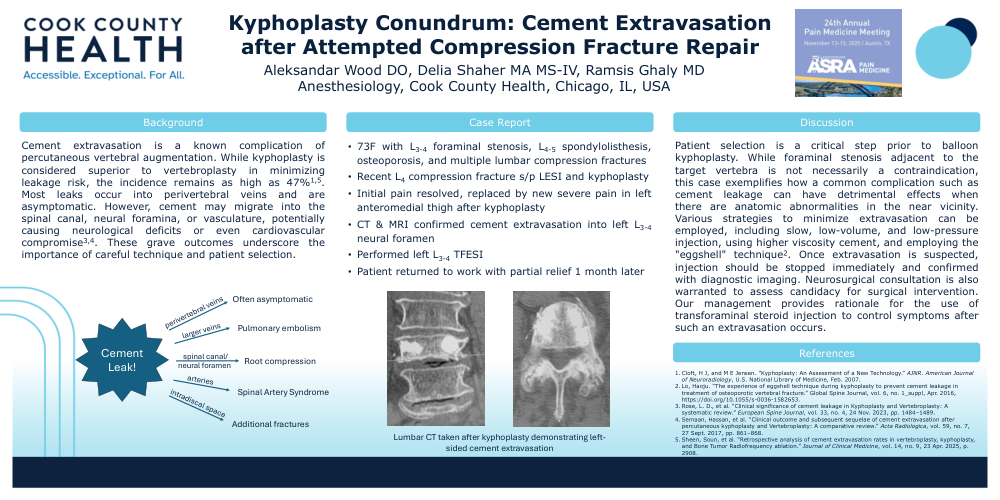
Cement extravasation is a known complication of percutaneous vertebral augmentation. While kyphoplasty is considered superior to vertebroplasty in minimizing leakage risk, the incidence remains as high as 47%1,5. Most leaks occur into perivertebral veins and are asymptomatic. However, cement may migrate into the spinal canal, neural foramina, or vasculature, potentially causing neurological deficits or even cardiovascular compromise3,4. These grave outcomes underscore the importance of careful technique and patient selection.
Patient selection is a critical step prior to balloon kyphoplasty. While foraminal stenosis adjacent to the target vertebra is not necessarily a contraindication, this case exemplifies how a common complication such as cement leakage can have detrimental effects when there are anatomic abnormalities in the near vicinity. Various strategies to minimize extravasation can be employed, including slow, low-volume, and low-pressure injection, using higher viscosity cement, and employing the "eggshell" technique2. Once extravasation is suspected, injection should be stopped immediately and confirmed with diagnostic imaging. Neurosurgical consultation is also warranted to assess candidacy for surgical intervention. Our management provides rationale for the use of transforaminal steroid injection to control symptoms after such an extravasation occurs.