343 posters, 5 videos, 2 audios, 18 topics, 33 sessions, 263 authors, 202 institutions
ePostersLive by SciGen Technologies S.A. All rights reserved.
24th Annual Pain Medicine Meeting 2025
November 13-15, 2025| JW Marriott Austin, Austin, Texas

2197882
Celiac Plexus Block and Spinal Cord Ischemia: A Case Report of Suspected Adamkiewicz Artery Vasospasm
Part of Topic
Medically Challenging Cases
Celiac Plexus Block and Spinal Cord Ischemia: A Case Report of Suspected AdamkiewiczArtery Vasospasm
Introduction
Celiac plexus block (CPB) is a well-established technique for managing upper abdominal pain. While generallysafe, rare serious complications such as spinal cord ischemia and paraplegia have been reported. The arteryof Adamkiewicz (AKA), which supplies the thoracolumbar spinal cord, lies near the CPB target zone and maybe affected by injury, vasospasm, or embolism. We present a case of transient bilateral lower extremityweakness and sensory loss following CPB, likely due to AKA vasospasm.
Materials and Methods
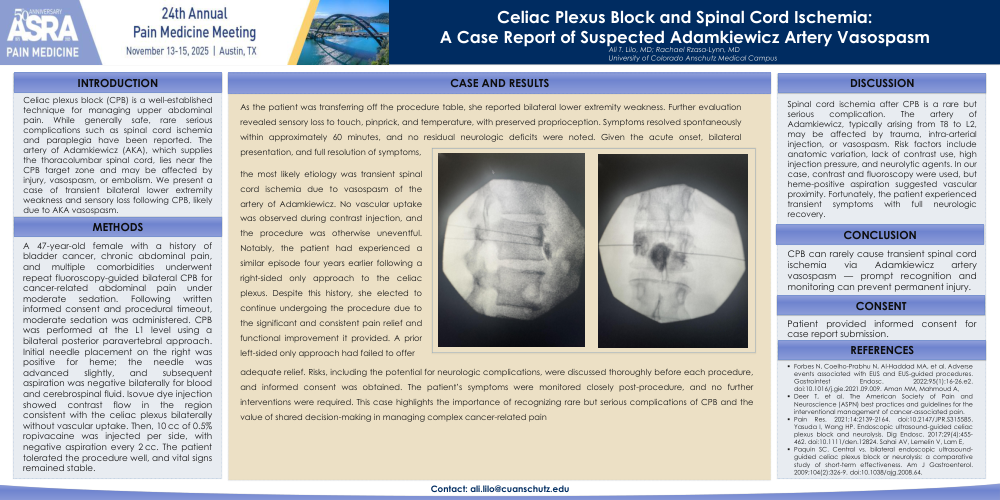
A 47-year-old female with a history of bladder cancer, chronic abdominal pain, and multiple comorbiditiesunderwent repeat fluoroscopy-guided bilateral CPB for cancer-related abdominal pain under moderatesedation. Following written informed consent and procedural timeout, moderate sedation was administered.CPB was performed at the L1 level using a bilateral posterior paravertebral approach. Initial needleplacement on the right was positive for heme; the needle was advanced slightly, and subsequent aspirationwas negative bilaterally for blood and cerebrospinal fluid. Isovue dye injection showed contrast flow in theregion consistent with the celiac plexus bilaterally without vascular uptake. Then, 10 cc of 0.5% ropivacainewas injected per side, with negative aspiration every 2 cc. The patient tolerated the procedure well, and vitalsigns remained stable.
ABSTRACT PREVIEW: CELIAC PLEXUS BLOCK AND SPINAL CORD ISCHEMIA: A CASEREPORT OF SUSPECTED ADAMKIEWICZ ARTERY VASOSPASM
Celiac Plexus Block and Spinal Cord Ischemia: A Case Report of Suspected AdamkiewiczArtery Vasospasm
Abstract ID:
2197882
Abstract Category:
Medically Challenging Cases
Abstract Status:
Complete / Locked
Results/Case Report
As the patient was transferring off the procedure table, she reported bilateral lower extremity weakness.Further evaluation revealed sensory loss to touch, pinprick, and temperature, with preserved proprioception.Symptoms resolved spontaneously within approximately 60 minutes, and no residual neurologic deficitswere noted. Given the acute onset, bilateral presentation, and full resolution of symptoms, the most likelyetiology was transient spinal cord ischemia due to vasospasm of the artery of Adamkiewicz. No vascularuptake was observed during contrast injection, and the procedure was otherwise uneventful. Notably, thepatient had experienced a similar episode four years earlier following a right-sided only approach to theceliac plexus. Despite this history, she elected to continue undergoing the procedure due to the significantand consistent pain relief and functional improvement it provided. A prior left-sided only approach had failedto offer adequate relief. Risks, including the potential for neurologic complications, were discussedthoroughly before each procedure, and informed consent was obtained. The patient’s symptoms weremonitored closely post-procedure, and no further interventions were required. This case highlights theimportance of recognizing rare but serious complications of CPB and the value of shared decision-making inmanaging complex cancer-related pain.
Discussion
Spinal cord ischemia after CPB is a rare but serious complication. The artery of Adamkiewicz, typically arisingfrom T8 to L2, may be affected by trauma, intra-arterial injection, or vasospasm. Risk factors includeanatomic variation, lack of contrast use, high injection pressure, and neurolytic agents. In our case, contrastand fluoroscopy were used, but heme-positive aspiration suggested vascular proximity. Fortunately, thepatient experienced transient symptoms with full neurologic recovery.
References
Forbes N, Coelho-Prabhu N, Al-Haddad MA, et al. Adverse events associated with EUS and EUS-guidedprocedures.
Gastrointest Endosc
. 2022;95(1):16-26.e2. doi:10.1016/j.gie.2021.09.009.
Aman MM, Mahmoud A, Deer T, et al. The American Society of Pain and Neuroscience (ASPN) bestpractices and guidelines for the interventional management of cancer-associated pain.
J Pain Res
.2021;14:2139-2164. doi:10.2147/JPR.S315585.
Yasuda I, Wang HP. Endoscopic ultrasound-guided celiac plexus block and neurolysis.
Dig Endosc
.2017;29(4):455-462. doi:10.1111/den.12824.
Sahai AV, Lemelin V, Lam E, Paquin SC. Central vs. bilateral endoscopic ultrasound-guided celiac plexusblock or neurolysis: a comparative study of short-term effectiveness.
Am J Gastroenterol
.2009;104(2):326-9. doi:10.1038/ajg.2008.64.