343 posters, 5 videos, 2 audios, 18 topics, 33 sessions, 263 authors, 202 institutions
ePostersLive by SciGen Technologies S.A. All rights reserved.
24th Annual Pain Medicine Meeting 2025
November 13-15, 2025| JW Marriott Austin, Austin, Texas

2197614
Concurrent Basivertebral Nerve Ablation and Sacroiliac Joint Fusion Using a Single Compressive Transfixing Lateral Implant.
Poster Presenter
Authors
Affiliations
Part of Topic
Medically Challenging Cases
Video
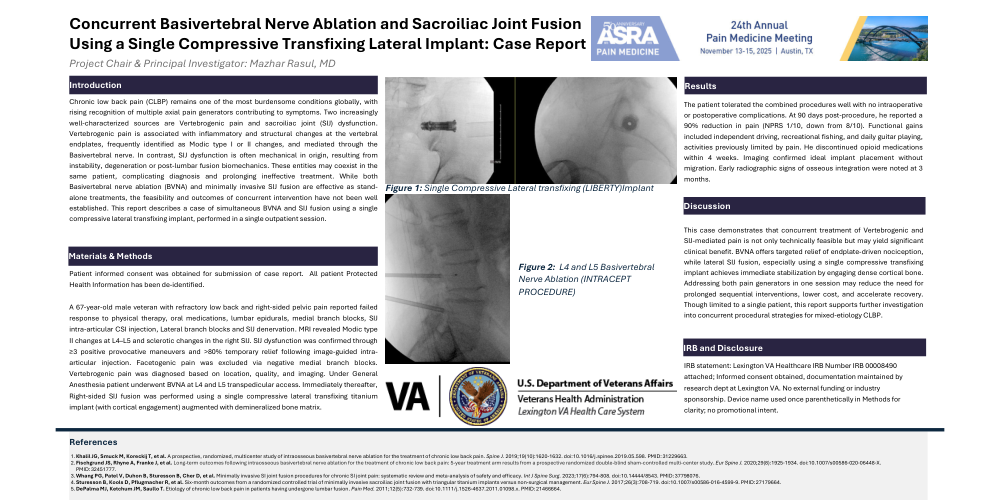
Title: Concurrent Basivertebral Nerve Ablation and Sacroiliac Joint Fusion Using a Single Compressive Transfixing Lateral Implant: Case Report
Project Chair: Mazhar Rasul, MD (Mano73@hotmail.com) Principal Investigator/Submitting Author: Mazhar Rasul, MD (Mano73@hotmail.com)
Co-Author: N/A
Introduction Chronic low back pain (CLBP) remains one of the most burdensome conditions globally, with rising recognition of multiple axial pain generators contributing to symptoms. Two increasingly well-characterized sources are Vertebrogenic pain and sacroiliac joint (SIJ) dysfunction. Vertebrogenic pain is associated with inflammatory and structural changes at the vertebral endplates, frequently identified as Modic type I or II changes, and mediated through the Basivertebral nerve. In contrast, SIJ dysfunction is often mechanical in origin, resulting from instability, degeneration or post-lumbar fusion biomechanics. These entities may coexist in the same patient, complicating diagnosis and prolonging ineffective treatment. While both Basivertebral nerve ablation (BVNA) and minimally invasive SIJ fusion are effective as stand-alone treatments, the feasibility and outcomes of concurrent intervention have not been well established. This report describes a case of simultaneous BVNA and SIJ fusion using a single compressive lateral transfixing implant, performed in a single outpatient session.
Materials and Methods:
Patient informed consent was obtained for submission of case report. All patient Protected Health Information has been de-identified.
A 67-year-old male veteran with refractory low back and right-sided pelvic pain reported failed response to physical therapy, oral medications, lumbar epidurals, medial branch blocks, SIJ intra-articular CSI injection, Lateral branch blocks and SIJ denervation. MRI revealed Modic type II changes at L4–L5 and sclerotic changes in the right SIJ. SIJ dysfunction was confirmed through ≥3 positive provocative maneuvers and >80% temporary relief following image-guided intra-articular injection. Facetogenic pain was excluded via negative medial branch blocks. Vertebrogenic pain was diagnosed based on location, quality, and imaging. Under General Anesthesia patient underwent BVNA at L4 and L5 transpedicular access. Immediately thereafter, Right-sided SIJ fusion was performed using a single compressive lateral transfixing titanium implant (with cortical engagement) augmented with demineralized bone matrix.
Results: The patient tolerated the combined procedures well with no intraoperative or postoperative complications. At 90 days post-procedure, he reported a 90% reduction in pain (NPRS 1/10, down from 8/10). Functional gains included independent driving, recreational fishing, and daily guitar playing, activities previously limited by pain. He discontinued opioid medications within 4 weeks. Imaging confirmed ideal implant placement without migration. Early radiographic signs of osseous integration were noted at 3 months.
Discussion: This case demonstrates that concurrent treatment of Vertebrogenic and SIJ-mediated pain is not only technically feasible but may yield significant clinical benefit. BVNA offers targeted relief of endplate-
driven nociception, while lateral SIJ fusion, especially using a single compressive transfixing implant achieves immediate stabilization by engaging dense cortical bone. Addressing both pain generators in one session may reduce the need for prolonged sequential interventions, lower cost, and accelerate recovery. Though limited to a single patient, this report supports further investigation into concurrent procedural strategies for mixed-etiology CLBP.