343 posters, 5 videos, 2 audios, 18 topics, 33 sessions, 263 authors, 202 institutions
ePostersLive by SciGen Technologies S.A. All rights reserved.
24th Annual Pain Medicine Meeting 2025
November 13-15, 2025| JW Marriott Austin, Austin, Texas

2197611
Combined Use of Basivertebral Nerve Ablation and Lumbar Multifidus Stimulation for Chronic Intractable Low Back Pain
Poster Presenter
Authors
Affiliations
Part of Topic
Medically Challenging Cases
Title: Combined Use of Basivertebral Nerve Ablation and Lumbar Multifidus Stimulation for Chronic Intractable Low Back Pain: A Case Report
Project Chair: Mazhar Rasul, MD (Mano73@hotmail.com) Principal Investigator/Submitting Author: Mazhar Rasul, MD (Mano73@hotmail.com)
Co-Author: N/A
Introduction: Chronic low back pain (CLBP) is a leading cause of disability worldwide, often involving overlapping etiologies. Two underrecognized contributors include Vertebrogenic pain mediated by nociceptive signals from degenerated vertebral endplates via the Basivertebral nerve and Neuromuscular Dysfunction resulting from Lumbar Multifidus atrophy. Targeted therapies for each mechanism, Basivertebral nerve ablation (BVNA) and restorative Lumbar Multifidus stimulation are FDA-approved and demonstrate independent effectiveness. However, clinical evidence is limited regarding their combined use in patients with mixed structural and functional pathology. This report describes the successful use of BVNA and Lumbar Multifidus stimulation in a patient with refractory CLBP unresponsive to conservative and surgical therapies.
Materials and Methods:
Patient informed consent was obtained for submission of case report. All patient Protected Health Information has been de-identified.
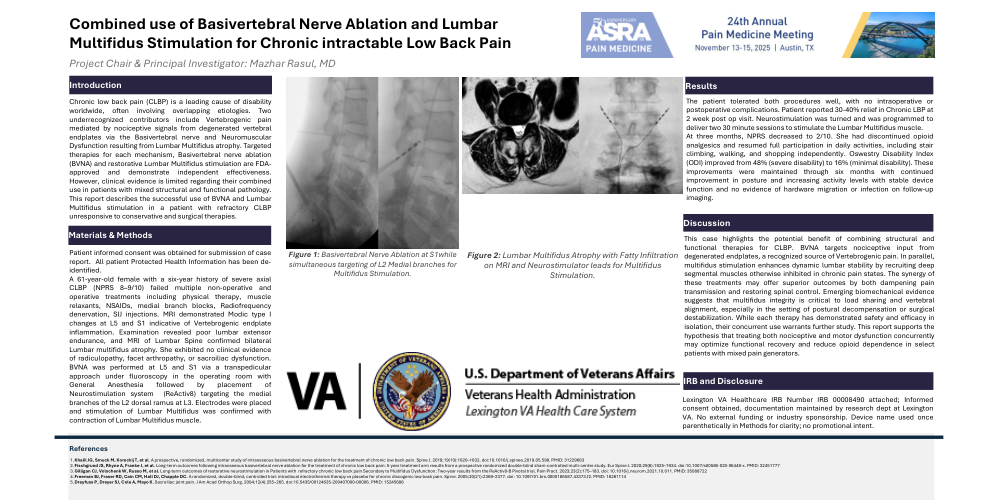
A 61-year-old female with a six-year history of severe axial CLBP (NPRS 8–9/10) failed multiple non-operative and operative treatments including physical therapy, muscle relaxants, NSAIDs, medial branch blocks, Radiofrequency denervation, SIJ injections. MRI demonstrated Modic type I changes at L5 and S1 indicative of Vertebrogenic endplate inflammation. Examination revealed poor lumbar extensor endurance, and MRI of Lumbar Spine confirmed bilateral Lumbar multifidus atrophy. She exhibited no clinical evidence of radiculopathy, facet arthropathy, or sacroiliac dysfunction. BVNA was performed at L5 and S1 via a transpedicular approach under fluoroscopy in the operating room with General Anesthesia followed by placement of Neurostimulation system (ReActiv8) targeting the medial branches of the L2 dorsal ramus at L3. Electrodes were placed and stimulation of Lumbar Multifidus was confirmed with contraction of Lumbar Multifidus muscle.
Results: The patient tolerated both procedures well, with no intraoperative or postoperative complications. Patient reported 30-40% relief in Chronic LBP at 2 week post op visit. Neurostimulation was turned and was programmed to deliver two 30 minute sessions to stimulate the Lumbar Multifidus muscle.
At three months, NPRS decreased to 2/10. She had discontinued opioid analgesics and resumed full participation in daily activities, including stair climbing, walking, and shopping
independently. Oswestry Disability Index (ODI) improved from 48% (severe disability) to 16% (minimal disability). These improvements were maintained through six months with continued improvement in posture and increasing activity levels with stable device function and no evidence of hardware migration or infection on follow-up imaging.
Discussion: This case highlights the potential benefit of combining structural and functional therapies for CLBP. BVNA targets nociceptive input from degenerated endplates, a recognized source of Vertebrogenic pain. In parallel, multifidus stimulation enhances dynamic lumbar stability by recruiting deep segmental muscles otherwise inhibited in chronic pain states. The synergy of these treatments may offer superior outcomes by both dampening pain transmission and restoring spinal control. Emerging biomechanical evidence suggests that multifidus integrity is critical to load sharing and vertebral alignment, especially in the setting of postural decompensation or surgical destabilization. While each therapy has demonstrated safety and efficacy in isolation, their concurrent use warrants further study. This report supports the hypothesis that treating both nociceptive and motor dysfunction concurrently may optimize functional recovery and reduce opioid dependence in select patients with mixed pain generators.