343 posters, 5 videos, 2 audios, 18 topics, 33 sessions, 263 authors, 202 institutions
ePostersLive by SciGen Technologies S.A. All rights reserved.
24th Annual Pain Medicine Meeting 2025
November 13-15, 2025| JW Marriott Austin, Austin, Texas

2197609
Case report of most resistant Chronic Low Back Pain responding to Novel Restorative Neurostimulation of Lumbar Multifidus muscle.
Poster Presenter
Authors
Affiliations
Part of Topic
Medically Challenging Cases
Title: Case report of most resistant Chronic Low Back Pain responding to Novel Restorative Neurostimulation of Lumbar Multifidus muscle.
Project Chair: Mazhar Rasul, MD (Mano73@hotmail.com) Principal Investigator/Submitting Author: Mazhar Rasul, MD (Mano73@hotmail.com)
Co-Author: N/A
Introduction: Neuromuscular Dysfunction resulting from Lumbar Multifidus Dysfunction has been recognized as a significant contributor of Chronic low back pain (CLBP), which is a leading cause of disability worldwide. This case report describes the successful use of Lumbar Multifidus stimulation in a patient with refractory CLBP unresponsive to conservative and most advanced surgical therapies.
Materials and Methods:
Patient informed consent was obtained for submission of case report. All patient Protected Health Information has been de-identified.
A 64-year-old male with over 40 plus years history of Chronic low Back Pain CLBP (NPRS 8–9/10) with unsuccessful response to multiple modalities ranging from noninvasive to most advanced surgical treatment options from movement based therapies Physical Therapy, Chiropractic care, Acupuncture) to Narcotic and Non-Narcotic medications (muscle relaxants, NSAIDs and anti-neuralgics) and with different Interventional procedures including Lumbar medial branch blocks, Radiofrequency denervation, SIJ injections, Lumbar Epidural Steroid Injections etc.
Of note patient also did not respond favorably to 2 different spinal cord stimulator systems and a Dorsal Root Ganglion (DRG) stimulator trial. Patient currently has a Intrathecal Drug Delivery System (ITDDS) and respond somewhat with an infusion of bupivacaine and clonidine which helps with pain in feet but Low Back Pain persisted.
Clinical history was consistent with exacerbation of low back pain with every movement, patient favored leaning back in the chair and resting on the armchair on either side to support himself. It was also noticed that when patient was standing he would like to lean his back against the wall for support his weight against the wall with his arm. Patient was also noticed to have a waddling gait. Patient stated his chronic nonspecific low back pain is a nuisance in his life he can never not think about it.
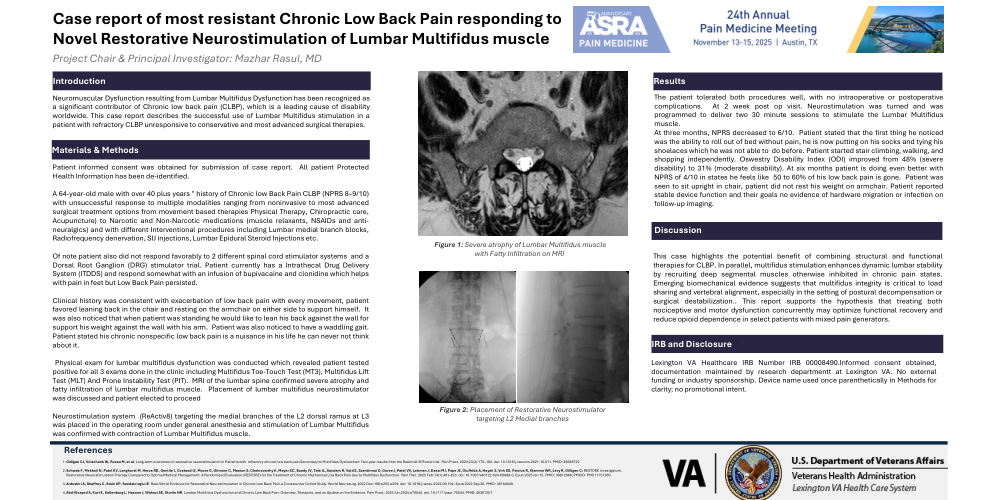
Physical exam for lumbar multifidus dysfunction was conducted which revealed patient tested positive for all 3 exams done in the clinic including Multifidus Toe-Touch Test (MT3), Multifidus Lift Test (MLT) And Prone Instability Test (PIT). MRI of the lumbar spine
confirmed severe atrophy and fatty infiltration of lumbar multifidus muscle. Placement of lumbar multifidus neurostimulator was discussed and patient elected to proceed
Neurostimulation system (ReActiv8) targeting the medial branches of the L2 dorsal ramus at L3 was placed in the operating room under general anesthesia and stimulation of Lumbar Multifidus was confirmed with contraction of Lumbar Multifidus muscle.
Results: The patient tolerated both procedures well, with no intraoperative or postoperative complications. At 2 week post op visit. Neurostimulation was turned and was programmed to deliver two 30 minute sessions to stimulate the Lumbar Multifidus muscle.
At three months, NPRS decreased to 6/10. Patient stated that the first thing he noticed was the ability to roll out of bed without pain, he is now putting on his socks and tying his shoelaces which he was not able to do before. Patient started stair climbing, walking, and shopping independently. Oswestry Disability Index (ODI) improved from 48% (severe disability) to 31% (moderate disability). At six months patient is doing even better with NPRS of 4/10 in states he feels like 50 to 60% of his low back pain is gone. Patient was seen to sit upright in chair, patient did not rest his weight on armchair. Patient reported stable device function and their goals no evidence of hardware migration or infection on follow-up imaging.
Discussion: This case highlights the potential benefit of combining structural and functional therapies for CLBP.. In parallel, multifidus stimulation enhances dynamic lumbar stability by recruiting deep segmental muscles otherwise inhibited in chronic pain states. Emerging biomechanical evidence suggests that multifidus integrity is critical to load sharing and vertebral alignment, especially in the setting of postural decompensation or surgical destabilization.. This report supports the hypothesis that treating both nociceptive and motor dysfunction concurrently may optimize functional recovery and reduce opioid dependence in select patients with mixed pain generators.