343 posters, 5 videos, 2 audios, 18 topics, 33 sessions, 263 authors, 202 institutions
ePostersLive by SciGen Technologies S.A. All rights reserved.
24th Annual Pain Medicine Meeting 2025
November 13-15, 2025| JW Marriott Austin, Austin, Texas

2197605
Approach Considerations in Sacroiliac Joint Fusion Among Patients with BMI > 47
Poster Presenter
Authors
Affiliations
Part of Topic
Medically Challenging Cases
Video
Title: Approach Considerations in Sacroiliac Joint Fusion Among Patients with BMI > 47: A Retrospective Case Series
Project Chair: Mazhar Rasul, MD Principal Investigator/Submitting Author: Mazhar Rasul, MD Co-Author(s): N/A
Introduction: Sacroiliac joint (SIJ) dysfunction accounts for 15–30% of chronic low back pain and is often underdiagnosed in high-risk populations. Patients with a history of prior lumbar fusion, trauma, leg length discrepancy, or compensatory gait alterations are particularly susceptible to SIJ instability and arthropathy. Diagnosis is clinical and radiographic but relies mostly on pain provocation testing and confirmatory intra-articular diagnostic injections. Once diagnosed, and after failure of conservative measures, patients may be considered for MIS SIJ fusion procedures. Two dominant surgical approaches have emerged: posterior allograft-based fusion and lateral transfixing implant fixation. These procedures have shown success in the general population; however, there is limited evidence on outcomes in patients with severe obesity (BMI > 47), where surgical access, procedural success, and biologic fusion potential may be altered. The mechanical environment, volume of soft tissue, and depth of instrumentation in this population may influence implant trajectory, fixation strength, and post-operative healing response. This case series compares outcomes following posterior versus lateral SIJ fusion in two patients with BMIs greater than 47, a demographic often excluded from published trials.
Methods: The patient provided informed consent for case presentation. All protected health information was de-identified.
Two male patients (ages 52 and 53) presented with greater than one year of chronic Sacral low back pain Both had failed an extensive course of conservative therapies, including physical therapy, chiropractic manipulation, acupuncture, and a multimodal medication regimen including NSAIDs, muscle relaxants, and anticonvulsants. Physical exam for both revealed ≥3 positive SIJ provocative maneuvers and >75% pain relief following fluoroscopy-guided intra-articular injection. Each also experienced transient benefit from sacral lateral branch radiofrequency ablation.
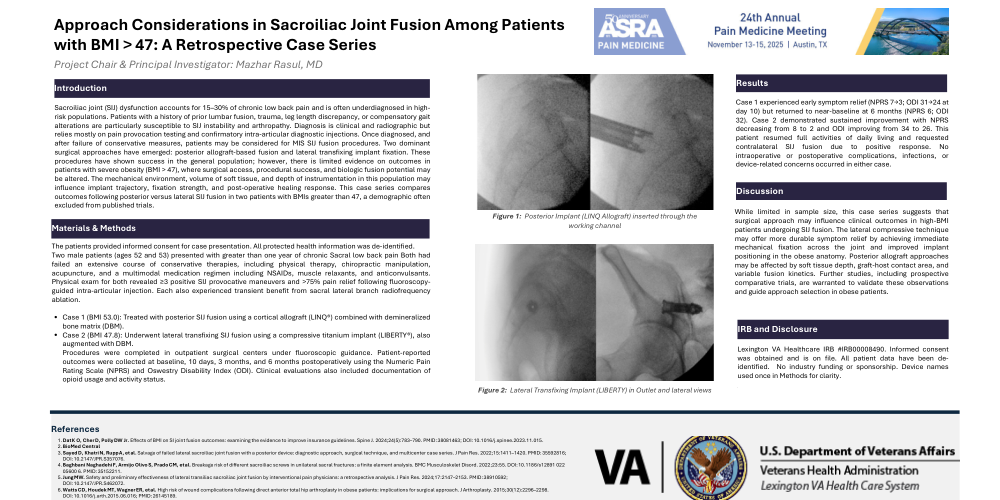
· Case 1 (BMI 53.0): Treated with posterior SIJ fusion using a cortical allograft (LINQ®) combined with demineralized bone matrix (DBM).
· Case 2 (BMI 47.8): Underwent lateral transfixing SIJ fusion using a compressive titanium implant (LIBERTY®), also augmented with DBM.
Procedures were completed in outpatient surgical centers under fluoroscopic guidance. Patient-reported outcomes were collected at baseline, 10 days, 3 months, and 6 months postoperatively using the Numeric Pain Rating Scale (NPRS) and Oswestry Disability Index (ODI). Clinical evaluations also included documentation of opioid usage and activity status.
Results: Case 1 experienced early symptom relief (NPRS 7→3; ODI 31→24 at day 10) but returned to near-baseline at 6 months (NPRS 6; ODI 32). Case 2 demonstrated sustained improvement with NPRS decreasing from 8 to 2 and ODI improving from 34 to 26. This patient resumed full activities of daily living and requested contralateral SIJ fusion due to positive response. No intraoperative or postoperative complications, infections, or device-related concerns occurred in either case.
Discussion: While limited in sample size, this case series suggests that surgical approach may influence clinical outcomes in high-BMI patients undergoing SIJ fusion. The lateral compressive technique may offer more durable symptom relief by achieving immediate mechanical fixation across the joint and improved implant positioning in the obese anatomy. Posterior allograft approaches may be affected by soft tissue depth, graft-host contact area, and variable fusion kinetics. Further studies, including prospective comparative trials, are warranted to validate these observations and guide approach selection in obese patients.