343 posters, 5 videos, 2 audios, 18 topics, 33 sessions, 263 authors, 202 institutions
ePostersLive by SciGen Technologies S.A. All rights reserved.
24th Annual Pain Medicine Meeting 2025
November 13-15, 2025| JW Marriott Austin, Austin, Texas

2197563
Turning Down the Heat: Lumbar Sympathetic Block for Autoimmune-Associated Erythromelalgia
Poster Presenter
Authors
Affiliations
Part of Topic
Medically Challenging Cases
Turning Down the Heat:
Lumbar Sympathetic Block
for Autoimmune-Associated
Erythromelalgia
University of Cincinnati
Department of Anesthesiology and Pain Medicine
Kunal Parmar, MD; Laura DeVita, MD
INTRODUCTION
Erythromelalgia is a rare neurovascular pain disorder
involving episodes of burning pain, erythema, warmth,
and edema affecting the distal extremities, particularly
the hands or feet. Symptoms are exacerbated by heat or
exertion and relieved with cooling. Treatment can often
be difficult in patients with underlying autoimmune
conditions, such as in our patient. For patients who
don’t respond to medications, interventional options
like lumbar sympathetic block (LSB) may provide relief.
This case highlights the potential role of sympathetic
blockade in managing lower-limb erythromelalgia when
typical pharmacologic therapies fail.
CLINICAL COURSE
A 64-year-old woman with fibromyalgia and systemic
lupus erythematosus (SLE) on immunosuppressants,
presented with bilateral foot pain.
• She described the pain as constant, burning,
tingling, and sharp, rated 6 out of 10 on the visual
analog scale (VAS), which worsened with heat and
movement.
• Her symptoms improved with cooling measures
and topical compounded creams.
• Examination revealed erythema and tenderness
in both feet.
• Imaging was unremarkable.
• She had been treated with pregabalin, duloxetine,
capsaicin, and mexiletine, with partial relief but
eventually returned three years later with
intolerable side effects. TENS therapy was
attempted without improvement.
• She complained of worsening pain causing new
functional limitations and poor sleep.
• Given the persistence of her symptoms and
reduced quality of life, she underwent bilateral L4
lumbar sympathetic block under fluoroscopic
guidance.
• At one-month follow-up, she reported improved
pain, better mobility, and increased
independence with daily activities.
Lumbar sympathetic block may offer a
meaningful improvement in pain and
function for patients with
erythromelalgia, particularly when
standard treatments are ineffective.
It should be considered early in the
treatment course for appropriately
selected patients.
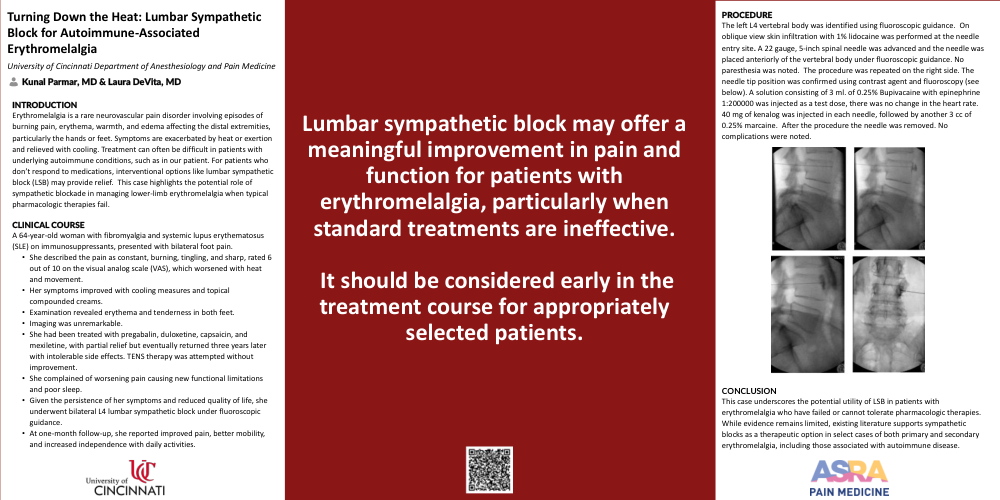
PROCEDURE
The left L4 vertebral body was identified using
fluoroscopic guidance. On oblique view skin infiltration
with 1% lidocaine was performed at the needle entry
site. A 22 gauge, 5-inch spinal needle was advanced and
the needle was placed anteriorly of the vertebral body
under fluoroscopic guidance. No paresthesia was
noted. The procedure was repeated on the right side.
The needle tip position was confirmed using contrast
agent and fluoroscopy (see below). A solution consisting
of 3 ml. of 0.25% Bupivacaine with epinephrine
1:200000 was injected as a test dose, there was no
change in the heart rate. 40 mg of kenalog was injected
in each needle, followed by another 3 cc of 0.25%
marcaine. After the procedure the needle was
removed. No complications were noted.
CONCLUSION
This case underscores the potential utility of LSB in
patients with erythromelalgia who have failed or
cannot tolerate pharmacologic therapies. While
evidence remains limited, existing literature supports
sympathetic blocks as a therapeutic option in select
cases of both primary and secondary
erythromelalgia, including those associated with
autoimmune disease.