343 posters, 5 videos, 2 audios, 18 topics, 33 sessions, 263 authors, 202 institutions
ePostersLive by SciGen Technologies S.A. All rights reserved.
24th Annual Pain Medicine Meeting 2025
November 13-15, 2025| JW Marriott Austin, Austin, Texas

2197121
Titanium Allergy Following COVID-19 Infection
Poster Presenter
Authors
Affiliations
Part of Topic
Medically Challenging Cases
Introduction
Titanium hardware is often used in medical procedures due to its biocompatibility for most cases. However, one would be remiss to exclude titanium toxicity in calculating risks and benefits pre-operatively, which can originate from deposition in the bone from general wear of the hardware. Additionally, in orthopedic implants, there has been documentation of titanium hypersensitivity presenting as eczema and bone formation after implantation, leading to implant rejection.
Case
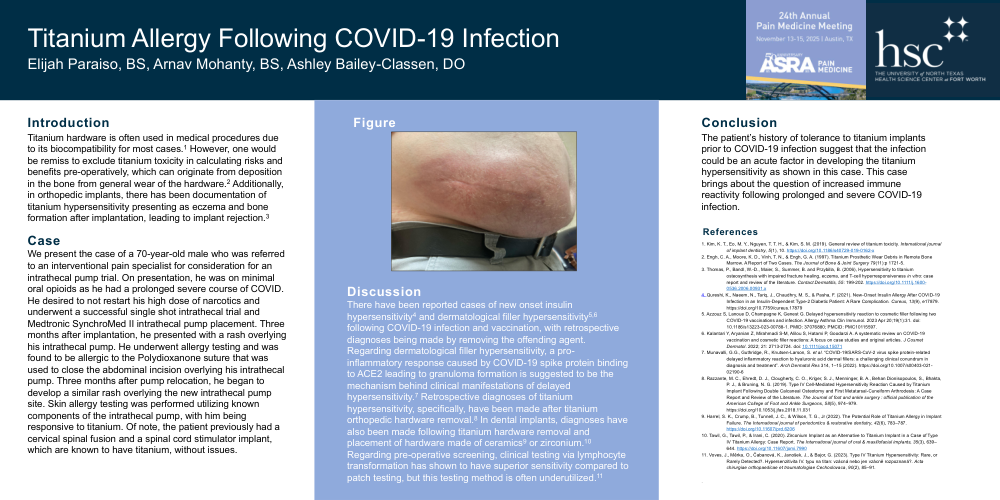
We present the case of a 70-year-old male who was referred to an interventional pain specialist for consideration for an intrathecal pump trial. On presentation, he was on minimal oral opioids as he had a prolonged severe course of COVID. He desired to not restart his high dose of narcotics and underwent a successful single shot intrathecal trial and Medtronic SynchroMed II intrathecal pump placement. Three months after implantation, he presented with a rash overlying his intrathecal pump. He underwent allergy testing and was found to be allergic to the Polydioxanone suture that was used to close the abdominal incision overlying his intrathecal pump. Three months after pump relocation, he began to develop a similar rash overlying the new intrathecal pump site. Skin allergy testing was performed utilizing known components of the intrathecal pump, with him being responsive to titanium. Of note, the patient previously had a cervical spinal fusion and a spinal cord stimulator implant, which are known to have titanium, without issues.
Discussion
There have been reported cases of new onset insulin hypersensitivity and dermatological filler hypersensitivity following COVID-19 infection and vaccination, with retrospective diagnoses being made by removing the offending agent. Regarding dermatological filler hypersensitivity, a pro-inflammatory response caused by COVID-19 spike protein binding to ACE2 leading to granuloma formation is suggested to be the mechanism behind clinical manifestations of delayed hypersensitivity. Retrospective diagnoses of titanium hypersensitivity, specifically, have been made after titanium orthopedic hardware removal. In dental implants, diagnoses have also been made following titanium hardware removal and placement of hardware made of ceramics or zirconium. Regarding pre-operative screening, clinical testing via lymphocyte transformation has shown to have superior sensitivity compared to patch testing, but this testing method is often underutilized.
Conclusion
The patient’s history of tolerance to titanium implants prior to COVID-19 infection suggest that the infection could be an acute factor in developing the titanium hypersensitivity as shown in this case. This case brings about the question of increased immune reactivity following prolonged and severe COVID-19 infection.