343 posters, 5 videos, 2 audios, 18 topics, 33 sessions, 263 authors, 202 institutions
ePostersLive by SciGen Technologies S.A. All rights reserved.
24th Annual Pain Medicine Meeting 2025
November 13-15, 2025| JW Marriott Austin, Austin, Texas

2197025
Targeting the Gut via the Spine: Spinal Cord Stimulation to Treat Chronic Idiopathic Gastroparesis
Poster Presenter
Authors
Affiliations
Part of Topic
Medically Challenging Cases
Targeting the Gut via the Spine: Spinal Cord Stimulation to Treat Chronic Idiopathic Gastroparesis
Nivetha Srinivasan, MD; Haijun Zhang, MD; Andrew Kaufman, MD
Rutgers New Jersey Medical School
Introduction
Gastroparesis is characterized by delayed gastric emptying and commonly presents with difficult-to-treat abdominal pain and nausea, significantly reducing quality of life (QoL) [1]. Symptoms are often attributed to underlying dysautonomia, which delays gastric motility. Spinal cord stimulation (SCS) can interrupt sympathetic pathways that transmit pain signals to the thalamus and cerebral cortex, where pain is processed [1]. SCS has demonstrated benefit in patients with chronic visceral pain and may improve gastric motility by autonomic modulation [1-5]. This case report presents the use of SCS to treat idiopathic gastroparesis with intractable nausea, epigastric pain, and food intolerance, highlighting its potential as a novel therapy.
Case Description
Our patient is a 21-year-old female with chronic gastroparesis, lower gastrointestinal dysmotility status post colostomy, postural orthostatic tachycardia syndrome, and demyelinating disease. She developed intractable nausea, epigastric pain, and severe food intolerance in 2015 following multiple viral illnesses and was diagnosed with idiopathic gastroparesis. She experienced significant weight loss and was hospitalized for superior mesenteric artery syndrome, requiring chronic total parental nutrition, which eventually caused liver failure. Nutritional support was then transitioned to GJ-tube.
In late 2017, the patient received a gastric stimulator with initial symptomatic relief, but required three replacements due to battery depletion or lead migration. Following COVID-19 infection in 2023, the gastric stimulator’s efficacy diminished, with only partial improvement in nausea but persistent abdominal pain. Oral intake remained intolerable, prompting referral to our pain clinic.
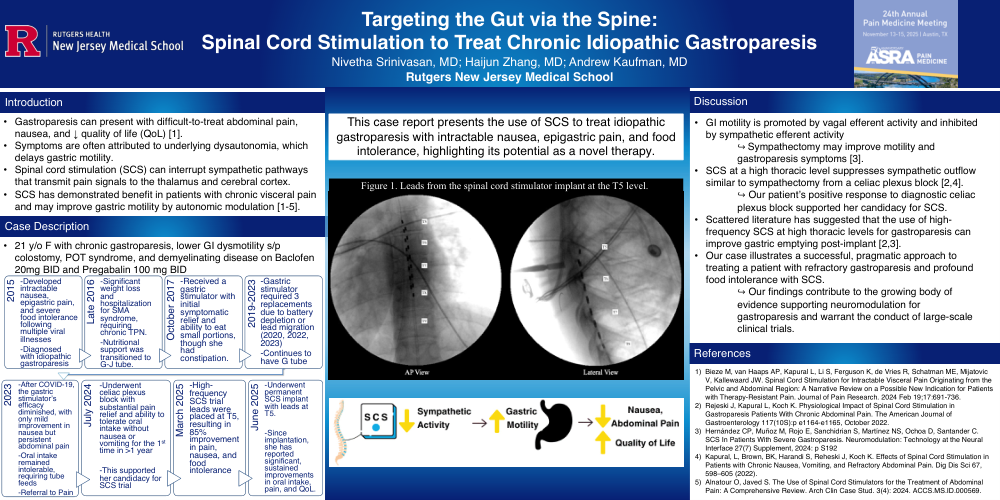
In July 2024, the patient underwent a celiac plexus block with substantial pain relief and the ability to tolerate oral intake without nausea or vomiting for the first time in over a year. This supported her candidacy for the SCS trial. In March 2025, high-frequency SCS trial leads were placed at T5, resulting in 85% improvement in pain, nausea, and food intolerance. In June 2025, she underwent permanent SCS implantation with leads at T5. Since implantation, she has reported significant, sustained improvements in oral intake, pain, and QoL.
Gastrointestinal motility is promoted by vagal efferent activity and inhibited by sympathetic efferent activity; thus, sympathectomy may improve motility and gastroparesis symptoms [3]. SCS at a high thoracic level suppresses sympathetic outflow similar to sympathectomy from a celiac plexus block [2,4]. Thus, our patient’s positive response to diagnostic celiac plexus block supported her candidacy for SCS.
So far, scattered literature has suggested that the use of high-frequency SCS at high thoracic levels for gastroparesis can improve gastric emptying post-implant [2,3]. Our case illustrates a successful, pragmatic approach to treating a patient with refractory gastroparesis and profound food intolerance with SCS. Our findings contribute to the growing body of evidence supporting neuromodulation for gastroparesis and warrant the conduct of large-scale clinical trials.
References
-
Bieze M, van Haaps AP, Kapural L, Li S, Ferguson K, de Vries R, Schatman ME, Mijatovic V, Kallewaard JW. Spinal Cord Stimulation for Intractable Visceral Pain Originating from the Pelvic and Abdominal Region: A Narrative Review on a Possible New Indication for Patients with Therapy-Resistant Pain. Journal of Pain Research. 2024 Feb 19;17:691-736.
-
Rejeski J, Kapural L, Koch K. Physiological Impact of Spinal Cord Stimulation in Gastroparesis Patients With Chronic Abdominal Pain. The American Journal of Gastroenterology 117(10S):p e1164-e1165, October 2022.
-
Hernández CP, Muñoz M, Rojo E, Sanchidrian S, Martínez NS, Ochoa D, Santander C. SCS In Patients With Severe Gastroparesis. Neuromodulation: Technology at the Neural Interface 27(7) Supplement, 2024: p S192
-
Kapural, L, Brown, BK, Harandi S, Reheski J, Koch K. Effects of Spinal Cord Stimulation in Patients with Chronic Nausea, Vomiting, and Refractory Abdominal Pain. Dig Dis Sci 67, 598–605 (2022).
-
Alnatour O, Javed S. The Use of Spinal Cord Stimulators for the Treatment of Abdominal Pain: A Comprehensive Review. Arch Clin Case Stud. 3(4): 2024. ACCS.MS.ID.000569.