343 posters, 5 videos, 2 audios, 18 topics, 33 sessions, 263 authors, 202 institutions
ePostersLive by SciGen Technologies S.A. All rights reserved.
24th Annual Pain Medicine Meeting 2025
November 13-15, 2025| JW Marriott Austin, Austin, Texas

2196672
Rare presentation of Discogenic T2 Arthropathy Masquerading as Cardiac Pain: A Case Report
Poster Presenter
Authors
Affiliations
Part of Topic
Medically Challenging Cases
Rare presentation of Discogenic T2 Arthropathy Masquerading as Cardiac Pain:
A Case Report
Ochuko Ogbon, MD, Penmetcha Taruna, MD, Ramsis Ghaly, MD
INTRODUCTION
Thoracic disc herniations (TDH) are uncommon, accounting for only 0.25-1% of all symptomatic disc herniations. Due to their rarity and varied clinical presentations, they are often misdiagnosed, leading to prolonged patient morbidity. We present a challenging case of a 43-year-old female with intractable upper extremity radiculopathy.
CASE PRESENTATION
A 43-year-old right-handed female with medical history significant for rheumatoid arthritis, prior L3-L4 microdiscectomy, and left total hip arthroplasty presented with a 3-month history of severe, disabling left upper extremity pain radiating to the left scapula and chest wall, associated with numbness, tingling, and subjective weakness. Multiple evaluationsexcluded cardiac, pulmonary, neurologic and vascular etiologies via laboratory studies, electrocardiogram, computed tomography angiography, spine CTs and MRIs.
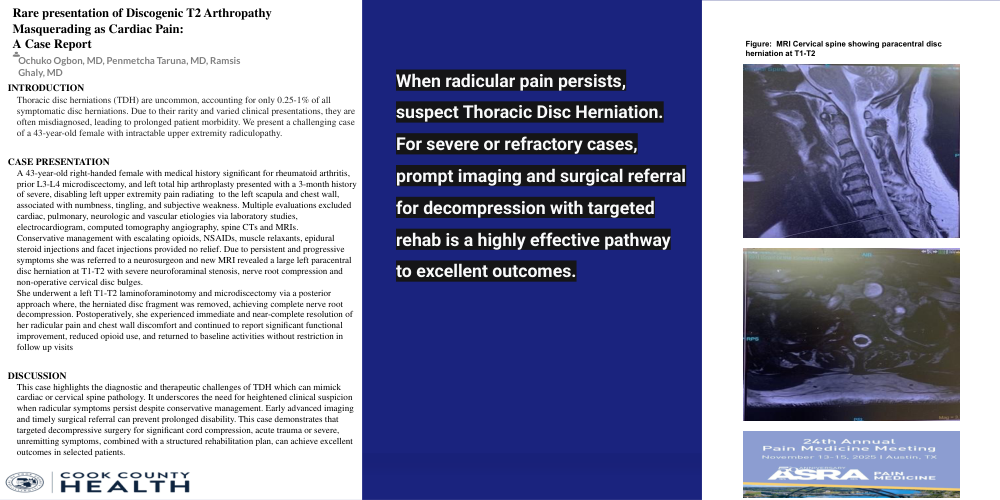
Conservative management with escalating opioids, NSAIDs, muscle relaxants, epidural steroid injections and facet injections provided no relief. Due to persistent and progressive symptoms she was referred to a neurosurgeon and new MRI revealed a large left paracentral disc herniation at T1-T2 with severe neuroforaminal stenosis, nerve root compression and non-operative cervical disc bulges.
She underwent a left T1-T2 laminoforaminotomy and microdiscectomy via a posterior approach where, the herniated disc fragment was removed, achieving complete nerve root decompression. Postoperatively, she experienced immediate and near-complete resolution of her radicular pain and chest wall discomfort and continued to report significant functional improvement, reduced opioid use, and returned to baseline activities without restriction in follow up visits
DISCUSSION
This case highlights the diagnostic and therapeutic challenges of TDH which can mimick cardiac or cervical spine pathology. It underscores the need for heightened clinical suspicion when radicular symptoms persist despite conservative management. Early advanced imaging and timely surgical referral can prevent prolonged disability. This case demonstrates that targeted decompressive surgery for significant cord compression, acute trauma or severe, unremitting symptoms, combined with a structured rehabilitation plan, can achieve excellent outcomes in selected patients.