343 posters, 5 videos, 2 audios, 18 topics, 33 sessions, 263 authors, 202 institutions
ePostersLive by SciGen Technologies S.A. All rights reserved.
24th Annual Pain Medicine Meeting 2025
November 13-15, 2025| JW Marriott Austin, Austin, Texas

2196239
Peripheral nerve blocks for chronic migraine: A case report on long term improvement following repeat multi-site injections
Poster Presenter
Authors
Affiliations
Part of Topic
Medically Challenging Cases
Peripheral nerve blocks for chronic migraine: A case report on long term improvement following repeat multi-site injections
Authors Diane H. Jang, MD1, Albert Chang, MD2, Joseph D. Strunk, MD1
1Dept of Anesthesiology and Pain Medicine–Virginia Mason Medical Center, Seattle, WA. 2COAST Injury Medicine, Kirkland, WA.
Background:
Chronic migraine is a debilitating neurologic disorder with significant functional impairment. For patients who have failed multiple pharmacologic preventives, peripheral nerve blocks targeting extracranial sensory nerves can offer a valuable non-systemic, targeted therapeutic option.
Purpose:
This case demonstrates the potential for serial peripheral nerve blocks to successfully manage severe, chronic migraines in the long-term.
Materials & Methods:
This single-patient case report is exempt from IRB review per institutional policy, as it includes no identifiable patient information.
The patient provided informed consent for this report.
|
The Patient: A 30-year-old woman with a 10-year history of chronic migraines |
|
|
Daily, constant, waxiing-and-waning, left-sided periorbital pressure |
|
Weekly left-sided periorbital, occipital, and temporal pressure with and without aura |
|
Prior preventative therapies |
Topiramate, nortriptyline, duloxetine, propranolol, CGRP monoclonal antibodies (inject), Gepants (oral) |
|
Abortive therapies |
Rizatriptan, Naratriptan |
Intervention:
|
The Blocks |
|
|
Targets |
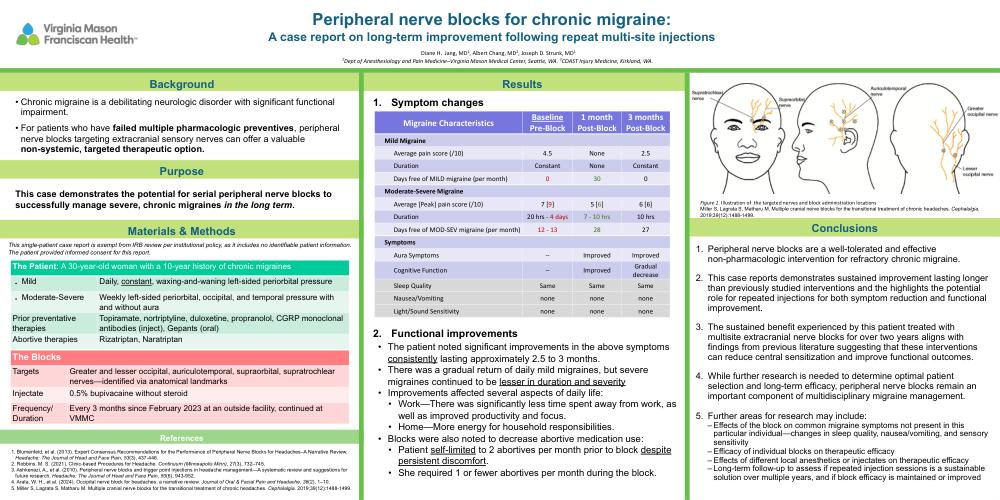
Greater and lesser occipital, auriculotemporal, supraorbital, supratrochlear nerves—identified via anatomical landmarks |
|
Injectate |
0.5% bupivacaine without steroid |
|
Frequency/ Duration |
Every 3 months since 2023 at an outside facility, continued at VMMC |
Results:
1 Symptoms Changes
|
Migraine Characteristics |
Baseline Pre-Block |
1 month Post-Block |
3 months Post-Block |
|
Mild Migraine |
|||
|
Average pain score (/10) |
4.5 |
None |
2.5 |
|
Duration |
Constant |
None |
Constant |
|
Days free of MILD migraine (per month) |
0 |
30 |
0 |
|
Moderate-Severe Migraine |
|||
|
Average [Peak] pain score (/10) |
7 [9] |
5 [6] |
6 [6] |
|
Duration |
20 hrs - 4 days |
7 - 10 hrs |
10 hrs |
|
Days free of MOD-SEV migraine (per month) |
12 - 13 |
28 |
27 |
|
Symptoms |
|||
|
Aura Symptoms |
-- |
Improved |
Improved |
|
Cognitive Function |
-- |
Improved |
Gradual decrease |
|
Sleep Quality |
Same |
Same |
Same |
|
Nausea/Vomiting |
none |
none |
none |
|
Light/Sound Sensitivity |
none |
none |
none |
2. Functional Improvements
-
The patient noted significant improvements in the above symptoms consistently lasting approximately 2.5 to 3 months.
-
There was a gradual return of daily mild migraines, but severe migraines continued to be lesser in duration and severity
-
Improvements affected several aspects of daily life:
-
Work—There was significantly less time spent away from work, as well as improved productivity and focus.
-
Home—More energy for household responsibilities.
-
Blocks were also noted to decrease abortive medication use:
-
Patient self-limited to 2 abortives per month prior to block despite persistent discomfort.
-
She required 1 or fewer abortives per month during the block.
Conclusions
-
Peripheral nerve blocks are a well-tolerated and effective non-pharmacologic intervention for refractory chronic migraine.
-
This case reports demonstrates sustained improvement lasting longer than previously studied interventions and the highlights the potential role for repeated injections for both symptom reduction and functional improvement.
-
The sustained benefit experienced by this patient treated with multisite extracranial nerve blocks for over two years aligns with findings from previous literature suggesting that these interventions can reduce central sensitization and improve functional outcomes.
-
While further research is needed to determine optimal patient selection and long-term efficacy, peripheral nerve blocks remain an important component of multidisciplinary migraine management.
-
Further areas for research may include:
-
Effects of the block on common migraine symptoms not present in this particular individual—changes in sleep quality, nausea/vomiting, and sensory sensitivity
-
Efficacy of individual blocks on therapeutic efficacy
-
Effects of different local anesthetics or injectates on therapeutic efficacy
-
Long-term follow-up to assess if repeated injection sessions is a sustainable solution over multiple years, and if block efficacy is maintained or improved
References
-
Blumenfeld, et al. (2013). Expert Consensus Recommendations for the Performance of Peripheral Nerve Blocks for Headaches–A Narrative Review. Headache: The Journal of Head and Face Pain, 53(3), 437-446.
-
Robbins, M. S. (2021). Clinic-based Procedures for Headache. Continuum (Minneapolis Minn), 27(3), 732–745.
-
Ashkenazi, A., et al. (2010). Peripheral nerve blocks and trigger point injections in headache management—A systematic review and suggestions for future research. Headache: The Journal of Head and Face Pain, 50(6), 943-952.
-
Arata, W. H., et al. (2024). Occipital nerve block for headaches: a narrative review. Journal of Oral & Facial Pain and Headache, 38(2), 1–10.
-
Miller S, Lagrata S, Matharu M. Multiple cranial nerve blocks for the transitional treatment of chronic headaches. Cephalalgia. 2019;39(12):1488-1499.